 Sprott Money


Prices are fetched automatically and may not reflect current merchant prices. Currency conversions and tax treatment are approximate. Rankings are based solely on price. We are not a dealer and accept no responsibility for transactions with listed merchants. Past performance is not indicative of future results. This site does not provide investment advice. Full disclaimer
About the 1 oz American Buffalo Gold Coin
America's First Pure Gold Bullion Coin
The 1 oz American Gold Buffalo is the only .9999 fine (24-karat) gold coin issued by the United States Mint. It was created in 2006 specifically to compete with the Canadian Maple Leaf, Austrian Philharmonic, and Australian Kangaroo in international markets where buyers preferred pure gold over the 22-karat alloy of the 1oz American Gold Eagle. For American investors who want the highest purity gold with US government backing and IRA eligibility, the Buffalo is the sole option from the US Mint.
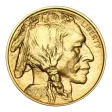
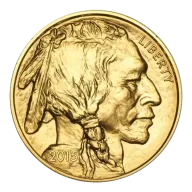
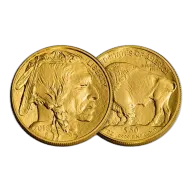
The coin adapts James Earle Fraser's 1913 Indian Head (Buffalo) nickel design, widely considered one of the most iconic American coin designs. The obverse carries a composite portrait of a Native American man, reportedly based on three tribal leaders: Iron Tail (Oglala Lakota), Two Moons (Northern Cheyenne), and Big Tree (Kiowa). The reverse depicts an American bison believed to be modelled after "Black Diamond," a resident of the Central Park Zoo, though Fraser himself gave conflicting accounts of his inspiration.
All bullion versions are struck at the West Point Mint and carry the "W" mint mark. The $50 face value matches the 1 oz Gold Eagle, despite the Buffalo containing pure gold and the Eagle being alloyed. Production is limited to the 1 oz size for bullion; a brief experiment with fractional sizes (1/2 oz, 1/4 oz, 1/10 oz) in 2008 was not repeated. Fewer than 100,000 total fractional Buffalo coins were minted that year, and they now command significant numismatic premiums.
The pure gold composition makes the Buffalo noticeably softer than alloyed coins. Dealers and collectors regularly note that Buffalos are more prone to contact marks and surface scratches. This is an inherent property of 24-karat gold, not a manufacturing defect, and buyers should handle coins by the edges and store them in protective capsules.
Gold Buffalo Dimensions and Weight
| Attribute | Value |
|---|---|
| Weight | 31.108 g (1 troy oz exactly) |
| Purity | .9999 fine gold (24 karat) |
| Diameter | 32.70 mm |
| Thickness | 2.95 mm |
| Face value | $50 USD |
| Edge | Reeded |
| Obverse | Native American portrait (James Earle Fraser, adapted from 1913 Buffalo nickel) |
| Reverse | American bison; inscriptions include "UNITED STATES OF AMERICA," "E PLURIBUS UNUM," "IN GOD WE TRUST" |
| Mint | US Mint, West Point (mint mark W) |
| Legal tender | United States of America |
| First issued | 2006 |
The 2008 Fractional Experiment
Fractional Gold Buffalos were produced once only, in 2008:
| Denomination | Face value | Weight | Diameter | Approx. mintage |
|---|---|---|---|---|
| 1/2 oz | $25 | 15.554 g | 26.50 mm | <100,000 total |
| 1/4 oz | $10 | 7.777 g | 22.00 mm | (across all three sizes) |
| 1/10 oz | $5 | 3.110 g | 16.50 mm |
The fractional programme was discontinued due to production challenges with the pure gold composition at small sizes and insufficient demand relative to the Gold Eagle fractional programme, which was already well established.
Gold Buffalo Tax and Retirement Account Status
The Gold Buffalo's combination of US government issue and .9999 purity gives it favourable tax treatment across most jurisdictions:
- US (IRA): Fully eligible for inclusion in Individual Retirement Accounts. At .9999 fine, it exceeds the IRS minimum purity requirement of .995 for gold. Both Traditional (tax-deferred) and Roth (tax-free withdrawals) IRAs can hold Gold Buffalos, provided they are stored at an IRS-approved depository. This is one of the Buffalo's strongest selling points for American investors.
- US (capital gains): Like all physical precious metals, profits are taxed at the collectibles rate of up to 28% federal (not the lower 15/20% rate for stocks). The 3.8% Net Investment Income Tax may apply on top. Dealers must file IRS Form 1099-B for sales of 25 or more pieces in a single transaction.
- US (sales tax): No federal sales tax. Over 35 states exempt bullion purchases entirely. A handful of states apply partial exemptions with thresholds (California over $2,000, Florida over $500, New York over $1,000).
- UK: VAT-exempt as investment gold. Not UK legal tender, so subject to Capital Gains Tax. UK buyers prioritising CGT efficiency should consider the 1oz Gold Britannia instead.
- EU: Listed on the EU's annual investment gold coin list. VAT-exempt across all EU member states.
- Canada: GST/HST-exempt at .9999 purity. Not eligible for RRSP (not issued by a Canadian mint).
- Australia: GST-free as investment-grade gold (well above the 99.5% purity threshold). Capital gains tax applies with a 50% discount for holdings over 12 months.
- Singapore: GST-exempt as Investment Precious Metals. No capital gains tax.
- Hong Kong: No sales tax, no import duty, no capital gains tax.
- New Zealand: GST-exempt as fine gold at 99.5%+ purity.
From the Buffalo Nickel to America's Purest Gold Coin
The Gold Buffalo's origin story begins with the American Gold Eagle's purity disadvantage. When the Eagle launched in 1986 at 22 karats (.9167 fine), it was competitive with the Krugerrand (also 22k) but lagged behind the Canadian Maple Leaf (.9999, launched 1979) in markets where buyers preferred pure gold. Asian markets in particular showed a strong cultural preference for 24-karat gold, and the US Mint was losing market share.
Congress addressed this gap with the Presidential $1 Coin Act of 2005 (Public Law 109-145), which authorised the US Mint to produce a .9999 fine gold bullion coin. The design was drawn from James Earle Fraser's 1913 Indian Head nickel, a coin that had been out of circulation since 1938 but remained one of the most admired American coin designs. Fraser (1876-1953) was an accomplished sculptor whose other works include the "End of the Trail" sculpture. The first Gold Buffalos were released on 22 June 2006.
Production was suspended in 2009 when the US Mint could not source enough .9999 fine gold blanks to meet demand during the financial crisis. This was the only year since 2006 that new bullion Buffalos were not produced. The 2008 fractional experiment (1/2 oz, 1/4 oz, 1/10 oz) was also abandoned after a single year, making those coins extremely scarce.
Notable special editions include the 2013-W Reverse Proof (commemorating the 100th anniversary of the original Buffalo nickel design) and the 2026-W Proof, which is the first dual-dated Gold Buffalo (1776-2026), featuring a "250" privy mark for America's 250th anniversary, limited to 15,000 pieces.
Gold Buffalo vs Gold Eagle: The US Mint's Two Gold Coins
The most direct comparison is between the Gold Buffalo and the 1oz American Gold Eagle, since both come from the US Mint and both are US legal tender at $50 face value. The core difference is purity: the Buffalo is .9999 (24k pure gold), the Eagle is .9167 (22k, alloyed with 3% silver and 5.33% copper). Both contain exactly one troy ounce of fine gold, but the Eagle weighs 33.93g total while the Buffalo weighs 31.108g.
The Eagle's alloy makes it harder and more scratch-resistant, which matters for coins that may be handled. The Buffalo's pure gold is softer and more susceptible to contact marks. On the other hand, the Buffalo's higher purity means it meets IRA requirements on its own merits, whereas the Eagle relies on a specific statutory exemption in IRC Section 408(m)(3) that bypasses the normal .995 purity requirement. Both are IRA-eligible, but through different legal mechanisms.
The Eagle has a 20-year head start (1986 vs 2006) and comes in four sizes (1 oz, 1/2 oz, 1/4 oz, 1/10 oz). The Buffalo is effectively 1 oz only. This gives the Eagle deeper secondary market liquidity and more flexibility for partial liquidation. Neither coin has the advanced anti-counterfeiting technology found on the 1oz Gold Britannia (latent image, micro-text) or the Canadian Maple Leaf (Bullion DNA).
Buffalo vs International .9999 Competitors
Against the Canadian Maple Leaf (also .9999), the Buffalo lacks the Maple's MintShield anti-fingerprint coating and micro-engraved laser security mark. The Maple Leaf is available in more sizes (1 oz down to 1 g) and typically carries similar or slightly lower premiums. The Buffalo's advantage is brand appeal in the American market and the Fraser design's collector crossover demand.
Compared to the 1oz Gold Britannia (.9999 since 2013), the Buffalo lacks CGT exemption for UK buyers and the Britannia's four-layer visual security system. For UK investors specifically, the Britannia is almost always the better choice. The Buffalo's strength is in the US market, where its combination of .9999 purity, IRA eligibility, and iconic American design makes it the natural pure-gold counterpart to the Gold Eagle.
1 oz American Buffalo Gold Coin: frequently asked questions
-
The cheapest 1 oz American Buffalo currently listed on this page is CA$6,494.45, which is 5.2% over the gold spot price, with Sprott Money offering that price. Premiums on the Buffalo typically run slightly above those of the American Gold Eagle, reflecting its higher purity.
-
Yes. The American Buffalo is struck in 999.9 fine gold, making it 24 karat. It is the purest gold bullion coin issued by the US Mint, and at that fineness it exceeds the IRS minimum purity threshold for gold IRA inclusion. Unlike the 22k American Gold Eagle, the Buffalo contains no alloying metals.
-
Start with a precise scale: a genuine 1 oz Buffalo weighs 31.1035 grams. Check the diameter (32.70 mm) and reeded edge. Pure gold is not magnetic, so a magnet test should show no attraction. The fine relief detail on the Native American portrait and bison is difficult to replicate accurately. Coins marked "COPY" are legal reproductions, not genuine Buffalo coins.
-
The Buffalo is struck in .9999 fine (24k) gold, while the Eagle uses a 22k (.9167) gold-copper-silver alloy. Striking pure gold requires greater die wear, and the higher purity commands a premium in markets, particularly in Asia, that prefer 24k gold. The Eagle also has a longer mintage history and deeper secondary market liquidity, which tends to compress its premium slightly relative to the Buffalo.