
1 listing
Filters
| Product | /oz | Premium | Price | |
|---|---|---|---|---|

 IDC Coin and Bullion
|
$5,026.12 | +14.02% | $502.62 | View Deal |
Prices are fetched automatically and may not reflect current merchant prices. Currency conversions and tax treatment are approximate. Rankings are based solely on price. We are not a dealer and accept no responsibility for transactions with listed merchants. Past performance is not indicative of future results. This site does not provide investment advice. Full disclaimer
About the 1/10 oz Gold Standard Gold Bar
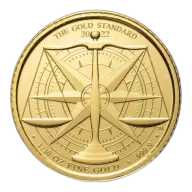
The 1/10 oz Gold Standard Bar from The Royal Mint
One tenth of a troy ounce, 3.1104 grams, is the smallest commonly produced fractional gold weight, and this bar carries it in 999.9 fine gold from The Royal Mint. The Gold Standard name comes from the Royal Mint's range marking Britain's formal adoption of the gold standard: the Coinage Act of 1816 made Britain the first nation to formally adopt the system, building on Sir Isaac Newton's 1717 report that fixed the value of the gold guinea, and the country stayed on it until 1931. The range launched in 2016 to mark the 200th anniversary.
At this weight the buyer is paying for accessibility, not efficiency. Tenth-ounce gold carries the highest relative premiums of any standard bullion weight, because die work, quality control, and packaging cost nearly the same as for a 1 oz product but are spread over a tenth of the gold. Bars at 1/10 oz are also uncommon; at this size the market is dominated by sovereign coins, which trade on recognisability and government backing.
What the format does well is lower the entry price. A tenth-ounce unit is the gateway product for new gold buyers, popular for gifts and for incremental accumulation, and the low price point keeps a broad pool of potential buyers at resale even though bid-ask spreads are the widest of any fractional size. Buyers building serious weight should compare against a 1oz gold bar before committing to tenths.
Tax Position of a 1/10 oz Royal Mint Gold Bar
The headline for UK buyers is a split decision. As investment gold at 999.9 fineness, the bar is VAT-exempt in the UK and across the EU. But bars are not CGT-exempt: only UK legal tender coins escape Capital Gains Tax, so gains above the £3,000 annual allowance are taxable at 18% or 24%. The Royal Mint's own Gold Standard coins, as UK legal tender, are both VAT-free and CGT-exempt, which is the comparison any UK buyer of this bar should run first. CGT only bites on gains, and at roughly £300-£350 per tenth-ounce unit it takes a substantial holding to generate gains above the allowance, but accumulating bars rather than coins forfeits the exemption permanently.
- US: No federal sales tax; most states exempt bullion. Some states only exempt above a threshold (California $2,000, New York $1,000, Florida $500), and a single tenth-ounce bar can fall below those lines. Long-term gains taxed at the 28% collectibles rate. IRA eligibility requires 99.5%+ purity from accredited refiners with approved custody.
- Canada: 0% GST/HST at 99.5%+ purity, which 999.9 fine gold clears easily.
- Australia: 0% GST on investment-grade gold of 99.5%+ purity.
- Singapore and Hong Kong: No sales tax on qualifying investment gold and no capital gains tax.
Gold Standard 1/10 oz Bar vs Fractional Coins and Larger Bars
The natural rivals at this weight are sovereign tenth-ounce coins. The 1/10oz gold Britannia is the standout for UK buyers: at approximately £300-£350 it is the lowest-cost entry into CGT-free gold, an advantage no bar can match. The 1/10 oz American Gold Eagle is the most popular fractional gold coin in the world and is IRA-eligible. Both come in mint tubes (25 coins for the Britannia, 50 for the Eagle), are roughly 16.5mm across, and enjoy the best liquidity in the tenth-ounce class. Bars at this size are the rarer choice, and at resale the coin's universal recognisability counts.
The other comparison is vertical. Accumulating one full ounce through ten tenth-ounce units costs roughly $400 more in premiums than buying a single 1 oz product, and building 10 oz exclusively from tenths adds $3,500-$4,000 against 1 oz units. Tenth-ounce gold runs 10-18% over spot where 1 oz bars run 1-4%, so the divisibility of small units is expensive. The honest framing: a tenth-ounce bar is for gifting, for a first purchase, or for holding gold in the smallest sellable pieces. For everything else, fewer, larger units keep more of the money in metal. The Gold Standard range also includes coin formats for buyers who want the CGT exemption with the same branding.
1/10 oz Gold Standard Gold Bar: frequently asked questions
-
The cheapest Royal Mint 1/10oz Gold Standard bar listed here is $502.62, based on a $4,408.10 gold spot price. Smaller fractional gold bars typically carry a higher percentage premium over spot than larger sizes, reflecting fixed fabrication and packaging costs spread across less metal.
-
The bar weighs 3.1104 g of 999.9 fine gold (four nines, 24 carat). One tenth of a troy ounce is approximately 3.11 grams. The 999.9 purity means the bar contains no more than 0.01% non-gold content, meeting the investment-gold standard across all major markets.
-
The Gold Standard is a bullion bar series from The Royal Mint, the UK's official mint. First issued in 2016 to mark the 200th anniversary of Britain's formal adoption of the gold standard monetary system, the series is struck in 999.9 fine gold and designed by Royal Mint graphic designer Dominique Evans. It commemorates Britain's role as the first major economy to formally tie its currency to gold.