1 listing
Filters
| Product | /oz | Premium | Price | |
|---|---|---|---|---|

 IDC Coin and Bullion
Out of Stock
IDC Coin and Bullion
Out of Stock
|
$5,919.10 | +34.28% | $2,959.56 | View Deal |
Prices are fetched automatically and may not reflect current merchant prices. Currency conversions and tax treatment are approximate. Rankings are based solely on price. We are not a dealer and accept no responsibility for transactions with listed merchants. Past performance is not indicative of future results. This site does not provide investment advice. Full disclaimer
About the 1/2 oz Engelhard Gold Bar
A Discontinued Refiner's Gold at Half-Ounce Weight
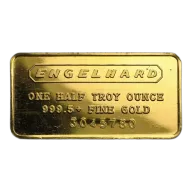
The 1/2 oz Engelhard gold bar contains 15.55 grams of 999.9 fine gold, produced by one of the most historically significant precious metals refiners in the world. Engelhard was founded in 1902 by Charles W. Engelhard Sr. in Newark, New Jersey, and by the 1950s had become the world's largest precious metals smelter. The company processed gold for the US Treasury and was a dominant force in global refining for decades. Charles Engelhard Jr., who consolidated the family holdings into Engelhard Industries in 1958, is widely cited as the inspiration for Ian Fleming's James Bond villain Auric Goldfinger.
Engelhard exited the retail bullion market in the late 1980s to focus on industrial catalysts and materials technology. BASF acquired the company in 2006 for US$5 billion, renaming it BASF Catalysts LLC. No new Engelhard-branded bullion has been produced since the mid-1980s. Every Engelhard gold bar on the market today is secondary market inventory, which gives these bars a collector dimension that newly produced bars from active refiners do not carry.
The 1/2 oz size sits within Engelhard's broader range, which spanned from 1 oz to large institutional formats. The collector market for Engelhard bars is strongest in silver (where over 40 documented 1 oz varieties exist), but gold bars also attract a following for their historical provenance. The premium over spot on Engelhard gold bars reflects both the gold content and the brand's discontinued status, though the markup is more modest on gold bars than on the rarer silver varieties. For buyers focused purely on maximising gold per dollar, a currently-produced LBMA bar from PAMP Suisse or Valcambi will typically offer a lower premium.
1/2 oz Engelhard Gold Bar Specifications
| Attribute | Detail |
|---|---|
| Weight | 1/2 troy oz (15.5518g) |
| Purity | 999.9 fine gold (24 karat) |
| Manufacturer | Engelhard (now BASF Catalysts LLC) |
| Country of origin | United States |
| Production status | Discontinued (production ceased mid-1980s) |
| Format | Bar |
| Face value | None (not legal tender) |
| Serial number | Most bars carry unique serial numbers |
Engelhard produced bars using multiple manufacturing methods across different eras: cast (poured), pressed, and extruded formats. The weight and purity are consistent across methods; the finish and surface appearance vary. Genuine bars carry the distinctive Engelhard hallmarks (including the 'E' mark or globe logo, depending on production era), weight stamp, and purity marking. Serial numbers follow era-specific formats that collectors use to date and authenticate pieces.
Authentication is particularly important for Engelhard products. The AllEngelhard.com community maintains the definitive catalogue of varieties and known counterfeits. Genuine bars show consistent fonts, spacing, and edge finishing for their production era. Buyers purchasing on the secondary market should verify the serial number format and physical characteristics against documented varieties.
Tax Treatment for the 1/2 oz Engelhard Gold Bar
Despite being discontinued, Engelhard gold bars receive the same tax treatment as any other 999.9 fine gold bar. The metal's purity and form, not the manufacturer's current operating status, determine tax classification.
- United States: No federal sales tax. State-level exemptions in most states. The bar meets the 99.5% purity requirement for IRA inclusion, though specific eligibility depends on the custodian; some IRA administrators accept Engelhard bars given the brand's historical standing and purity, while others may require bars from currently operating accredited refiners. Capital gains taxed at the collectibles rate of up to 28%.
- United Kingdom: VAT-exempt as investment gold (995+ fineness). Subject to CGT on disposal; bars are not UK legal tender.
- Canada: GST/HST exempt at 99.5%+ purity.
- European Union: VAT-exempt under the Investment Gold Directive for gold bars at 995+ fineness.
- Australia: GST-free as investment-grade gold at 99.5%+ purity.
- New Zealand: GST-exempt for fine gold at 99.5%+ purity.
- Singapore: GST-exempt under the IPM scheme for gold at 99.5%+ purity.
- Hong Kong: No sales tax, no import duty, no capital gains tax.
From Newark Refinery to Bond Villain Inspiration
The Engelhard story begins in 1902 when Charles W. Engelhard Sr. purchased the Charles F. Croselmire Company in Newark, New Jersey. In 1904 he acquired Baker and Co., a platinum smelter, and in 1905 established Hanovia Chemical and Manufacturing Company. His son, Charles Engelhard Jr., consolidated the family's precious metals interests into Engelhard Industries, Inc. in 1958, listing the company on the New York Stock Exchange.
By the mid-twentieth century, Engelhard was the world's largest precious metals smelter, processing gold, silver, platinum, and palladium for industrial, institutional, and retail customers. The company's involvement with South African gold refining during the apartheid era and Charles Jr.'s flamboyant lifestyle are widely acknowledged as inspiration for the character of Auric Goldfinger in Ian Fleming's 1959 novel.
Retail silver bar production began in the late 1960s and ran through approximately 1986, spanning the Hunt Brothers silver boom of 1979-1980. The silver spike led to mass meltdowns of Engelhard bars as holders cashed in at $50/oz, paradoxically making surviving bars rarer and more collectible decades later. Engelhard exited the retail bullion business in the late 1980s, pivoting to focus on industrial catalysts, chemical process technologies, and surface technologies. BASF's hostile acquisition in 2006 ended Engelhard's century-long run as an independent company.
Gold bar production followed a similar timeline to the silver bars, though gold varieties are less extensively catalogued than the 40+ documented silver bar types. The brand retains strong recognition in the North American precious metals market, and secondary-market Engelhard bars are routinely traded by major dealers alongside currently produced products.
1/2 oz Engelhard Gold Bar: frequently asked questions
-
Engelhard was acquired by BASF, and gold bar production ceased around that time. The Engelhard name no longer issues new bullion products. Bars found on the market today are vintage pieces produced before the acquisition, which is a significant part of their appeal to collectors and stackers across the UK, US, Canada, and Australia.
-
Engelhard bars are sought after because production stopped when BASF acquired the company, meaning the supply is fixed. Their .9999 fineness and the reputation Engelhard built over decades mean vintage bars regularly trade above melt value. Condition, serial number legibility, and assay card presence all influence how much above melt a specific bar commands.
-
Engelhard bars were stamped with a serial number, weight, and purity directly on the bar surface. No central Engelhard serial number registry exists, so verification relies on physical checks: confirm the bar weighs 15.55 g, inspect engraving depth and font consistency, and compare hallmark placement against known genuine examples. An assay card from the original sale adds further confidence.