1 listing
Filters
| Product | /oz | Premium | Price | |
|---|---|---|---|---|

 Atkinsons Bullion
|
$4,671.12 | +7.50% |
$1,167.75
£875
|
View Deal |
Prices are fetched automatically and may not reflect current merchant prices. Currency conversions and tax treatment are approximate. Rankings are based solely on price. We are not a dealer and accept no responsibility for transactions with listed merchants. Past performance is not indicative of future results. This site does not provide investment advice. Full disclaimer
About the 1/4 oz C.Hafner Gold Bar
A German Refiner's Quarter-Ounce Gold Bar
The 1/4 oz C.Hafner gold bar contains 7.7759 grams of 999.9 fine gold, produced by C.Hafner GmbH + Co. KG in Pforzheim, Germany. Founded in 1850 by Carl Hafner, the company is Germany's oldest family-owned precious metals refinery, now in its fifth generation of family management under Birgitta Hafner and Dr Philipp Reisert. C.Hafner is one of only six German companies on the LBMA Good Delivery Refiner List, having gained accreditation in 2013.
The company has a distinctive position in the refining industry: it sources exclusively from recycled secondary materials. No primary-mined gold enters C.Hafner's production. The original business, known as Kehretspräparation, involved recovering precious metals from the sweepings and filings of Pforzheim's dense cluster of jewellery workshops. That recycling heritage has continued for over 175 years and now underpins the company's claim to be the first refinery with a carbon-neutral recycling process.
At the quarter-ounce weight, this bar serves buyers who want fractional gold from an established LBMA refiner. Premiums per gram are higher than on larger bars, but the lower total outlay makes regular purchases feasible. Compared to Swiss equivalents from Valcambi or PAMP Suisse, C.Hafner bars are more commonly encountered through European dealer networks, particularly in Germany and Austria. They are less widely stocked outside Europe.
Each bar ships in C.Hafner's proprietary CertiCard, a tamper-evident assay card containing a certificate that confirms the tested purity and serial number. The CertiCard allows authentication before the packaging is opened, providing chain-of-custody assurance without breaking the seal.
1/4 oz C.Hafner Gold Bar Specifications
| Property | Detail |
|---|---|
| Weight | 1/4 troy oz (7.7759 g) |
| Purity | 999.9 fine gold (24 karat) |
| Manufacturer | C.Hafner GmbH + Co. KG, Pforzheim, Germany |
| LBMA accredited | Yes (Good Delivery since 2013) |
| Format | Minted bar in CertiCard (tamper-evident assay card) |
| Serial number | Unique serial on each bar |
| Face value | None (bar, not legal tender) |
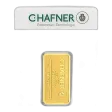
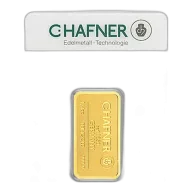
C.Hafner produces both minted and cast gold bars. At the 1/4 oz weight, the minted format is standard. The bar features the C.HAFNER name, weight, 999.9 purity mark, and unique serial number in a clean, minimalist layout typical of German precision manufacturing. No annually changing designs are used; the presentation is consistent and brand-focused across all sizes.
The company also produces SmartPack (10 x 1g or 10 x 2g divisible units) and SmartBox (25 x 1g) formats designed for buyers who want to break their gold into smaller tradeable units, though these are separate products from the standard bar range. The minted bar range spans from 1g to 100g, with cast bars available from 1 oz to 1kg.
Pforzheim, known as Goldstadt (Gold City), has been Germany's jewellery and precious metals centre since the 18th century. C.Hafner's location in this cluster of specialist workshops and refiners is directly connected to the company's founding business of recovering precious metals from craft waste.
Tax Position for the 1/4 oz C.Hafner Gold Bar
At 999.9 purity from an LBMA Good Delivery refiner, this bar qualifies for investment gold tax exemptions in all major markets. The German provenance is particularly relevant for tax treatment in Germany and the EU.
Purchase Tax
- Germany: VAT-exempt as investment gold. Germany applies 19% standard VAT to silver and platinum, but gold bars at 999+ purity are zero-rated.
- European Union: VAT-exempt under the EU Investment Gold Directive for bars at 995+ purity. C.Hafner bars are widely stocked across EU dealer networks.
- United Kingdom: VAT-exempt as investment gold at 995+ purity.
- United States: No federal sales tax. State-level exemptions vary. C.Hafner bars exceed the 99.5% IRA purity requirement and the LBMA accreditation qualifies them for most IRA custodians, though they are less commonly encountered by US dealers than Swiss bars.
- Canada: GST/HST-exempt for gold at 99.5%+ purity.
- Australia: GST-free as investment-grade gold.
- Switzerland: VAT-exempt on investment gold at the 8.1% standard rate.
- Singapore: GST-exempt under the IPM scheme for gold at 99.5%+ purity from approved refiners.
- Hong Kong: No sales tax or duties.
Capital Gains
Germany offers a significant tax advantage for gold bars: gains are completely exempt from capital gains tax if the gold is held for more than one year. This one-year holding period exemption, combined with the VAT-free purchase of gold bars, makes bars the most tax-efficient form of gold investment for German residents. C.Hafner bars, as a domestic product widely available through German dealers, are a natural fit for this strategy.
In the United Kingdom, gold bars are subject to CGT at 18% or 24% on gains above GBP 3,000. Bars are not CGT-exempt regardless of manufacturer. UK buyers seeking CGT-free gold at this price point should consider the 1/4 oz Gold Britannia or the Gold Sovereign. Gold bars do qualify for UK SIPP pensions.
The United States taxes gold as a collectible at up to 28%. Canada applies a 50% inclusion rate. Australia offers a 50% CGT discount after 12 months. Singapore and Hong Kong impose no capital gains tax.
175 Years of Precious Metal Recycling in Germany's Gold City
Carl Hafner established the company in 1850 in Pforzheim, a city that had been a centre for goldsmithing and jewellery production since the 18th century. The original business was Kehretspräparation, a term that translates roughly to "sweepings preparation." In Pforzheim's dense cluster of workshops, gold dust, filings, and offcuts accumulated on floors and in ventilation systems. Carl Hafner built a business recovering these precious traces, melting them down and refining them back into usable gold.
This was urban mining long before the term existed. The company has maintained its recycling-only approach for over 175 years, never sourcing from primary mining operations. Five generations of the Hafner family have managed the business, and it remains privately held. The current leadership, Birgitta Hafner and Dr Philipp Reisert, have expanded the company's sustainability credentials, claiming carbon-neutral recycling processes and installing photovoltaic systems covering over 50% of the facility's electricity needs.
The LBMA Good Delivery accreditation came in 2013, placing C.Hafner alongside much larger refiners in terms of international market acceptance. The company also became an LBMA Affiliate Member to participate in industry standards development. Beyond investment bars, C.Hafner produces industrial precious metal products (semi-finished goods, powders, and components) and operates subsidiaries including HILDERBRAND in Geneva (brazing pastes) and Deutsche Aurumed in Bavaria (dental alloys, acquired in 2017).
C.Hafner does not sell directly to retail customers. All bars are distributed through authorised dealers and banks, which means buyers will find them through precious metals retailers rather than from the refiner itself. This distribution model keeps the company focused on refining and manufacturing rather than retail operations.
C.Hafner vs Other Quarter-Ounce Gold Bars
At the 1/4 oz weight, C.Hafner competes primarily with other LBMA-accredited European refiners and with bars from Swiss and UK producers.
vs Heraeus
Heraeus is another German LBMA-accredited refiner, based in Hanau. Both companies produce 999.9 fine bars with institutional-grade quality and assay card packaging. Heraeus is a larger company with broader global distribution and stronger brand recognition outside Germany. C.Hafner's differentiator is its exclusive use of recycled materials, which may appeal to environmentally conscious buyers. Premiums are generally similar.
vs Baird & Co.
The 1/4 oz Baird & Co. bar is produced by the UK's only LBMA-accredited refinery. For UK buyers, Baird offers domestic provenance and integrated vault storage for SIPP pensions. C.Hafner's advantage is its German heritage, sustainability positioning, and established European dealer network. Both are LBMA-accredited with 999.9 purity. The choice between them often reflects geographic preference: UK buyers may lean toward Baird, continental European buyers toward C.Hafner.
vs PAMP Suisse
PAMP Suisse bars command higher premiums due to the Fortuna design and Veriscan digital authentication. C.Hafner's CertiCard provides authentication through physical packaging rather than digital technology. For buyers prioritising cost efficiency over brand prestige, C.Hafner will typically offer a lower premium for the same amount of gold. PAMP has stronger recognition in Asian and Middle Eastern markets; C.Hafner is stronger in German-speaking Europe.
For buyers in Germany, the combination of VAT-free purchase, one-year CGT exemption, and a locally produced LBMA bar from the country's oldest family refinery makes C.Hafner a particularly logical choice. Outside Germany, the bar competes on its LBMA accreditation, sustainability credentials, and competitive pricing against more globally marketed brands.
1/4 oz C.Hafner Gold Bar: frequently asked questions
-
The cheapest C.Hafner 1/4 oz gold bar listed on this page is $1,167.75, available from Atkinsons Bullion. That works out to around 7.5% over the gold spot price. Prices shift with the spot market, so check back for the latest figures.
-
A 1/4 troy ounce gold bar weighs 1/4 oz (7.776 g). Note that a troy ounce (31.103 g) is slightly heavier than a standard avoirdupois ounce (28.35 g), so the two measures are not interchangeable when buying bullion.
-
Minted gold bars like this carry a fineness stamp and are typically sealed in a tamper-evident assay card. Check that the card seal is intact and that the bar's weight matches the 999.9 fine, 1/4 troy ounce specification. Broken seals, mismatched markings, or prices well below competing dealers are common warning signs.
-
C.Hafner is a German precious metals refinery that produces minted gold bars in a range of gram and troy ounce denominations. Their bars are refined to 999.9 fineness and are available through bullion dealers in Europe and internationally.