 Ainslie Bullion


Prices are fetched automatically and may not reflect current merchant prices. Currency conversions and tax treatment are approximate. Rankings are based solely on price. We are not a dealer and accept no responsibility for transactions with listed merchants. Past performance is not indicative of future results. This site does not provide investment advice. Full disclaimer
About the 100g Ainslie Gold Bar
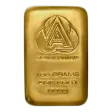
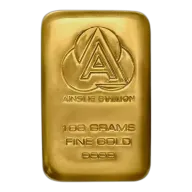
The 100g Ainslie Gold Bar
This bar from Ainslie contains 100 grams (3.2151 troy ounces) of .9999 fine gold. The 100g weight is one of the most efficient points on the gold bar curve: typical premiums of 2-4% over spot approach kilo bar territory, and the step up from 50g bars, which usually run 3-6%, is one of the sharpest efficiency gains in the gram bar range. Only kilo bars offer meaningfully lower percentage premiums, and they demand roughly ten times the outlay.
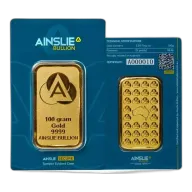
At current gold prices a 100g bar represents an investment in the region of $10,000, so this is a weight for committed buyers rather than first purchases. What it delivers in exchange is concentration: a substantial gold position in a single object roughly 47 x 27 x 5 mm, small enough to fit in a shirt pocket and stored or vaulted with minimal space cost. Gold bars at this weight are typically sealed in assay packaging, and keeping that packaging intact matters for resale, since a bar removed from its card may need re-assaying before a dealer will pay full value.
The trade-off against smaller units is divisibility. A 100g bar sells as a single transaction; a holder who may want to liquidate in stages is better served by several 1 oz gold bars, accepting the slightly higher per-gram cost as the price of flexibility. For buyers whose plan is to accumulate gold weight and hold, the 100g format is one of the most cost-efficient retail products available.
Tax Treatment of a 100g .9999 Gold Bar
At .9999 fineness this bar comfortably exceeds the purity thresholds that define investment gold in every major jurisdiction.
- Australia: GST-free as investment-grade gold, which the Australian definition sets at 99.5%+ purity in a form commonly traded on commodity markets. Capital gains tax applies on disposal, with a 50% CGT discount for individuals holding longer than 12 months.
- UK: VAT-exempt as investment gold (995+ fineness). Bars are not CGT-exempt, since that exemption is reserved for UK legal tender coins; gains above the £3,000 annual allowance are taxable at 18-24%.
- US: Most states exempt bullion bars from sales tax. Long-term capital gains are taxed at the collectibles rate of up to 28%. IRA-eligible bars must be 99.5%+ purity from LBMA/COMEX/NYMEX-accredited refiners and held at an approved depository.
- EU: VAT-exempt at 995+ purity; capital gains treatment varies by country, with Germany taxing nothing on bars held over one year.
- Canada: GST/HST exempt at 99.5%+ purity.
- New Zealand: GST-exempt at 99.5%+ gold purity.
- Singapore: 0% GST under the Investment Precious Metals scheme, and no capital gains tax.
- Hong Kong: No sales tax, no import duty, no capital gains tax.
100g Ainslie Bar vs Swiss Refiner Bars and Other Weights
The 100g gold bar market is anchored by the big LBMA-accredited refiners. The Valcambi 100g is described as one of the world's best-selling products in the format, backed by the largest refining capacity in the world at 2,000 metric tonnes annually, and typically offers the lowest acquisition premiums. The PAMP Suisse 100g carries the Lady Fortuna design, a slightly higher premium, and better premium retention at resale. Argor-Heraeus, Heraeus, Umicore, the Perth Mint, and the Royal Mint round out the field. Those names matter at resale: LBMA-accredited bars are recognised by dealers worldwide, while bars from refiners outside that circle can face narrower buyer pools or assay requirements when sold internationally.
Against other weights, the 100g bar occupies a sweet spot for larger buyers. Compared with the 1 oz bar it is a substantially bigger purchase, around 3.2 times the gold, with a lower per-gram premium (2-4% versus 3-5% for 1 oz minted bars). Compared with the 1 kilo gold bar at 1-2% premiums, it gives up a little cost efficiency in exchange for a far more accessible price point and easier resale to private buyers, since the kilo's six-figure price narrows its retail market.
For buyers weighing this bar against the mainstream Swiss alternatives, the questions to ask the dealer are the practical ones: the premium being charged against the Valcambi benchmark, and whether the bar ships in sealed, serialised assay packaging, which underpins buyback value regardless of brand.
100g Ainslie Gold Bar: frequently asked questions
-
The cheapest Ainslie 100g gold bar listed here is $14,394.54, approximately 2.9% over the current $4,408.10 gold spot price. Prices update in near real-time from dealer feeds.
-
Across the 1 dealer tracked on this page, the lowest premium is currently 2.9% with the best deal from Ainslie Bullion. Larger bars like the 100g typically carry a lower percentage premium over spot than smaller 1oz or fractional bars.
-
The Ainslie 100g gold bar contains exactly 100 grams of 999.9 fine gold, the four-nines standard equivalent to 24-carat purity. At 99.99% gold content it meets standard investment-grade thresholds and is distinct from 100oz bars, which are considerably larger.
-
The Ainslie 100g gold bar is produced by Ainslie Bullion, a private Australian bullion refinery and retailer. Ainslie manufactures its own branded bars in gold, silver, and platinum and sells them directly to investors.