1 listing
Filters
| Product | /oz | Premium | Price | |
|---|---|---|---|---|

 Chards
Out of Stock
Chards
Out of Stock
|
$4,473.62 | +2.95% |
$14,382.99
£10,778
|
View Deal |
Prices are fetched automatically and may not reflect current merchant prices. Currency conversions and tax treatment are approximate. Rankings are based solely on price. We are not a dealer and accept no responsibility for transactions with listed merchants. Past performance is not indicative of future results. This site does not provide investment advice. Full disclaimer
About the 100g BulMint Gold Bar
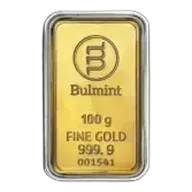
The 100g BulMint Gold Bar
The 100g BulMint gold bar contains 100 grams (3.2151 troy oz) of 999.9 fine gold. The 100 gram class is one of the most cost-efficient ways to buy retail gold: typical premiums of 2-4% over spot put it close to kilo-bar territory, and the drop from the 50g class (3-6%) to 100g is one of the sharpest efficiency gains anywhere in the gram bar range. Only kilo bars offer meaningfully lower percentage premiums.
That efficiency comes with a serious price tag. At current gold prices a 100g bar represents roughly a $10,000-$10,500 purchase, so this is a weight for buyers consolidating a substantial allocation rather than building a position gradually. For investors who want divisibility, smaller gold bars sacrifice some premium efficiency in exchange for the ability to sell in parts.
The 100g format is most at home in Europe, where it ranks among the most popular gold bar sizes and metric weights are the norm; it is also a common weight in Singapore and Hong Kong. In the US it is available but less dominant than troy-ounce denominations. One general caution applies to any gold bar at this weight: brand recognition drives resale. Bars from LBMA-accredited refiners enjoy universal dealer acceptance, while bars from less widely recognised producers can face wider spreads or a request for assay testing before purchase, so it is worth confirming a producer's accreditation status and buying sealed bars where offered.
Tax Treatment of a 100g 999.9 Gold Bar
At 999.9 fineness, this bar comfortably clears the investment-gold purity thresholds used by every major jurisdiction, which makes purchase taxes simple in most places. Capital gains are where the differences appear.
- UK: 0% VAT, since investment gold at 995+ fineness is exempt. The bar is not CGT-exempt, however; only UK legal tender coins qualify, so gains above the £3,000 annual allowance are taxable at 18-24%.
- EU: 0% VAT across all member states under the Investment Gold Directive for bars at 995+ fineness. Capital gains rules vary by country; Germany taxes nothing on bars held over a year.
- US: No federal sales tax and most states exempt bullion, some with thresholds (California exempts purchases over $2,000, which a 100g gold bar exceeds). Long-term gains are taxed at the 28% collectibles rate. IRA eligibility requires 99.5%+ purity from an accredited refiner held at an approved depository, so it depends on the producer's accreditation.
- Canada: GST/HST exempt at the 99.5% threshold.
- Australia and New Zealand: GST-free as investment-grade gold at 99.5%+ purity.
- Singapore and Hong Kong: Singapore exempts qualifying investment gold from GST; Hong Kong has no sales tax or duty. Neither taxes capital gains.
BulMint 100g vs Valcambi, PAMP, and Other Sizes
The benchmark products at this weight are Swiss. The Valcambi 100g bar is described as one of the world's best-selling products in the format, backed by the largest refining capacity of any precious metals refinery globally, and typically carries the lowest acquisition premiums. The PAMP Suisse 100g bar adds the Lady Fortuna design and costs slightly more, but retains its premium better at resale. Both are LBMA-accredited and recognised by dealers worldwide, which is the standard any other 100g bar gets measured against. Argor-Heraeus, Heraeus, Umicore, Perth Mint, and the Royal Mint also produce 100g bars.
For a bar outside that top tier, the buying decision usually comes down to discount versus liquidity. A lower price per gram only pays off if the spread at resale does not give it back; bars without wide brand recognition may sell closer to melt value, and a dealer may want the bar tested before buying it. Sealed packaging and intact certification narrow that gap.
On size, the comparison runs in two directions. Against 1 oz bars, the 100g gold bar offers a lower per-gram premium (2-4% versus 3-5%) at the cost of divisibility, since selling means parting with all 3.22 ounces at once. Against kilo bars, 100g keeps the entry point an order of magnitude lower while giving up only a modest further premium saving.