
 IDC Coin and Bullion
 Gold Stock Canada
Prices are fetched automatically and may not reflect current merchant prices. Currency conversions and tax treatment are approximate. Rankings are based solely on price. We are not a dealer and accept no responsibility for transactions with listed merchants. Past performance is not indicative of future results. This site does not provide investment advice. Full disclaimer
About the 100g Johnson Matthey Gold Bar
A Discontinued Refiner's Enduring 100g Gold Bar
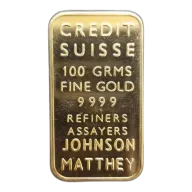
The 100g Johnson Matthey gold bar carries the hallmark of one of precious metals history's most respected names. Johnson Matthey, a British company founded in 1817, was an LBMA Good Delivery refiner for over a century before selling its precious metals refining division to Asahi Group Holdings in 2015. No new Johnson Matthey bars have been produced since the sale, which means every 100g JM bar on the market today is secondary market stock.
That discontinued status gives these bars a profile similar to vintage Engelhard bars. The JM name carries strong recognition among experienced bullion buyers, and the bars remain fully LBMA-compliant in terms of quality. At 999 fineness (three nines rather than four), the purity is slightly below the 999.9 standard that most current production bars use, but it comfortably exceeds the 995 threshold required for investment gold exemptions in all major jurisdictions.
The 100g weight class offers strong premium efficiency for gold accumulation. At roughly 3.215 troy ounces, the cost-per-gram is substantially lower than smaller bars and approaches kilo bar territory. For buyers in European markets where metric weights are the standard trading denomination, the 100g format is one of the most commonly stocked sizes.
Secondary market JM bars may trade at a modest premium above generic refiner bars of equivalent weight, reflecting the brand's heritage value. That premium is less pronounced than what discontinued Engelhard bars command, but it distinguishes JM bars from current-production alternatives. For buyers who prefer a recognised LBMA refiner name without paying the higher premiums attached to Swiss brands like PAMP Suisse, a Johnson Matthey bar is a practical middle ground. The bars are readily accepted by dealers in both North American and European markets, and the JM hallmark ensures straightforward resale.
100g Johnson Matthey Gold Bar Specifications
| Attribute | Detail |
|---|---|
| Weight | 100 grams (3.215 troy oz) |
| Purity | 999 fine gold (three nines) |
| Manufacturer | Johnson Matthey (United Kingdom) |
| Format | Minted bar |
| Production status | Discontinued (refining sold to Asahi in 2015) |
| LBMA Good Delivery | Yes (historic accreditation) |
| Serial number | Individually serialised |
Johnson Matthey produced gold bars across a range of weights for both retail and institutional markets. The company's refining operations were based in the UK, and JM was one of only five members of the LBMA Good Delivery referee panel, the elite group of refiners trusted to certify other refiners' products. That status speaks to the quality assurance behind JM-hallmarked bars.
The 999 purity is notable. Most modern production bars from Swiss and Australian refiners use 999.9 (four nines), but 999 exceeds the 995 LBMA Good Delivery minimum and meets investment gold purity requirements in every major market. The practical difference in gold content between 999 and 999.9 on a 100g bar is 0.09 grams, worth roughly a few dollars at current prices.
Tax Treatment of the 100g Johnson Matthey Gold Bar
At 999 fineness, this bar meets the purity thresholds for investment gold exemptions in all major bullion markets. The 995 minimum applies across the UK, EU, Australia, Canada, and Singapore.
- UK: VAT-exempt as investment gold. Subject to CGT on disposal (gold bars are not eligible for the CGT exemption reserved for UK legal tender coins). Annual CGT allowance is £3,000.
- US: No federal sales tax. State sales tax exempt in most states. Capital gains taxed at the 28% collectibles rate for long-term holdings. IRA-eligible as a gold bar from an LBMA-accredited refiner meeting the 99.5%+ purity threshold.
- Canada: GST/HST exempt for gold at 99.5%+ purity. Eligible for RRSP and TFSA accounts when held through an approved custodian.
- EU: VAT-exempt under the EU Investment Gold Directive (bars of 995+ purity, 1g minimum). Capital gains treatment varies by country. In Germany, gains are tax-free after a one-year holding period.
- Australia: GST-free as investment-grade gold (99.5%+ purity).
- Singapore: GST-exempt under the Investment Precious Metals scheme for LBMA-accredited bars at 99.5%+ purity.
- Hong Kong: No sales tax, no import duty, no capital gains tax.
Johnson Matthey vs Current-Production 100g Gold Bars
The key question with a Johnson Matthey 100g bar is whether the brand heritage justifies any premium over current-production alternatives from active refiners.
Against Asahi Refining, JM's direct successor, the comparison is instructive. Asahi acquired JM's precious metals business in 2015 and produces bars using the same refining infrastructure. Asahi bars are current production with modern packaging, but the brand lacks the decades of name recognition that JM built. JM bars may trade at a modest premium on the secondary market; Asahi bars will generally be cheaper as new production.
Compared to Swiss LBMA refiners like PAMP Suisse and Valcambi, JM bars offer a different value proposition. Swiss bars carry current-production assay cards with modern security features, and PAMP's Fortuna design commands premium retention on resale. JM bars trade on heritage rather than packaging sophistication. For buyers focused on the lowest cost-per-gram of gold from a recognised LBMA name, JM bars are often competitive with Valcambi on price while carrying stronger brand sentiment.
The Perth Mint's 100g Kangaroo bar offers government-mint backing and a tamper-evident blister card with modern security features. It carries a higher purity (999.9 versus JM's 999) and is current production, but typically trades at a slightly higher premium than secondary-market JM bars.
For collectors of discontinued refiner products, JM bars hold a particular appeal. The brand's 200-year history and its status as one of five LBMA Referees give JM-hallmarked gold a provenance that no current-production bar from a newer refiner can replicate. That historical value is modest in dollar terms but meaningful to buyers who consider a bar's story part of its worth.
100g Johnson Matthey Gold Bar: frequently asked questions
-
Johnson Matthey exited the retail bullion market, ending production of its branded gold bars. The bars still in circulation today are secondary-market pieces, traded between investors and dealers rather than sourced new from the refinery. JM bars remain recognisable and widely accepted, but no new production has occurred for decades.
-
Genuine Johnson Matthey bars carry an assay mark, a serial number, and the refinery's hallmark stamped into the surface. Weight and dimensions should match the stated specification exactly. For high-value purchases, buyers typically rely on a professional assay, a trusted dealer's authentication, or ultrasonic testing to confirm genuineness.