 Go Gold


 Knox Safe Custody

Prices are fetched automatically and may not reflect current merchant prices. Currency conversions and tax treatment are approximate. Rankings are based solely on price. We are not a dealer and accept no responsibility for transactions with listed merchants. Past performance is not indicative of future results. This site does not provide investment advice. Full disclaimer
About the 100g Minted Bars Gold Bar
From the Refinery Behind the Krugerrand
The 100g Rand Refinery minted gold bar carries the hallmark of one of the gold industry's most historically significant operations. Rand Refinery was established in 1920 by the Transvaal Chamber of Mines and has since processed an estimated 50,000 tonnes of gold, roughly one-third of all gold ever mined in human history. The refinery is LBMA Good Delivery accredited, has been since 1921, and is one of only five members of the LBMA Good Delivery referee panel.
The connection to the Krugerrand is direct. Rand Refinery produces the gold blanks (planchets) that the South African Mint strikes into Krugerrands. The same refinery, the same quality chain, and the same 999.9 purity applied to both the minted bar range and the blanks for the world's most widely distributed gold coin. The minted bar series was introduced in 2012 to diversify Rand Refinery's retail product range beyond the cast bar formats that had been its primary output for institutional clients.
At 100 grams of 999.9 fine gold, this bar hits the premium-efficient sweet spot of the metric bar range. The reverse features a Springbok antelope design with a repeating African elephant pattern background, an anti-counterfeiting measure unique to Rand Refinery. The word "LOXODONTA" (the genus of the African elephant) appears alongside the elephant motif, adding an educational element that distinguishes these bars visually from the more austere designs of Swiss refiners.
Each bar is packaged in the current-generation "Black Assay" tamper-evident card, which carries the assay certificate, serial number (prefixed "RR"), weight, and purity markings. Earlier production runs used a "Red Assay" card with the same security elements. Both generations are authentic and accepted equally by dealers.
The bar is available from dealers across the US, UK, and South Africa. Rand Refinery's LBMA status means it is accepted by bullion dealers worldwide, though its brand recognition among retail buyers is lower than PAMP Suisse or Valcambi. It typically trades at a small discount to equivalent Swiss bars, offering a cost-effective way to hold LBMA-accredited gold with a century of refining heritage behind it.
100g Rand Refinery Gold Bar Specifications
| Attribute | Detail |
|---|---|
| Weight | 100 grams (3.215 troy oz) |
| Purity | 999.9 fine gold (24 karat) |
| Manufacturer | Rand Refinery (Germiston, South Africa) |
| Format | Minted (stamped) |
| Packaging | Black Assay tamper-evident card |
| Serial number | "RR" prefix + six-digit code |
| LBMA Good Delivery | Yes (accredited since 1921) |
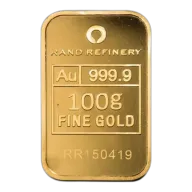
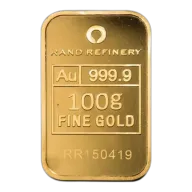
| Obverse | Rand Refinery crucible logo, weight, purity, serial number |
| Reverse | Springbok antelope with elephant pattern background |
The Rand Refinery minted bar range was introduced in 2012 and includes seven weights: 2.5g, 5g, 8g, 10g, 20g, 50g, and 100g. The 8g denomination is unusual in Western markets and likely targets the Indian subcontinent, where weights close to the traditional tola (11.66g) are common gift sizes. Rand Refinery also produces cast bars in weights up to 400 oz (LBMA Good Delivery format) and tola-denominated bars for Middle Eastern and South Asian markets.
The company rebranded in 2011, replacing the original Springbok head logo with a circular design representing a pouring crucible, a direct reference to the gold refining process. Pre-2011 bars carry the older logo; both are authentic. The current Black Assay packaging replaced the earlier Red Assay cards and provides the same authentication elements.
Tax Treatment of the 100g Rand Refinery Gold Bar
At 999.9 fine gold and LBMA-accredited origin, this bar qualifies for investment gold exemptions in all major markets.
- South Africa: Investment gold is VAT-exempt. Gold Krugerrands specifically are zero-rated under the VAT Act, but investment gold bars also qualify for exemption. Capital gains tax applies with a 40% inclusion rate for individuals (effective maximum rate approximately 18%).
- UK: VAT-exempt on purchase. Subject to CGT on disposal. Gold bars do not qualify for the CGT exemption available to UK legal tender coins. Annual CGT allowance is £3,000.
- US: No federal sales tax. State sales tax exempt in most states. Capital gains taxed at the 28% collectibles rate for long-term holdings. IRA-eligible as a 999.9 fine bar from an LBMA-accredited refiner.
- Canada: GST/HST exempt for gold at 99.5%+ purity. RRSP eligible as 999.9 fine gold from an LBMA-accredited refinery.
- EU: VAT-exempt under the EU Investment Gold Directive. In Germany, gains are tax-free after one year of holding.
- Australia: GST-free as investment-grade gold (99.5%+ purity).
- Singapore: GST-exempt under the Investment Precious Metals scheme for LBMA-accredited gold bars at 99.5%+ purity.
- Hong Kong: No sales tax, no import duty, no capital gains tax.
Rand Refinery: A Century of Gold Refining
Rand Refinery opened in December 1921 in Germiston, near Johannesburg, at a time when South Africa dominated world gold production. For much of the twentieth century, the Witwatersrand basin produced the majority of the world's gold, and Rand Refinery processed virtually all of it. The estimated 50,000 tonnes refined since opening represents roughly one-third of all gold ever mined by humanity.
The refinery is owned by five South African mining companies: AngloGold Ashanti (42.41%), Sibanye Gold (33.15%), DRDGOLD (11.3%), Harmony Gold (10.38%), and Gold Fields (2.76%). This ownership structure ties it directly to the mining operations that supply its raw material, creating a vertically integrated chain from mine face to finished bar.
For its first nine decades, Rand Refinery focused primarily on cast bars for institutional clients, particularly the 400 oz Good Delivery format held by central banks in Bank of England vaults and other sovereign depositories. The 2012 introduction of minted bars for retail investors was a strategic diversification, extending the Rand Refinery brand to a market segment previously served almost exclusively by Swiss refiners.
The connection to South Africa's most famous gold product is foundational. Rand Refinery produces the gold blanks from which every Krugerrand is struck. Since 1998, the refinery has also managed Krugerrand marketing. The quality assurance that goes into Krugerrand blanks applies equally to these minted bars, as they come from the same refining and quality control processes.
Rand Refinery also has a multi-metal capability. The refining process extracts platinum group metals from input material alongside gold, reflecting South Africa's position as the world's largest producer of platinum and palladium. About 40% of the gold refined at the Germiston facility now comes from outside South Africa, including mines across West and East Africa, making it a continental hub for African gold production.
Rand Refinery vs PAMP, Perth Mint, and Swiss Competitors at 100g
Rand Refinery competes at the same LBMA quality tier as the Swiss and Australian market leaders, with a pricing advantage and a unique heritage story.
Against PAMP Suisse, the Rand Refinery bar generally trades at a lower premium. PAMP's Lady Fortuna design, VeriScan digital verification, and Swiss brand prestige all command a price premium that Rand Refinery's Springbok design does not match in most Western markets. For buyers focused on acquiring the most gold for their money from an LBMA-accredited refiner, the Rand Refinery bar is typically the more cost-effective choice. PAMP bars retain their premium better on resale, which partially offsets the initial savings.
Compared to the 100g Perth Mint Kangaroo bar, the dynamic is similar. Both are LBMA-accredited and 999.9 fine. The Perth Mint offers government backing from the Western Australian Government and stronger brand recognition in Asia-Pacific markets. Rand Refinery offers comparable quality at typically lower premiums, with stronger presence in African and Middle Eastern markets. Both bars feature culturally specific wildlife designs: the Kangaroo for Australia, the Springbok for South Africa.
The heritage argument is where Rand Refinery stands alone. No other active refiner can claim to have processed one-third of all gold ever mined, and the direct connection to Krugerrand production gives these bars a provenance story that resonates with buyers who value historical significance. For a buyer choosing between two LBMA bars at the same weight, the Rand Refinery bar carries a century of gold industry history that no Swiss refiner's marketing can replicate.
100g Minted Bars Gold Bar: frequently asked questions
-
The cheapest Rand Refinery 100g minted bar we track is $14,400.89 from Go Gold, around 4.2% over the $4,408.10 gold spot price. A 100-gram bar contains 3.215 troy ounces of .9999 fine gold, so its value moves in step with the gold market.
-
Minted bars typically carry a slightly higher premium than cast bars of the same weight, because the stamping, polishing, and individual assay-card packaging add to production cost. The Rand Refinery 100g minted bar currently trades at around 4.2% over spot. Cast bars of similar weight from the same refinery usually trade a little tighter, depending on market supply.
-
A minted gold bar is produced by cutting a precise blank from a rolled gold sheet, then stamping it under pressure to imprint the design, weight, purity, and serial number. The result is a bar with crisp edges, a polished face, and consistent dimensions. This differs from a cast (poured) bar, which is formed by pouring molten gold into a mould and has a rougher, more varied surface. Both contain the same gold purity.
-
In the UK, gains on gold bars above the £3,000 annual allowance are taxable at 18% or 24% depending on your income tax band. Investment-grade gold bars are VAT-free in the UK. In Canada, 50% of any capital gain is included in taxable income. US investors pay up to 28% on long-term gains from gold. Consult a tax adviser for your specific position.
-
Rand Refinery is a South African gold refinery established in 1920 in Germiston, near Johannesburg, and opened in 1921. The refinery holds LBMA Good Delivery accreditation, which means its bars are accepted by bullion dealers and central banks worldwide. Rand Refinery also produces the gold blanks used to strike Krugerrand coins.