1 listing
Filters
| Product | /oz | Premium | Price | |
|---|---|---|---|---|

 Suisse Gold
Out of Stock
Suisse Gold
Out of Stock
|
$4,586.83 | +5.54% |
$14,746.84
€12,868
|
View Deal |
Prices are fetched automatically and may not reflect current merchant prices. Currency conversions and tax treatment are approximate. Rankings are based solely on price. We are not a dealer and accept no responsibility for transactions with listed merchants. Past performance is not indicative of future results. This site does not provide investment advice. Full disclaimer
About the 100g Suisse Gold Bar
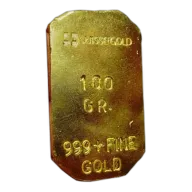
The 100g Suisse Gold Bar
The 100g Suisse Gold Bar contains 100 grams (3.2151 troy ounces) of 999 fine gold. One hundred grams is a serious commitment, with a metal value around $10,000-$10,500 at 2026 gold prices, and it buys one of the most premium-efficient formats in retail gold. Bars at this weight typically trade at 2-4% over spot, a level only kilo bars meaningfully undercut, and the drop from 50g bars (3-6%) to 100g is one of the sharpest efficiency gains anywhere in the gram-denominated bar range.
The 100g size is a standard trading weight in European bullion markets and a common format in Singapore and Hong Kong, while remaining less dominant in the US, where troy-ounce denominations rule retail trade. For buyers working in metric units it occupies a sweet spot: near-optimal premium efficiency without the psychological and practical barriers of a kilo-sized purchase.
Physically the format is remarkable for how little space it occupies. A 100g gold bar runs roughly 47mm x 27mm x 5mm depending on the manufacturer, small enough for a shirt pocket, and bars at this weight are typically sealed in assay cards. Keeping that card intact matters: breaking the seal can mean re-assaying before resale. The trade-off against smaller formats is divisibility. A single 100g bar sells as one unit, where the same gold in 1 oz bars can be liquidated piece by piece, so this weight suits buyers deploying a lump sum rather than building flexibility into a gold bar holding they expect to sell in stages.
Tax Position of a 100g Gold Bar
At 999 fineness this bar clears the 995 minimum that defines investment gold in the jurisdictions that exempt it:
- UK: 0% VAT as investment gold (995+ fineness). Bars are never CGT-exempt in the UK; only UK legal tender coins qualify, so gains above the £3,000 annual allowance are taxed at 18-24%. A roughly $10,000 bar can generate gains that exceed that allowance on its own, which makes the CGT exposure a real cost to weigh against the low premium.
- EU: 0% VAT on investment gold bars of 995+ fineness across all member states. Capital gains rules vary by country; Germany taxes nothing on bullion held over a year, which pairs well with a low-premium bar like this.
- US: No federal sales tax, most states exempt bullion, and a $10,000+ purchase clears every state threshold (the highest is California's $2,000). Long-term gains are taxed at the collectibles rate of up to 28%. IRA gold must be at least 99.5% pure from an accredited refiner and held at an approved depository.
- Canada: GST/HST-free at 99.5%+ purity.
- Australia and New Zealand: GST-free as investment-grade gold (99.5%+).
- Singapore: 0% GST under the Investment Precious Metals scheme, no capital gains tax.
- Hong Kong: No sales tax, no import duty, no capital gains tax.
100g Bar vs 1 oz Bars, Kilo Bars, and the Swiss Majors
The vertical comparison first. Against 1 oz gold bars, the 100g bar wins on cost: roughly 2-4% over spot versus 3-5% for the smaller bar (1 oz bars more broadly run 1-4% for minted product). The 1 oz format answers with divisibility and the deepest resale market in bullion, since every dealer worldwide trades ounce bars. Against kilo bars, the 100g gives up a little premium efficiency (kilo bars reach 1-2%) but avoids concentrating $100,000+ of value in a single unit with a narrower retail buyer pool.
The horizontal comparison is about refiner. The benchmark products at this weight are the Valcambi 100g, made by the largest precious metals refinery in the world by capacity at 2,000 metric tonnes annually and described as one of the best-selling bars in the format, and the PAMP Suisse 100g with its Lady Fortuna design. Valcambi typically has the lower acquisition premium; PAMP costs slightly more and retains its premium better at resale. Argor-Heraeus, Heraeus, Umicore, Perth Mint, and the Royal Mint also produce 100g bars, all with LBMA-accredited liquidity.
Where a given 100g bar sits against those names depends on its refiner's recognition. LBMA-accredited bars in sealed assay cards command the strongest buyback prices; bars outside that circle remain saleable on their gold content but may face wider spreads or re-assay friction. At a five-figure price point, that resale question deserves as much attention as the purchase premium.