1 listing
Filters
| Product | /oz | Premium | Price | |
|---|---|---|---|---|

 AU Bullion
Out of Stock
AU Bullion
Out of Stock
|
$4,544.84 | +4.60% |
$1,461.18
CA$2,047
|
View Deal |
Prices are fetched automatically and may not reflect current merchant prices. Currency conversions and tax treatment are approximate. Rankings are based solely on price. We are not a dealer and accept no responsibility for transactions with listed merchants. Past performance is not indicative of future results. This site does not provide investment advice. Full disclaimer
About the 10g Asahi Refining Gold Bar
The 10g Asahi Gold Bar
Asahi Refining occupies an unusual position among bar producers: it is the North American successor to Johnson Matthey's gold and silver refining business, which it acquired in March 2015 for USD 186 million. The deal transferred Johnson Matthey's LBMA London Good Delivery status for both gold and silver to Asahi's Salt Lake City and Brampton, Ontario refineries, and after adding Republic Metals' Florida plant in 2019, Asahi became the largest refiner of gold mined in North America. A 10g Asahi bar therefore carries accreditation lineage that most generic-brand bars cannot match, while typically trading closer to generic pricing than premium Swiss names like the 10g PAMP Suisse Fortuna.
The 10g size itself sits in the middle of the gram bar range. At 0.3215 troy oz, it holds more metal than a 1/4 oz sovereign coin at a broadly similar price point, around USD 1,000 to 1,100 at current gold prices. Typical 10g bar premiums run 8 to 12% over spot, similar to 5g bars and 1/10 oz coins; the big premium improvement in the gram range only arrives at 50g, where premiums drop to 3 to 6%. Buyers choosing 10g are usually making regular, accessible gold purchases rather than optimising premium per gram. The bar is COMEX-approved and IRA-qualifying, which gives US retirement buyers a reason to pick Asahi over unaccredited private mints, and 10g gold bars are a standard format every dealer recognises.
10g Asahi Gold Bar Specifications
| Specification | Detail |
|---|---|
| Weight | 10 g (0.3215 troy oz) |
| Purity | .9999 fine gold |
| Type | Minted bar |
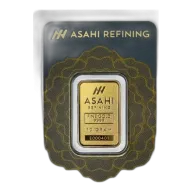
| Markings | Asahi logo, metal content, purity, individual serial number |
| Reverse | Repeating Asahi logo pattern |
| Refiner accreditation | LBMA Good Delivery (gold and silver), LBMA Responsible Gold, COMEX approved |
Asahi's minted gold bar line runs 1g, 2.5g, 5g, 10g, and 1 oz, all at .9999 fine, in the standard Asahi design plus themed Diwali and Lunar variants. The 10g format is the largest of the gram-denominated minted sizes before the line steps up to the 1 oz bar; Asahi's larger gold products (10 oz, 1 kilo, 100 oz, 400 oz) are cast rather than minted.
A 10g minted bar in its assay card is roughly credit-card sized, with the bar itself approximately 24mm by 14mm. Multiple bars stack flat, and the tamper-evident card should stay sealed: breaking the seal can mean re-assaying at resale and reduces buyback value.
Tax Treatment of the 10g Asahi Gold Bar
At .9999 fine, the bar clears the investment-gold purity threshold in every major jurisdiction, so it gets the favourable gold treatment across the board.
- UK: VAT-exempt as investment gold (the threshold is 995 fine). Bars are not CGT-exempt, however; only UK legal tender coins qualify, so gains above the £3,000 annual allowance are taxable.
- US: most states exempt bullion from sales tax, with some applying dollar thresholds the roughly $1,000 price of a 10g bar may not always clear (Florida exempts over $500, while California's exemption starts at $2,000). IRA eligibility requires gold of 99.5%+ purity from an accredited refiner held at an approved depository; Asahi's COMEX approval and LBMA accreditation mean its bars qualify.
- EU: VAT-exempt under the Investment Gold Directive for bars of 995+ fineness.
- Canada: GST/HST exempt at 99.5%+ purity. Asahi's Brampton, Ontario refinery makes the brand a familiar one for Canadian dealers.
- Australia and New Zealand: GST-free as investment-grade gold at 99.5%+ purity.
- Singapore: GST-exempt as an Investment Precious Metal; the bar form and LBMA-accredited refiner satisfy the IPM rules. No capital gains tax.
- Hong Kong: no sales tax, no import duty, no capital gains tax.
From Tokyo Silver Recovery to Johnson Matthey's Heir
The parent company was founded in Tokyo in 1952 as Asahi Chemical Laboratory, originally recovering silver from photographic fixing effluent. The business grew into Asahi Holdings, a Tokyo Stock Exchange listed group spanning precious metals recycling and environmental services, and rebranded as ARE Holdings in July 2023.
The Asahi Refining brand familiar to bullion buyers dates from March 2015, when Asahi completed its acquisition of Johnson Matthey's gold and silver refining businesses. The purchase brought the refineries in Salt Lake City, Utah and Brampton, Ontario, and Johnson Matthey's LBMA Good Delivery listings transferred to both sites. Asahi's own marketing claims nearly 200 years of industry experience by counting from the Johnson Matthey heritage, which traces to around 1817.
In February 2019 Asahi won a New York bankruptcy court auction for the assets of Miami-based Republic Metals Corporation with a USD 25.5 million bid, adding the Opa-locka, Florida plant as a fourth North American facility and making Asahi the largest refiner of gold mined in North America. For a buyer of the 10g bar, this history matters mainly as provenance: the brand on the assay card is backed by two of the longest-accredited refining operations on the continent, and bars from LBMA-accredited refiners sell internationally without the assay-testing friction that non-accredited bars can face.
Asahi vs PAMP, Valcambi, and Other 10g Bars
The 10g minted bar market is dominated by LBMA-accredited refiners: PAMP Suisse, Valcambi, Argor-Heraeus, Heraeus, Perth Mint, and the Royal Mint all produce the format in tamper-evident assay cards with serial numbers. Asahi sits in this accredited tier, so the practical differences come down to design, brand premium, and security features rather than metal quality, since all are .9999 fine.
The 10g PAMP Suisse Fortuna commands a modest premium over generic refiner bars on the strength of its design and recognition, and PAMP and Valcambi cards carry VeriScan verification technology, while Argor-Heraeus uses kinebar holographic security. Asahi's bars rely on the serial number, the repeating logo pattern on the reverse, and the sealed card itself. Buyers who want the cheapest accredited metal will often find Asahi priced below the Swiss design brands; buyers who expect to resell internationally may prefer the more universally photographed PAMP or Valcambi formats, though any LBMA-accredited bar sells without difficulty.
The other comparison worth making is against the 1/4 oz sovereign coin at the same price point. A quarter-ounce coin contains 7.78g of gold against the bar's 10g, so the bar buys more metal per dollar of metal value, but 1/4 oz gold coins from sovereign mints typically carry lower percentage premiums and stronger brand recognition. More gold favours the bar; easier resale favours the coin.