1 listing
Filters
| Product | /oz | Premium | Price | |
|---|---|---|---|---|

 AU Bullion
Out of Stock
AU Bullion
Out of Stock
|
$5,817.29 | +33.88% |
$1,870.29
CA$2,620
|
View Deal |
Prices are fetched automatically and may not reflect current merchant prices. Currency conversions and tax treatment are approximate. Rankings are based solely on price. We are not a dealer and accept no responsibility for transactions with listed merchants. Past performance is not indicative of future results. This site does not provide investment advice. Full disclaimer
About the 10g Baird & Co. Gold Bar
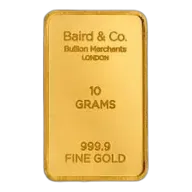
The 10g Baird & Co. Gold Bar
Baird & Co. is described as the UK's largest gold refiner and the only independent UK refiner on the LBMA Good Delivery List for gold. Its bars are made in-house at a 30,000 sq ft high-security refinery in Beckton, east London, with gold struck at 999.9 fine across a range running from 1g to 1kg in both cast and minted formats. For buyers who want a domestically refined British gold bar rather than an imported Swiss product, Baird is effectively the home-grown option, and its LBMA full membership (held since September 2000) gives the brand the accreditation that matters most for resale recognition.
The 10g weight is a mid-range metric size, slightly larger in gold content than a 1/4 oz coin at 7.78g. It is a standard format across Europe and a popular regular-purchase weight in Germany, Austria, and Switzerland, though in the ounce-dominated UK and US markets, troy denominations remain more common. Typical 10g gold bar premiums run 8-12% over spot, similar to 5g bars and 1/10 oz coins; the sharp improvement in the gram-bar premium curve only arrives at 50g, where the band drops to 3-6%.
At roughly the same outlay, the main alternative is a 1/4 oz gold coin from a sovereign mint: the bar carries more gold (10g vs 7.78g) while the coin usually offers a lower percentage premium and broader recognition. UK buyers have an extra wrinkle covered in the tax tab: bars are VAT-exempt but never CGT-exempt.
Baird 10g Gold Bar Specifications
| Attribute | Detail |
|---|---|
| Metal | Gold |
| Weight | 10 grams (0.3215 troy oz) |
| Purity | 999.9 fine |
| Refiner | Baird & Co., Beckton, London |
| Formats | Cast and minted bars produced |
Baird produces both bar styles: cast bars with a hand-poured appearance made at the Beckton refinery, and precision-struck minted bars in sealed packaging. Across the market, a 10g gold bar is small, roughly 24mm x 14mm for the bar itself, and minted bars at this weight are typically sealed in tamper-evident assay cards that are credit-card sized and stack flat for storage. Keeping the seal intact matters: breaking an assay card can mean re-assaying at resale.
The 999.9 fineness comfortably exceeds the LBMA Good Delivery minimum of 995 and the 99.5% purity thresholds used by investment-grade tax definitions. Authentication risk is low at this size; the tungsten-core problem that affects gold bars is mainly a concern for 100g+ pieces, and a 10g bar from an LBMA-accredited refiner bought sealed from an authorised dealer carries minimal counterfeiting exposure. Standard checks (precise weight, dimensions, and electromagnetic verifiers such as the Sigma Metalytics unit) are all effective at this weight.
Tax Treatment of the Baird 10g Gold Bar
At 999.9 fine, this bar qualifies as investment gold in every jurisdiction that uses a purity test, so purchase taxes are rarely an issue. The differences arise on disposal.
- United Kingdom: VAT-exempt as investment gold (995+ purity). Bars are NOT CGT-exempt; that exemption is reserved for UK legal tender coins such as the Britannia and Sovereign. Gains above the £3,000 annual allowance are taxable at 18-24% depending on income, so for UK buyers expecting significant gains, a CGT-exempt coin can beat a bar on lifecycle cost despite the bar's lower purchase premium. Qualifying gold can be held in a SIPP, where it is also CGT-exempt.
- United States: no federal sales tax; most states exempt bullion bars, with a minority taxing them and several using purchase thresholds. A 10g gold bar at recent prices clears the common $1,000 thresholds but not California's $2,000. Long-term gains are taxed at the collectibles rate of up to 28%. IRA-eligible bars must be 99.5%+ purity from accredited refiners and held at an approved depository.
- EU: VAT-exempt as investment gold at 995+ fineness. Germany makes gains tax-free after a 12-month hold.
- Canada, Australia, New Zealand: exempt from GST/HST or GST as gold above the 99.5% purity threshold.
- Singapore and Hong Kong: no GST or sales tax on qualifying gold and no capital gains tax. Baird has had a Singapore branch since 2013.
Baird & Co. Since 1967
Tony Baird, born in Lanarkshire in 1942, began bartering coins at school after his family moved to London. The launch of the South African Krugerrand in 1967 turned the hobby into a business: he became a full-time coin dealer and was among the first to trade Krugerrands in the UK. By the mid-1970s he had a permanent office in Stratford, east London, and was regularly collecting gold coins from Switzerland. When the UK imposed 15% VAT on gold coins from April 1982 and the coin market collapsed, Baird diversified into jewellery manufacturing and gold bar production; the firm's first refinery had already opened in 1979.
A Hatton Garden retail branch followed in 1987, still the company's registered office and showroom at 48 Hatton Garden today. In 1996 Baird launched what is described as the UK's first bullion website, one of the first dynamic e-commerce sites in the country, and in September 2000 the company became a full member of the LBMA. The refinery moved from Stratford to Beckton in 2008 to make way for London Olympics redevelopment.
The following decade brought steady expansion: Sunday Times Fast Track rankings from 2011 to 2013, the world's first commercial rhodium investment bar in 2012, a Singapore office in October 2013, appointment as an official Royal Mint distributor in 2016, and in 2018 both the Queen's Award for Enterprise for International Trade (after overseas sales grew 229% in three years) and a partnership with Tuvalu on the world's first legal tender rhodium coin. Tony Baird died in 2015; the company remains privately owned, refining gold, silver, platinum, palladium, and rhodium.
Baird 10g Bar vs PAMP, Valcambi, and the 1/4 oz Coin
At 10g, the dominant alternatives are the Swiss minted bars: the 10g PAMP Suisse gold bar with its Fortuna design, plus Valcambi, Argor-Heraeus, and Heraeus, all sealed in tamper-evident assay cards with serial numbers. All are LBMA-accredited, as is Baird, so the resale recognition gap is smaller than the brand gap suggests; the practical differences are design, packaging technology (PAMP and Valcambi offer VeriScan-style verification, Argor-Heraeus its kinebar hologram), and price, where PAMP's Fortuna typically commands a modest premium over plainer refiner bars. Baird's pitch against the Swiss names is local: a British-refined bar, often at competitive pricing, from the only independent UK refiner with LBMA Good Delivery status for gold.
Baird's own cast bars are the budget route, since cast production is simpler and cast bars run cheaper than minted equivalents of the same weight, at the cost of a rougher hand-poured finish and no sealed card.
The cross-form comparison is the 1/4 oz sovereign coin at the same rough price point, such as the 1/4 oz Gold Britannia. The bar contains more gold (10g versus 7.78g) for similar money, but the coin usually carries a lower percentage premium and stronger liquidity, and for UK sellers the Britannia adds CGT exemption that no bar can match. Buyers maximising grams per pound lean to the bar; buyers optimising exit costs, especially in the UK, lean to the coin.