1 listing
Filters
| Product | /oz | Premium | Price | |
|---|---|---|---|---|

 Australian Bullion Company
|
$5,213.88 | +19.87% |
$1,676.30
A$2,354
|
View Deal |
Prices are fetched automatically and may not reflect current merchant prices. Currency conversions and tax treatment are approximate. Rankings are based solely on price. We are not a dealer and accept no responsibility for transactions with listed merchants. Past performance is not indicative of future results. This site does not provide investment advice. Full disclaimer
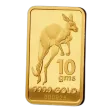
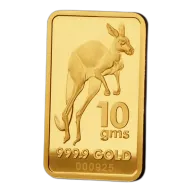
About the 10g Melbourne Mint Gold Bar
10 Grams of Gold in a Mid-Range Metric Bar
This Melbourne Mint bar contains 10 grams of gold, equal to 0.3215 troy oz, which makes it slightly heavier in gold content than a 1/4 oz coin. The 10g size is a mid-range metric weight: a meaningful but accessible purchase, currently around the $1,000-$1,100 mark, and a standard denomination carried by bullion dealers across Europe and popular as a savings vehicle in markets like India, the UAE, and Turkey, where banks and jewellers sell 10g bars extensively.
Economically, 10g sits in the steep part of the gold bar premium curve. Bars of 10g and smaller all fall in roughly the 8-15% premium band because fixed manufacturing costs weigh heavily on small pieces; the sharp drop to 3-6% only starts at 50g. So a 10g bar improves on 1g and 5g pieces but does not yet deliver the cost efficiency that draws buyers to 50g gold bars and above.
The relevant question at this price point is bar versus coin. A 1/4 oz sovereign coin costs about the same but contains 7.78g of gold against the bar's 10g; the bar gives you more metal for the money, while the coin usually carries a lower percentage premium and stronger brand recognition at resale. Buyers prioritising gold content per dollar lean to the bar, buyers prioritising liquidity lean to the coin. Keeping the bar sealed in its packaging matters either way, since intact assay packaging supports the resale price.
10g Gold Bar Format and Handling
| Attribute | Value |
|---|---|
| Weight | 10 grams (0.3215 troy oz) |
| Metal | Gold |
| Form | Bar |
| Typical bar dimensions at this weight | Approximately 24mm x 14mm |
Bars at this weight are normally produced as minted bars: cut from rolled gold sheet, polished, and sealed in tamper-evident assay cards carrying the serial number, weight, purity, and refiner hallmark. A carded 10g bar is roughly credit-card sized, and multiple cards stack flat for efficient storage. The card itself is part of the product: breaking the seal can mean the bar needs re-assaying before a dealer will pay full buyback, so cards should be stored flat and kept intact.
Authentication concerns are modest at this size. The tungsten-core counterfeiting problem that haunts gold bars is mainly a large-bar issue (100g and up), where a plated tungsten core can pass weight and dimension checks; for small carded bars bought from authorised dealers, the sealed assay card provides the chain-of-custody assurance. Electromagnetic verifiers such as the Sigma Metalytics unit work well on bars up to about 100g, so a 10g piece is easy to test non-destructively if it ever trades loose.
Tax Treatment of a 10g Gold Bar
Gold bars enjoy investment-gold exemptions in most major jurisdictions, with the usual caveat that purity thresholds apply (995 or 99.5% in most systems, which standard retail gold bars meet).
- United Kingdom: investment gold bars at 995+ fineness are VAT-free. Bars are not CGT-exempt, though: only UK legal tender coins get that, so gains above the £3,000 annual allowance are taxable at 18-24%.
- EU: VAT-exempt as investment gold under Directive 98/80/EC. Capital gains rules vary by country; Germany taxes nothing on gold held over a year.
- United States: no federal sales tax and most states exempt bullion, though a 10g bar (around $1,000-$1,100) sits near the exemption thresholds some states use: California exempts only over $2,000, while New York, Louisiana, and Massachusetts use $1,000 lines. Long-term gains are taxed at the collectibles rate of up to 28%. IRA-eligible bars must be 99.5%+ purity from accredited refiners and held at an approved depository.
- Canada: GST/HST exempt for gold at 99.5%+ purity in bar form.
- Australia and New Zealand: GST-free at 99.5%+ purity.
- Singapore: 0% GST for qualifying investment gold; no capital gains tax.
- Hong Kong: no sales tax, duty, or capital gains tax.
10g Bar vs Quarter-Ounce Coins and Larger Bars
The natural rival at this budget is the 1/4 oz gold coin: Eagles, Britannias, and Maple Leafs at that weight cost roughly the same $1,000-$1,100. The bar carries more gold (10g versus 7.78g), but quarter-ounce sovereign coins typically run lower percentage premiums than 10g bars and enjoy better brand recognition with dealers, particularly in the US and UK, where troy-ounce denominations dominate and metric bars are a minority format. In metric-native markets like Germany, Austria, and Switzerland, the 10g bar is a regular-purchase format and that liquidity gap narrows.
Within the gram-bar ladder, the comparison is mostly about patience. A 10g bar carries similar percentage premiums to 5g bars and 1/10 oz coins (8-12%), so consolidating two 5g purchases into one 10g bar saves little; the jump from 10g to 50g is where the curve breaks, dropping from 8-12% down to 3-6%. Buyers accumulating steadily often treat 10g as a stepping-stone weight and move up once the budget allows.
Against branded Swiss alternatives at the same weight, such as the 10g PAMP Suisse Fortuna or Valcambi equivalents, the trade is the familiar one: widely recognised LBMA-refiner cards command modest extra premium but resell with tighter spreads, while less famous brands compete on price.
10g Melbourne Mint Gold Bar: frequently asked questions
-
The cheapest Melbourne Mint 10g gold bar on BullionFerret is $1,676.30, currently around 19.9% over the $4,408.10 gold spot price. Use the comparison table above to see all current dealer prices and find the best available offer.
-
Melbourne Mint is an Australian bullion company based in Melbourne, Victoria. It produces gold and silver bars for retail and wholesale buyers. It is a separate business from the Perth Mint, which is government-owned, and from the Royal Australian Mint, which produces circulation and commemorative coinage.
-
Dealers are currently pricing this bar at around 19.9% above the gold spot price, with 1 dealer listed and the cheapest offer at $1,676.30. The premium on a 10g bar is typically higher than on a 1oz bar because fixed minting and handling costs are spread over a smaller amount of metal.
-
Common options include a home safe bolted to a wall or floor, a safety deposit box at a bank, and a specialist bullion vault service. Home storage keeps the bar accessible but requires adequate insurance and security. Vaulting services offer insured, audited storage without the need for a safe, and are often cost-effective for holdings beyond a few bars.