1 listing
Filters
| Product | /oz | Premium | Price | |
|---|---|---|---|---|

 Suisse Gold
Out of Stock
Suisse Gold
Out of Stock
|
$4,892.58 | +12.58% |
$1,573.00
€1,373
|
View Deal |
Prices are fetched automatically and may not reflect current merchant prices. Currency conversions and tax treatment are approximate. Rankings are based solely on price. We are not a dealer and accept no responsibility for transactions with listed merchants. Past performance is not indicative of future results. This site does not provide investment advice. Full disclaimer
About the 10g UBS Gold Bar
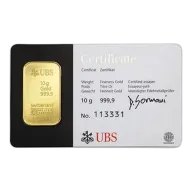
The 10g UBS Gold Bar
The 10g UBS Gold Bar contains 10 grams of 999.9 fine gold, which works out to 0.3215 troy ounces. That puts it in the middle of the metric gold bar range, slightly larger in gold content than a 1/4 oz coin and at a similar price point of roughly $1,000 to $1,100 at current gold prices. It is a meaningful but accessible purchase for buyers who want to accumulate gold in regular increments without committing to a full ounce at a time.
The 10g weight occupies a specific niche in the premium curve. Bars at this size typically trade at 8 to 12% over spot, a clear improvement on 1g and 5g bars but well short of the 3 to 6% premiums that start at 50g. Buyers choosing 10g are usually trading some premium efficiency for a lower entry price and the flexibility of selling in smaller pieces later.
The format has strong regional followings. In Germany, Austria, and Switzerland, 10g is a standard metric weight carried by every bullion dealer and a common regular-purchase format. In India, the UAE, and Turkey, 10g gold bars are popular savings vehicles and gifts sold by banks and jewellers. In the US and UK, where troy-ounce denominations dominate, buyers at this price point more often reach for 1/4 oz gold coins instead, so the 10g bar is available but less commonly traded.
10g UBS Gold Bar Specifications
| Specification | Detail |
|---|---|
| Metal | Gold |
| Purity | 999.9 (four nines) |
| Weight | 10 grams (0.3215 troy oz) |
| Form | Bar |
A 10g gold bar is a small object: bars at this weight measure approximately 24mm by 14mm, and when sealed in an assay card the whole package is roughly credit-card sized. Minted bars at this weight are normally sold in tamper-evident assay cards carrying the bar's serial number, weight, purity, and the refiner's hallmark. Multiple carded bars stack flat, so a position built from 10g bars stores efficiently.
Keeping the assay card intact matters for resale. A sealed card provides chain-of-custody assurance, and breaking the seal can mean the bar needs re-assaying before a dealer will pay full buyback value. Store cards flat rather than standing on edge, as the packaging is more fragile than the bar inside it.
10g Gold Bar Tax Treatment by Country
At 999.9 fine, a 10g gold bar comfortably clears the investment-gold purity thresholds in every major jurisdiction, so purchase taxes are rarely an issue. Taxes on disposal are where the form matters.
- UK: Investment gold bars (995+ fine) are VAT-exempt. Bars are not CGT-exempt, however; only UK legal tender coins qualify. Gains above the £3,000 annual allowance are taxed at 10 to 20% depending on income.
- US: No federal sales tax; most states exempt bullion bars, though some tax them or apply purchase thresholds. Long-term gains are taxed at the 28% collectibles rate. IRA eligibility requires 99.5%+ purity from an LBMA, COMEX, or NYMEX-accredited refiner, held at an approved depository.
- EU: Investment gold bars at 995+ fine are VAT-exempt in all member states. Capital gains rules vary; Germany taxes nothing on bars held longer than 12 months.
- Canada: 0% GST/HST at 99.5%+ purity.
- Australia and New Zealand: GST-free as investment-grade gold at 99.5%+ purity.
- Singapore and Hong Kong: No GST on qualifying investment gold and no capital gains tax in either jurisdiction.
For UK buyers planning large positions, the CGT liability on bars can outweigh the lower purchase premium compared with CGT-exempt legal tender coins. Elsewhere, the bar format carries no tax penalty.
10g UBS Bar vs Quarter-Ounce Coins and Other 10g Bars
The most direct alternative at this budget is a 1/4 oz sovereign-mint coin. Both cost roughly $1,000 to $1,100, but the trade is different on each side. A 1/4 oz coin contains 7.78g of gold against the bar's 10g, so the bar delivers more metal for the money. The coin typically carries a lower percentage premium, stronger brand recognition, and easier resale in ounce-denominated markets like the US and UK. The choice comes down to whether you value gold content or liquidity more.
Within the 10g bar format, the recognised Swiss names set the benchmark. The 10g PAMP Suisse bar and 10g Valcambi bar are the most widely traded examples, alongside 10g bars from Perth Mint, Argor-Heraeus, Heraeus, and the Royal Mint, all sealed in serial-numbered assay cards. Recognised brands in sealed cards enjoy good buyback liquidity worldwide.
Buyers should also weigh moving up the scale. The jump from 10g to 50g is the single biggest premium improvement in the gram bar range, from 8 to 12% down to 3 to 6% over spot. If the budget can stretch and divisibility is not a priority, one 50g gold bar buys its metal considerably more efficiently than five 10g bars.