1 listing
Filters
| Product | /oz | Premium | Price | |
|---|---|---|---|---|

 IDC Coin and Bullion
|
$5,144.13 | +16.70% | $51,441.28 | View Deal |
Prices are fetched automatically and may not reflect current merchant prices. Currency conversions and tax treatment are approximate. Rankings are based solely on price. We are not a dealer and accept no responsibility for transactions with listed merchants. Past performance is not indicative of future results. This site does not provide investment advice. Full disclaimer
About the 10 oz Engelhard Gold Bar
A Discontinued Classic from America's Historic Precious Metals Refiner
The 10 oz Engelhard gold bar is a discontinued product from one of the most historically significant precious metals refiners in the United States. Charles W. Engelhard Sr. founded the company in 1902 in Newark, New Jersey, and by the 1950s it had grown into the world's largest precious metals smelter. Engelhard exited the retail bullion market in the late 1980s to focus on industrial catalysts and materials, and in 2006, BASF acquired the company for US$5 billion, renaming it BASF Catalysts LLC.
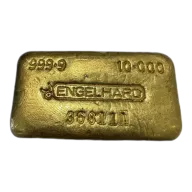
No new Engelhard bars have been produced since the mid-1980s. Every Engelhard bar on the market today is secondary-market stock, giving these bars a finite-supply characteristic that drives collector premiums above the metal content. The 10 oz gold bar is refined to 999.9 fine gold and carries a unique serial number, consistent with Engelhard's practice across nearly all bar sizes.
Engelhard bars occupy a distinctive niche between pure bullion investment and collectible numismatics. A buyer purchasing a 10 oz Engelhard gold bar is paying for both the gold content and the historical provenance of a brand that is no longer in production. Whether that collector premium is justified depends on the buyer's goals: pure metal accumulators will find better value in current-production LBMA bars, but those who value the heritage of American precious metals refining may see the premium as worthwhile.
The Engelhard name carries additional cultural cachet. Charles Engelhard Jr., who consolidated the family holdings into Engelhard Industries in 1958, is widely cited as the inspiration for Ian Fleming's James Bond villain Auric Goldfinger. The company also processed gold for the US Treasury and was involved in refining South African gold during the apartheid era.
10 oz Engelhard Gold Bar Specifications
| Property | Detail |
|---|---|
| Weight | 10 troy ounces (311.035 grams) |
| Purity | 999.9 fine gold |
| Manufacturer | Engelhard Industries (Newark, New Jersey, USA; ceased retail production mid-1980s) |
| Production methods | Cast (poured), pressed, and extruded variants exist |
| Serial number | Yes (nearly all Engelhard bars carry unique serial numbers) |
| Legal tender | No |
| Production status | Discontinued (all market stock is secondary-market) |
Engelhard bars were produced using multiple methods, resulting in visual variations between individual bars. Cast bars have a rough poured finish, pressed bars have a smoother surface, and extruded bars show a rolled appearance. All carry the Engelhard hallmark, weight, purity, and serial number. No standard dimensions were published across production runs, and tolerances vary by era and production method.
The AllEngelhard.com collector community maintains the definitive catalogue of known varieties across all sizes and is the primary authentication reference for buyers and sellers. For the 10 oz gold bar, authentication focuses on the hallmark design (which changed across production eras), font consistency in the weight and purity stamps, serial number format, and edge finishing characteristics. Counterfeits of Engelhard bars are documented, particularly for larger silver bars, making authentication an important step for secondary-market purchases.
Tax Position for the 10 oz Engelhard Gold Bar
At 999.9 fineness, Engelhard gold bars qualify for the same investment gold tax exemptions as any other high-purity gold bar, despite their discontinued status. The collector premium paid above the metal content does not alter the tax classification in any jurisdiction.
- United States: No federal sales tax. Roughly 35 states exempt bullion from state sales tax. Capital gains on gold bars are taxed at the 28% collectibles rate for long-term holdings. The collector premium paid above gold content becomes part of the cost basis, reducing the taxable gain on future sale. IRA eligibility depends on the specific custodian, as Engelhard is no longer an active refiner; some custodians accept them based on the .999+ purity and established provenance.
- United Kingdom: VAT-exempt as investment gold (995+ fineness). Subject to CGT on disposal with gains above the GBP 3,000 annual allowance taxed at 18% or 24%. Bars are not CGT-exempt regardless of their age or discontinued status.
- Canada: GST/HST exempt at 99.5%+ purity. CGT at 50% inclusion rate (66.67% above CAD 250,000).
- Australia: GST-free for investment-grade gold at 99.5%+ purity. CGT applies with a 50% discount for assets held longer than 12 months.
- EU: VAT-exempt under the EU Investment Gold Directive (995+ fineness).
- Singapore: GST-exempt under the Investment Precious Metals scheme for gold at 99.5%+ purity.
- Hong Kong: No sales tax, no import duty, no capital gains tax.
From Newark to BASF: The Engelhard Story
The Engelhard story begins in 1902 when Charles W. Engelhard Sr. purchased the Charles F. Croselmire Company in Newark, New Jersey. In 1904 he acquired Baker and Co., a platinum smelter, and in 1905 established the Hanovia Chemical and Manufacturing Company. His son, Charles Engelhard Jr., consolidated these holdings into Engelhard Industries, Inc. in 1958, listing it on the New York Stock Exchange.
By the mid-twentieth century, Engelhard was the world's largest precious metals smelter, processing gold and silver for governments, central banks, and industrial clients. The company began producing retail bullion bars in the late 1960s, timing that coincided with growing private gold ownership following the end of the gold standard in 1971 and the repeal of the US gold ownership ban in 1974.
Retail bar production continued through the Hunt Brothers silver boom of 1979-1980, a period that saw intense demand for physical precious metals. A significant number of Engelhard bars were melted during this spike, when silver briefly approached $50 per ounce, making surviving bars rarer than the original production run suggests.
Engelhard exited the retail bullion market in the late 1980s to concentrate on industrial applications, particularly catalytic converters and chemical catalysts. The company continued as a major industrial precious metals processor until BASF's hostile acquisition in 2006. The Engelhard name was formally retired on 1 August 2006 when the company became BASF Catalysts LLC. No retail bullion has been produced under the Engelhard name since, and no successor brand exists for the bar line.
Engelhard vs Johnson Matthey, PAMP Suisse, and Modern Alternatives
The 10 oz Engelhard gold bar exists in a category that straddles investment bullion and collectibles. Its most direct comparisons are with other discontinued refiner bars and with current-production LBMA alternatives.
The 10 oz Johnson Matthey bar is the closest peer. JM was Engelhard's contemporary as a major Anglo-American precious metals refiner, and JM bars also ceased production when Asahi Refining acquired JM's bullion operations in 2015. Both brands trade above their metal content on the secondary market. Engelhard bars generally command higher collector premiums than JM equivalents due to the greater variety of documented types, the Goldfinger cultural connection, and the longer period since production ceased.
The 10 oz Asahi Refining bar is JM's direct successor, produced at the same facilities with LBMA accreditation. Asahi bars trade near their metal content without a collector premium, making them the more cost-efficient choice for pure gold accumulation.
Among current-production Swiss bars, the 10 oz PAMP Suisse Fortuna bar and 10 oz Valcambi bar represent the modern standard: LBMA-accredited, factory-sealed in assay packaging, with anti-counterfeiting technology and global dealer acceptance. These bars offer lower premiums and stronger authentication infrastructure than secondary-market Engelhard stock.
The choice ultimately depends on what the buyer values. For lowest-cost gold accumulation, current LBMA bars win. For holding a piece of American precious metals history with potential numismatic appreciation, the Engelhard bar occupies a unique position that no modern refiner can replicate.
10 oz Engelhard Gold Bar: frequently asked questions
-
The cheapest 10 oz Engelhard gold bar tracked on this page is $51,441.28, derived from $4,408.10 spot price across 1 dealer. The bar contains 10 oz of 999.9 fine gold; its intrinsic value moves in step with the gold spot price throughout the day.
-
Engelhard Corporation was acquired by BASF, after which bullion production under the Engelhard name ceased. No new Engelhard bars have been minted since then. All 10oz Engelhard gold bars in circulation today are secondary-market pieces, which is part of why they attract collector interest alongside their bullion value.
-
Engelhard bars command a secondary-market premium driven by brand recognition and the fact that the company no longer produces them. Collectors and stackers value the discontinued status and the well-known hallmark. This demand means prices often exceed those of comparably sized bars from active refiners.
-
Engelhard bars carry a stamped serial number alongside the weight, purity (999.9), and Engelhard hallmark. Cross-reference the serial with any accompanying assay card. Because Engelhard no longer operates, there is no active online lookup service, so physical checks are essential: weigh the bar (10 troy oz, approximately 311g), measure dimensions against known references, and consider an XRF assay test for definitive confirmation of metal content.