1 listing
Filters
| Product | /oz | Premium | Price | |
|---|---|---|---|---|

 Best Bullion
Out of Stock
Best Bullion
Out of Stock
|
$4,468.02 | +3.91% |
$44,680.82
NZ$78,241
|
View Deal |
Prices are fetched automatically and may not reflect current merchant prices. Currency conversions and tax treatment are approximate. Rankings are based solely on price. We are not a dealer and accept no responsibility for transactions with listed merchants. Past performance is not indicative of future results. This site does not provide investment advice. Full disclaimer
About the 10 oz Go Gold Bar
The 10 oz Go Gold Bar
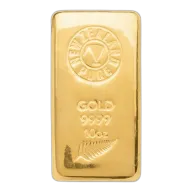
The 10 oz Go Gold bar contains ten troy ounces (311.035 grams) of 999.9 fine gold in a single rectangular ingot. At this weight, gold bars carry very low premiums, typically 1-3% over spot, which puts them near the bottom of the premium scale for retail gold. The trade-off is capital concentration: a 10 oz gold bar represents roughly $30,000 or more at current prices, so this format suits larger portfolios rather than incremental stacking.
Premiums on gold bars scale inversely with size. Smaller 1 oz gold bars run 1-4% over spot for minted bars and 1-3% for cast bars, while 1g bars can reach 15-25%. Moving up to a single 10 oz bar pushes the buyer toward the low end of that range, but it also makes liquidation an all-or-nothing decision. Selling a 10 oz bar means selling the full ten ounces at once; there is no way to release part of the position, which is the main practical argument for holding ten 1 oz bars instead.
Like all gold bars, the Go Gold bar is not legal tender and carries no face value. Buyers comparing it against branded competitors should weigh the resale picture: bars from LBMA-accredited refiners in sealed assay cards are widely accepted by dealers globally, while generic or non-LBMA bars remain liquid but can face slightly wider spreads and may require assay testing at the buyer's expense before resale. Keeping the bar in its original sealed packaging preserves its resale position either way.
10 oz Go Gold Bar Specifications
| Specification | Detail |
|---|---|
| Gross weight | 10 troy oz (311.035 g) |
| Purity | 999.9 fine gold |
| Form | Rectangular bar (ingot) |
| Face value | None (not legal tender) |
Gold bars are produced by one of two methods. Cast bars are made by pouring molten gold into moulds, which leaves a rougher finish but keeps production costs and premiums lower. Minted bars are cut from rolled gold sheet, polished, and usually sealed in tamper-evident assay card packaging carrying the bar's serial number, weight, purity, and the refiner's hallmark. The standard retail purity is 999.9 (four nines); the LBMA Good Delivery minimum is 995.
Authentication matters more for bars than coins because of the tungsten-core risk. Tungsten's density (19.25 g/cm3) sits close enough to gold's (19.32 g/cm3) that a gold-plated tungsten bar can pass weight and dimension checks, and XRF testing only reads the top 10-50 microns of surface. Ultrasonic testing is the most reliable non-destructive check: gold's sound velocity of 3,240 m/s differs sharply from tungsten's 5,170 m/s, immediately exposing a core substitution. The practical defence for retail buyers is simpler: buy from authorised dealers, keep the bar in its sealed assay card, and avoid breaking the seal, since an unsealed bar may need re-assaying at resale.
10 oz Gold Bar Tax Treatment by Country
At 999.9 purity, this bar clears the investment-gold thresholds in every major jurisdiction, so purchase taxes are zero almost everywhere. Disposal taxes are where bars differ from coins.
- UK: Investment gold (995+ fine) is 0% VAT, so the bar is VAT-free on purchase. But bars are not CGT-exempt; only UK legal tender coins are. Gains above the £3,000 annual allowance are taxed at 18-24% depending on income. Gold bullion is SIPP-eligible, and gold held in a SIPP is exempt from CGT.
- US: No federal sales tax; state treatment varies, with most states exempting bullion bars. Long-term gains are taxed at the 28% collectibles rate. IRA eligibility requires 99.5%+ purity from an LBMA/COMEX/NYMEX-accredited refiner with storage at an IRS-approved depository, so whether a Go Gold bar qualifies depends on the refiner's accreditation.
- EU: Investment gold bars at 995+ purity are VAT-exempt across all member states. Capital gains rules vary by country; Germany taxes nothing after a 12-month holding period.
- Canada: 0% GST/HST at 99.5%+ purity. Gains face CGT at the 50% inclusion rate.
- Australia: GST-free as investment-grade gold (99.5%+ purity from accredited refiners). CGT applies, with a 50% discount after 12 months for individuals.
- New Zealand: GST-exempt at 99.5%+ gold purity.
- Singapore: GST-exempt under the IPM scheme for gold bars at 99.5%+ purity from LBMA-accredited refiners. No capital gains tax.
- Hong Kong: No VAT, no duties, no capital gains tax.
The key distinction for UK buyers: the bar's lower purchase premium can be outweighed at sale by CGT that legal tender coins avoid entirely.
Go Gold vs Branded 10 oz Bars and Other Weights
The most direct alternatives are 10 oz gold bars from the major refiners that produce this format: PAMP Suisse, Valcambi, the Royal Canadian Mint, and the Perth Mint. All four are LBMA-accredited names with universal dealer recognition. A 10 oz PAMP Suisse gold bar commands a modest premium over generic refiner bars on the strength of brand recognition and the Fortuna design, while the 10 oz Royal Canadian Mint bar adds government-mint backing with serialisation and an assay certificate. Against these, a generic-brand bar competes on price: same fine gold content, typically a lower premium, but a narrower buyer pool and potentially wider spreads at resale.
Down the weight scale, 1 oz gold bars carry premiums of 1-4% for minted bars and 1-3% for cast. The 1 oz size is widely regarded as the sweet spot between premium efficiency and resale liquidity, and ten separate 1 oz bars allow partial liquidation that a single 10 oz bar cannot. Up the scale, 1 kg gold bars (32.15 oz) offer the lowest percentage premium of any commonly traded retail bar at 1-2%, but the buyer pool narrows further at that price point even though institutional buyers and refiners accept them readily.
The 10 oz format itself is less common in gold than in silver, where it is a dominant retail weight, precisely because of the unit cost. For a buyer already committed to a five-figure single purchase, the choice between this bar and a branded equivalent comes down to whether the upfront saving on a generic bar outweighs the smoother resale of an LBMA-accredited name.