1 listing
Filters
| Product | /oz | Premium | Price | |
|---|---|---|---|---|

 ITM Trading
|
$5,806.71 | +39.28% | $186.69 | View Deal |
Prices are fetched automatically and may not reflect current merchant prices. Currency conversions and tax treatment are approximate. Rankings are based solely on price. We are not a dealer and accept no responsibility for transactions with listed merchants. Past performance is not indicative of future results. This site does not provide investment advice. Full disclaimer
About the 1g Classic Gold Bar
The Smallest Bar in the Argor-Heraeus Classic Range
The 1g Argor-Heraeus Classic gold bar is the entry point to the Classic line, the Swiss refiner's standard investment-grade bar range, distinct from its Kinebar, Lunar Calendar, Origin Traced, and Small Craft specialty lines. It is a minted bar of 999.9 fine gold, produced at the Mendrisio refinery in Ticino, where Argor-Heraeus refines roughly 400 tonnes of gold annually, placing it in the same tier as PAMP and Valcambi within the Swiss refining cluster.
The pedigree behind the stamp is the main argument for choosing it. Argor-Heraeus has held LBMA Good Delivery accreditation for gold since 1961 and is one of only seven global LBMA Referees, the panel of refiners that audits other refiners' Good Delivery compliance. Every Classic bar carries an individual serial number, is certified by a sworn assayer, and ships in a numbered tamper-evident assay card.
A gram of gold is the smallest standard bar weight, equal to 0.032 troy oz, and the least efficient way to accumulate metal: manufacturing, assaying, and packaging costs are roughly fixed regardless of bar size, so spread across one gram they dominate the price, with typical 1g premiums of 8 to 15% over spot against low single digits for larger bars. The format exists for gifting, ultra-low-budget entry, and maximum divisibility rather than for stacking. Buyers planning to accumulate weight are better served by the 10g Classic gold bar or larger sizes in the same range.
1g Classic Gold Bar Specifications
| Attribute | Value |
|---|---|
| Fine gold content | 1 g (0.032 troy oz) |
| Purity | 999.9 (24 carat) |
| Format | Minted ingot |
| Serial number | Individual, on every bar |
| Packaging | Numbered tamper-evident assay card (blistercard) |
| Face value | None; not legal tender |
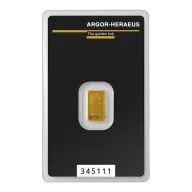
The obverse carries the Argor-Heraeus logo, a stylised AH monogram within a double circle with "Argor-Heraeus SA" around the ring and "Switzerland" below, followed by the weight, metal type, and purity arranged vertically, plus the serial number and sworn assayer mark. The reverse of minted Classic bars is left intentionally blank. The minimal design is deliberate: no allegorical figures or decorative motifs, which keeps production cost down and the authentication marks legible. A year of manufacture stamp has appeared on all Argor-Heraeus bars since 1988.
At this size the assay card does much of the work. A sealed card from an LBMA-accredited refiner provides chain-of-custody assurance, and breaking the seal reduces resale value because the bar may then need re-assaying. Buyers should keep the card intact and store it flat, since the packaging is more fragile than the bar inside it.
Tax Position of a 1g Investment Gold Bar
At 999.9 fine, the bar comfortably exceeds the investment-gold purity thresholds that drive favourable treatment in most jurisdictions. The bar is not legal tender and has no face value, so it never qualifies for coin-specific exemptions.
- United Kingdom: VAT-exempt as investment gold (the threshold is 995 fineness). Gains on disposal are within the scope of capital gains tax, unlike UK legal tender coins, though at this bar's price point any single disposal is unlikely to trouble the £3,000 annual CGT allowance.
- European Union and Switzerland: VAT-exempt as investment gold under the same purity rules.
- United States: sales tax depends on the buyer's state; several states apply thresholds (for example, Florida exempts bullion only above $500) that a single 1g bar will typically fall below, so small-bar buyers in threshold states can pay tax that a 1 oz purchase would avoid. The purity meets the IRA minimum for gold of 99.5%, though tiny bars are an impractical IRA holding.
- Canada, Australia, New Zealand: exempt from GST/HST and GST respectively, as gold refined to at least 99.5% purity.
- Singapore and Hong Kong: Singapore exempts qualifying investment precious metals from GST; Hong Kong has no sales tax on bullion.
Seven Decades of Swiss Refining Behind the Classic Line
Argor SA was founded in 1951 in Chiasso, in the Swiss canton of Ticino. Union Bank of Switzerland took full ownership in 1973, and the company gained its current name in 1986 through a joint venture with Heraeus Holding GmbH of Hanau, Germany. The refinery moved to a purpose-built facility in Mendrisio in 1988. Ownership over the following decades passed among Heraeus, Commerzbank, the Austrian Mint, and company management before Heraeus completed full acquisition on 13 July 2017, making Argor-Heraeus SA a wholly owned subsidiary.
The Classic line represents the company's foundational bar output, the core minted and cast ingots that preceded the Kinebar, launched in 1994 with kinegram holographic security, and all later specialty ranges. The Classic name distinguishes these plain bars from those lines in catalogues and secondary-market listings. The accreditation record is long: LBMA Good Delivery for gold since 1961 and silver since 1992, LPPM Good Delivery for platinum and palladium, COMEX accreditation since 1974, TOCOM since 1982, and DMCC since 2005. The serial-numbering scheme for the company's 400 oz Good Delivery cast bars has run continuously and unchanged since 1952, a small detail that illustrates how stable the operation behind even the smallest retail bar has been.
Argor-Heraeus vs PAMP and Valcambi at One Gram
The 1g gold market is dominated by the Swiss refiners, whose sealed assay cards are the global standard for the format. The most recognised competitor is the 1g PAMP Suisse Fortuna, with its Lady Fortuna design; PAMP bars command a modest premium over plainer refiner bars on the strength of that brand recognition. The Argor-Heraeus Classic takes the opposite approach, with a deliberately minimal logo-and-numerals obverse and a blank reverse, which keeps its premium positioning closer to generic Swiss bars while retaining full LBMA pedigree.
Valcambi offers a different angle on small gold with the CombiBar, a perforated sheet of fifty 1g segments that snap apart individually. The per-gram premium on a CombiBar is lower than buying 1g bars separately, so a buyer who specifically wants many gram-sized pieces gets better value there, at the cost of segments lacking individual assay cards once detached.
On resale, all three names are equally workable: recognised-brand 1g bars in sealed assay cards are accepted by dealers, while unbranded or opened-card bars have poor resale prospects. None of the three differs in tax treatment, since all are 999.9 fine investment gold. The honest comparison is upward in weight rather than across brands: a buyer accumulating gold gives up roughly 8 to 15% in premium at 1g against low single digits for a 1 oz gold bar, a penalty no brand choice can offset.
1g Classic Gold Bar: frequently asked questions
-
The cheapest 1g Argor-Heraeus Classic gold bar listed here is $186.69, from ITM Trading. That price includes a premium of around 39.3% over the $4,176.20 gold spot price. Small bars carry higher per-gram premiums than larger sizes, so the cost per gram here is substantially above what a 100g bar would cost per gram.
-
The Argor-Heraeus Classic 1g bar contains exactly 1g of 999.9 fine gold (24 carat). It is a minted bar produced by Argor-Heraeus at their Mendrisio, Switzerland facility, and ships in a numbered tamper-evident assay card confirming weight and purity.
-
Argor-Heraeus SA is a Swiss precious metals refinery founded in 1951, headquartered in Mendrisio in the Swiss canton of Ticino. The company has held LBMA Good Delivery status for gold since 1961. Since 2017 it has been a wholly owned subsidiary of Heraeus Holding GmbH, based in Hanau, Germany. All Classic bars are produced at the Mendrisio facility.
-
A 1g bar lets you own a small amount of physical gold, but the per-gram premium is considerably higher than on larger bars because packaging, assaying, and handling costs are spread over far less metal. Buyers who prioritise cost efficiency typically find that 10g, 50g, or 100g bars offer a noticeably lower premium per gram. The 1g format suits gifts or collectors more than bulk accumulation.