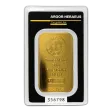
1 listing
Filters
| Product | /oz | Premium | Price | |
|---|---|---|---|---|

 BullionMart
|
$4,189.02 | +0.11% |
$6,734.18
CA$9,530
|
View Deal |
Prices are fetched automatically and may not reflect current merchant prices. Currency conversions and tax treatment are approximate. Rankings are based solely on price. We are not a dealer and accept no responsibility for transactions with listed merchants. Past performance is not indicative of future results. This site does not provide investment advice. Full disclaimer
About the 50g Classic Gold Bar
The 50g Argor-Heraeus Classic Gold Bar
The 50 gram Classic contains 1.6075 troy ounces of 999.9 fine gold and sits at the point where the gold premium curve flattens. Typical 50g bar premiums of 3-6% over spot represent a sharp drop from the 8-12% common on 10g bars, because at this size fixed manufacturing costs become a small fraction of the metal value. Several dealers describe 50g as the sweet spot of the metric range: most of the premium efficiency of a 100g bar at roughly half the outlay, which lands around $5,000-$5,500 at current gold prices.
The refiner is the other half of the case. Argor-Heraeus has held LBMA Good Delivery accreditation for gold since 1961, is COMEX-accredited since 1974, and serves as one of only seven global LBMA Referees, the panel that audits other refiners' Good Delivery compliance. Its Mendrisio refinery in the Swiss canton of Ticino runs roughly 400 tonnes of annual gold capacity, the same tier as PAMP and Valcambi. The Classic is the company's standard investment line, produced in both cast and minted formats at 50g, with every bar individually serial-numbered and certified by a sworn assayer.
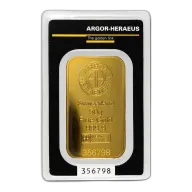
The design is deliberately bare: logo, weight, purity, serial number, blank reverse. That minimalism is a feature, keeping production costs and therefore premiums down. Buyers weighing this size against neighbours on the metric ladder can compare all 50g gold bars, or look at the broader field of gold bars.
50g Classic Gold Bar Specifications
| Attribute | Detail |
|---|---|
| Gold weight | 50 g (1.6075 troy oz) |
| Purity | 999.9 fine gold (24 carat) |
| Formats | Cast and minted versions both produced at 50g |
| Serial number | Individual, certified by an Argor-Heraeus sworn assayer |
| Packaging | Minted bars in a numbered tamper-evident assay card; cast bars with a numbered assay certificate |
| Face value | None; not legal tender |
A 50g gold bar is compact, approximately 44mm x 24mm x 3.5mm, with the assay card bringing minted versions up to roughly credit-card dimensions. Store carded bars flat to prevent bending, and keep seals intact: bars outside their original assay packaging may need re-assaying before resale.
The obverse carries the Argor-Heraeus AH monogram within a double circle, with weight, metal and purity in vertical arrangement plus the serial number and assayer mark; the reverse of minted Classic bars is intentionally blank. A year of manufacture stamp has appeared on all Argor-Heraeus bars since 1988. The 50g weight sits mid-ladder in a gold Classic range that runs from 1g minted bars to the 400 oz LBMA Good Delivery cast bar, with the 1 oz Classic gold bar the most traded of the smaller sizes.
Tax Treatment of the 50g Classic Bar
At 999.9 fineness the bar qualifies as investment gold in every major jurisdiction, so the purchase side is clean almost everywhere; the differences appear at sale.
- UK: VAT exempt as investment gold (995+ fineness), but CGT applies on disposal since bars are not legal tender coins. Gains above the £3,000 annual allowance are taxed at 18-24%. A single 50g bar's value makes this a live consideration rather than a technicality.
- EU and Switzerland: 0% VAT as investment gold. Germany adds a notable wrinkle: gains on bullion held over one year are tax-free, which suits a core accumulation weight popular in the German market.
- US: Most states exempt bullion from sales tax, some with thresholds that a $5,000+ bar comfortably clears. Long-term gains are taxed at the 28% collectibles rate. IRA-eligible at 99.5%+ purity from an accredited refiner held at an approved depository; Argor-Heraeus bars qualify.
- Canada: 0% GST/HST at 99.5%+ purity.
- Australia and New Zealand: GST-free as investment-grade gold at 99.5%+ purity.
- Singapore and Hong Kong: Exempt under Singapore's IPM scheme; no sales tax at all in Hong Kong, and no capital gains tax in either.
Seven Decades of the Classic Line
The Classic range is the foundational output of a refinery that has operated continuously since 1951, when Argor SA was established in Chiasso, Ticino. The company earned LBMA Good Delivery status for gold a decade later, in 1961, and passed into full Union Bank of Switzerland ownership in 1973. The 1986 joint venture with Heraeus Holding GmbH of Hanau created the Argor-Heraeus name, and the refinery moved into a purpose-built Mendrisio facility in 1988, the same year a manufacture-year stamp was added to every bar.
Ownership rotated among Heraeus, Commerzbank, the Austrian Mint and management after UBS exited in 1999, until Heraeus completed a full acquisition on 13 July 2017, making Argor-Heraeus a wholly owned subsidiary. Through all of it the Classic bars kept their role as the company's core ingots, the line that preceded the Kinebar (launched 1994 with its kinegram holographic security) and the later Lunar Calendar, Origin Traced and Small Craft specialty products. The serial-numbering scheme on the company's 400 oz Good Delivery bars has run unchanged since 1952.
Two institutional credentials frame the line's standing today. Argor-Heraeus has been one of the seven LBMA Referees since the panel was constituted in 2003, auditing other refiners' Good Delivery compliance, and its accreditations span COMEX (1974), TOCOM (1982) and DMCC (2005). The 50g Classic is, in effect, a small slice of Good Delivery infrastructure sold at retail.
50g Classic vs PAMP, Valcambi and the 1 oz Step Down
Within the 50g weight class, every major LBMA-accredited refiner competes: PAMP Suisse with its 50g Fortuna, Valcambi, Heraeus, Perth Mint and the Royal Mint all produce the size as minted bars in assay cards. The 50g PAMP Suisse Fortuna carries a modest brand premium for its Lady Fortuna design, while Valcambi and Argor-Heraeus typically fight over the lowest-premium slot among the Swiss names. The metal and the accreditation are equivalent across all of them; on a blank-reverse bar like the Classic, the deciding factor is usually simply the premium on the day.
The more interesting comparison is vertical. Against a 1 oz bar, the 50g costs roughly 60% more but contains 1.6 times the gold at a comparable or slightly lower premium per gram, so buyers who can fund the larger outlay get marginally more efficiency. Against 100g bars at 2-4% premiums, the 50g gives up perhaps 1-2 percentage points, a small price for halving the unit size; investors who cannot stretch to 100g capture most of the benefit here. The genuine cost of choosing 50g over smaller units is divisibility: one bar is one sale, where the same money in 1 oz bars can be liquidated in stages.
Regionally the format is strongest in Germany, Switzerland and Austria, where metric gold is the default and 50g is a core accumulation weight, and it is a traditional savings denomination in Middle Eastern gold markets. American buyers trade it less, since troy-ounce bars dominate US retail, which is worth remembering if the bar will eventually be sold there.
50g Classic Gold Bar: frequently asked questions
-
The cheapest 50g Argor-Heraeus Classic gold bar we track is $6,734.18 from BullionMart, closely tracking $4,176.20 gold spot for 50 grams. As a 999.9 fine gold bar from an LBMA Good Delivery-accredited Swiss refinery, its value is driven almost entirely by gold content, with a small brand and assay-card premium over unbranded alternatives.
-
We currently track 1 dealer listing the 50g Argor-Heraeus Classic, with BullionMart offering the best price at $6,734.18. Use the comparison table above to see all available dealers ranked by price, including any spread over gold spot.
-
The Argor-Heraeus Classic 50g bar is 999.9 fine gold, produced at Argor-Heraeus SA's Mendrisio, Switzerland facility. Each bar carries an individual serial number, a sworn assayer's mark, and ships sealed in a numbered tamper-evident assay card (blistercard). The Classic range uses a deliberately minimal design, with weight, purity, and the Argor-Heraeus logo on the obverse and a blank reverse.