1 listing
Filters
| Product | /oz | Premium | Price | |
|---|---|---|---|---|

 Ainslie Bullion
|
$4,460.55 | +2.55% |
$143,408.52
A$201,417
|
View Deal |
Prices are fetched automatically and may not reflect current merchant prices. Currency conversions and tax treatment are approximate. Rankings are based solely on price. We are not a dealer and accept no responsibility for transactions with listed merchants. Past performance is not indicative of future results. This site does not provide investment advice. Full disclaimer
About the 1 Kilo Ainslie Gold Bar
The 1 Kilo Ainslie Gold Bar
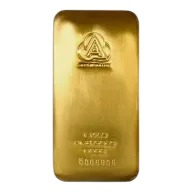
The 1 kilo Ainslie gold bar contains 1,000 grams of 999.9 fine gold, equal to 32.1507 troy ounces. The kilogram is the standard metric bullion weight, and at this size gold bars carry premiums of around 1-2% over spot, making the kilo bar the most premium-efficient retail gold format available. Buyers at this weight are optimising for the lowest cost per gram rather than flexibility, and the saving is real: a $100,000 allocation in bars rather than coins can save $2,000-4,000 in premiums.
The trade-off is divisibility. A kilo bar is an all-or-nothing sale; partial liquidation is not possible, so an investor who may need to raise smaller amounts of cash is better served holding several smaller units. The buyer pool at this price point is also narrower than for 1oz gold bars, though institutional buyers and refiners readily accept large bars.
Gold's density of 19.32 g/cm3 means a kilo bar is roughly the size of a small smartphone, which makes it easy to store and gives it the most compact value-to-space ratio of any gold form. Like all gold bars, it is not legal tender and carries no face value. One handling note for bars of this size: do not store multiple kilo bars loose together, because gold is soft enough that surface scratches can reduce resale appeal.
1 Kilo Ainslie Gold Bar Specifications
| Specification | Detail |
|---|---|
| Weight | 1 kilogram (1,000 g / 32.1507 troy oz) |
| Purity | 999.9 fine gold (four nines) |
| Form | Rectangular bar |
| Face value | None (bars are not legal tender) |
999.9 is the standard purity for retail gold bars, comfortably above the LBMA Good Delivery minimum of 995. Gold bars are made by one of two methods: cast bars are poured from molten gold into moulds, with a rougher finish and lower premiums, and minted bars are cut from rolled gold sheet, polished, and often sealed in assay card packaging at a higher premium. Retail bars typically come sealed in tamper-evident assay cards containing a certificate of authenticity with the bar's serial number, weight, purity, and refiner's hallmark.
Authentication deserves attention at this size. Tungsten's density (19.25 g/cm3) sits close enough to gold's (19.32 g/cm3) that a gold-plated tungsten bar can pass weight and dimension checks, a risk most relevant for bars of 100g and above. Ultrasonic testing is the most reliable non-destructive check, since gold's sound velocity (3,240 m/s) differs substantially from tungsten's (5,170 m/s). For retail buyers, purchasing from authorised dealers and keeping the bar in its sealed assay card eliminates the practical risk, and breaking the seal can reduce resale value because the bar may then need re-assaying.
1 Kilo Gold Bar Tax Treatment by Country
At 999.9 fine, this bar clears the purity thresholds for investment-gold treatment in every major jurisdiction.
- Australia: Investment-grade gold of 99.5%+ purity in a form commonly traded on commodity markets is GST-free. Numismatic and collector coins attract 10% GST, but standard bullion bars do not. Bullion held as an investment is subject to CGT, with a 50% CGT discount for individuals holding longer than 12 months.
- UK: Investment gold of 995+ fineness is VAT-exempt. Bars are not CGT-exempt, however; only UK legal tender coins enjoy that exemption. Gains above the GBP 3,000 annual allowance are taxed at 18-24% depending on income.
- US: Sales tax is state-dependent, with around 35 states exempting bullion. Long-term capital gains are taxed at the 28% collectibles rate. IRA eligibility requires gold of 99.5%+ purity from an LBMA/COMEX/NYMEX-accredited refiner, held at an IRS-approved depository, so check the refiner's accreditation before buying for an IRA.
- Canada: Gold refined to 99.5%+ purity in bar form is GST/HST-exempt federally.
- New Zealand: Gold of 99.5%+ purity in bar form is GST-exempt.
- EU: Investment gold bars of 995+ fineness are VAT-exempt across all member states. Capital gains rules vary by country; Germany taxes nothing on bars held over 12 months.
- Singapore: The Investment Precious Metals scheme exempts gold of 99.5%+ purity in bar form from GST, and Singapore levies no capital gains tax.
- Hong Kong: No sales tax, no import duty, no capital gains tax.
Ainslie Kilo Bar vs PAMP Suisse, Perth Mint, and Other Kilo Bars
The kilo gold bar market is dominated by LBMA-accredited refiners: PAMP Suisse, Valcambi, Argor-Heraeus, Heraeus, Metalor, Perth Mint, and the Royal Canadian Mint all produce kilo bars to Good Delivery purity standards. Bars from these refiners are interchangeable globally and can be sold to any dealer in any country, which is the main yardstick to weigh any kilo bar against.
The PAMP Suisse kilo gold bar is the brand-recognition benchmark. PAMP's Fortuna design commands a modest premium over generic refiner bars, and PAMP bars include VeriScan authentication technology. A buyer paying that brand premium is buying easier resale recognition rather than more gold.
The Perth Mint kilo gold bar offers something different: government backing from the Western Australian Government, plus LBMA accreditation. For Australian buyers comparing domestic options, that sovereign guarantee is the Perth Mint's distinguishing feature.
Argor-Heraeus bars, LBMA-accredited since 1961, add kinebar holographic security, an anti-counterfeiting measure worth noting at the kilo size where the tungsten-substitution risk is most relevant.
Against all of these, the practical questions for the Ainslie bar are price per gram and resale recognition. Premium scales inversely with bar size, so at one kilo the percentage gap between brands is small in absolute terms, but bars from refiners without universal recognition can be harder to sell internationally and may require assay testing at the buyer's expense before resale. Compare the live dealer prices on this page against the branded alternatives and decide whether the spread justifies the difference in resale convenience. Whichever bar wins on price, the same rule applies: keep it in its sealed assay card, because an intact seal preserves the chain of custody that smooths resale.
1 Kilo Ainslie Gold Bar: frequently asked questions
-
The Ainslie 1kg gold bar contains 1 Kilo of 999.9 fine gold, so its value tracks the gold spot price closely. The cheapest listing tracked today is $143,408.52. Because the bar is a larger denomination, fabrication costs are spread across more metal, which typically keeps the premium modest relative to smaller bars.
-
1 dealer on BullionFerret currently lists the Ainslie 1kg gold bar. The cheapest price today is $143,408.52 from Ainslie Bullion. Use the comparison table above to see the full spread and check each dealer's stock status before purchasing.
-
Reputable gold bars are typically sold with documentation such as an assay certificate or serial number; check any accompanying paperwork against the bar's markings and confirm the 999.9 fineness mark is present. For high-value bars, an XRF (X-ray fluorescence) assay by a professional bullion dealer or refiner is the most reliable method of independent verification.