 Kitco
Kitco
1 listing
Filters
| Product | /oz | Premium | Price | |
|---|---|---|---|---|
| $4,289.81 | +0.79% | $137,920.56 | View Deal |

Prices are fetched automatically and may not reflect current merchant prices. Currency conversions and tax treatment are approximate. Rankings are based solely on price. We are not a dealer and accept no responsibility for transactions with listed merchants. Past performance is not indicative of future results. This site does not provide investment advice. Full disclaimer
About the 1 Kilo Engelhard Gold Bar
A Collector-Grade Kilo Bar from America's Historic Refiner
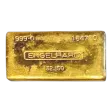
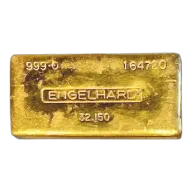
The 1 Kilo Engelhard Gold Bar is a product of Engelhard Industries, the American precious metals refiner founded by Charles W. Engelhard Sr. in 1902. By the 1950s, Engelhard was the world's largest precious metals smelter, processing gold for the US Treasury and operating refineries across multiple continents. The company exited the retail bullion market in the late 1980s and was ultimately acquired by BASF in 2006 for $5 billion.
Engelhard bars are no longer produced. Every bar on the market today is from existing inventory, which has been diminishing since production ceased. The brand carries significant collector recognition, particularly in the United States, and vintage Engelhard bars routinely trade above spot price. The company's silver bars are the most actively collected, with AllEngelhard.com documenting over 40 distinct 1oz varieties, but gold bars from the same era share the provenance premium.
For a kilo gold bar worth well over $100,000 in metal content alone, the collector premium on an Engelhard bar is proportionally smaller than on the company's smaller silver products, since the base value is so high. The practical question for buyers is whether the Engelhard name and discontinued status add enough value to justify paying more than the cost of a current-production bar from PAMP Suisse or Metalor.
Charles Engelhard Jr., who consolidated the family holdings into Engelhard Industries in 1958, is widely cited as the inspiration for Ian Fleming's James Bond villain Auric Goldfinger. The company also has the distinction of pioneering retail silver bar production during the late 1960s and 1970s, a period that included the Hunt Brothers silver spike of 1979 to 1980.
1 Kilo Engelhard Gold Bar Details
| Attribute | Detail |
|---|---|
| Weight | 1,000 grams (32.1507 troy ounces) |
| Purity | 999.9 fine gold (24 karat) |
| Manufacturer | Engelhard Industries (defunct, acquired by BASF 2006) |
| Country of origin | United States (Newark, New Jersey) |
| Production status | Discontinued (production ceased late 1980s) |
| Serial number | Yes |
| Legal tender | No (bar, not coin) |
Authentication Considerations
Engelhard bars are among the most counterfeited precious metals products globally. The 100oz silver size is the most targeted, but all larger formats warrant careful verification. For kilo gold bars, the tungsten-core counterfeiting risk is particularly relevant: tungsten's density (19.25 g/cm3) is close enough to gold's (19.32 g/cm3) that a gold-plated tungsten bar can pass weight and dimension checks. XRF analysis only penetrates 10 to 50 microns of surface, so a sufficiently thick gold shell will read as pure on XRF testing.
Ultrasonic testing is the most reliable non-destructive verification method for bars of this size. Gold's sound velocity (3,240 m/s) differs substantially from tungsten's (5,170 m/s), immediately revealing any core substitution. Genuine Engelhard bars show era-specific die markings, consistent font spacing, and correct serial number formats documented by the AllEngelhard collector reference. Purchasing from established dealers with authentication procedures is strongly recommended for vintage bars at this value level.
Tax Treatment of Engelhard Gold Bars
Engelhard gold bars at 999.9 purity receive the same investment gold tax treatment as bars from any other manufacturer. The discontinued status does not affect tax classification.
United States (Primary Market)
State sales tax varies, with approximately 35 states exempting bullion entirely. Capital gains taxed at up to 28% (collectibles rate) for holdings over one year. The 999.9 purity meets IRS requirements for precious metals IRA inclusion (minimum 99.5%), though IRA eligibility for specific vintage bars may depend on the custodian's approved list and authentication requirements. Engelhard bars have a strong secondary market in the US, where most were originally produced and sold.
United Kingdom
VAT-exempt as investment gold (995+ purity). Subject to CGT on disposal (not legal tender). Annual exempt amount of £3,000. SIPP eligible when held by an approved custodian.
Canada and Australia
GST/HST-exempt in Canada at 99.5%+ purity. Capital gains at a 50% inclusion rate. GST-free in Australia for investment-grade gold at 99.5%+ purity.
Singapore and Hong Kong
Singapore exempts investment gold from GST at 99.5%+ purity. Hong Kong has no sales tax, import duty, or capital gains tax.
Engelhard: From Newark Smelter to Bond Villain Inspiration
Charles W. Engelhard Sr. built his precious metals business by acquiring existing refining operations. In 1902 he purchased the Charles F. Croselmire Company in Newark, New Jersey. In 1904 he added Baker & Co., a platinum smelter also in Newark, and in 1905 established Hanovia Chemical and Manufacturing Company. These acquisitions made Engelhard a vertically integrated precious metals operation spanning refining, fabrication, and industrial applications.
His son, Charles Engelhard Jr., consolidated the family holdings into Engelhard Industries, Inc. in 1958 and listed the company on the New York Stock Exchange. The younger Engelhard became one of the wealthiest men in America and a prominent political figure, known for hosting lavish parties at his estates and maintaining close relationships with presidents. His passion for gold, combined with his flamboyant lifestyle, made him the widely cited inspiration for Ian Fleming's Auric Goldfinger.
By the 1950s, Engelhard was the world's largest precious metals smelter. The company processed gold for the US Treasury and was involved in refining South African gold during the apartheid era. Retail silver bar production began in the late 1960s and continued through approximately 1986, spanning the tumultuous Hunt Brothers silver manipulation of 1979 to 1980, when silver prices briefly touched $50 per ounce. A significant number of Engelhard silver bars were melted during that spike, making surviving bars rarer than original production numbers suggest.
Engelhard exited retail bullion in the late 1980s to focus on industrial catalysts and materials technology. BASF's hostile acquisition in 2006 ended the Engelhard name as an independent corporate entity. The company was renamed BASF Catalysts LLC on 1 August 2006. No new Engelhard-branded bullion has been produced since.
1 Kilo Engelhard Gold Bar: frequently asked questions
-
The cheapest 1 kilo Engelhard gold bar listed on our comparison is $137,920.56, which is about 0.8% over the $4,254.30 gold spot price for 1 Kilo of gold. Vintage Engelhard bars often trade at a premium to spot due to collector demand, so prices can vary more than for modern bars.
-
Engelhard was a major US precious metals refiner that is no longer in operation as an independent company. No new Engelhard bars have been produced for decades, meaning all bars in circulation today are vintage secondary-market pieces.
-
Vintage Engelhard bars frequently command a collector premium above the standard gold spot premium. Their scarcity (no new production) and strong brand recognition in the US market drive demand beyond raw metal value. The size of that collector premium varies with condition, serial-number style, and current market sentiment.
-
Engelhard bars carry serial numbers that vary by era and format; cross-referencing the number against known authentic examples from specialist resources is a common starting point. Beyond the serial number, buyers typically check weight, dimensions, and purity stamp, and use an ultrasonic or XRF test for high-value purchases. A reputable dealer's assay or a third-party grading service provides the most reliable verification.
-
Tax obligations depend on your country. In the UK, gains above the £3,000 annual exemption are taxed at 18% or 24% depending on your income tax band. In the US, physical gold is taxed as a collectible at up to 28% on long-term gains. In Canada, 50% of any capital gain is included in taxable income. Reporting rules also vary, so checking with a local tax adviser is recommended for a purchase of this size.