 Go Gold
1 listing
Filters
| Product | /oz | Premium | Price | |
|---|---|---|---|---|
| $4,453.09 | +3.57% |
$143,173.61
NZ$250,711
|
View Deal |

Prices are fetched automatically and may not reflect current merchant prices. Currency conversions and tax treatment are approximate. Rankings are based solely on price. We are not a dealer and accept no responsibility for transactions with listed merchants. Past performance is not indicative of future results. This site does not provide investment advice. Full disclaimer
About the 1 Kilo Go Gold Bar
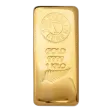
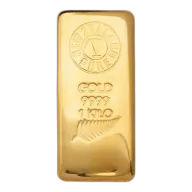
The 1 Kilo Go Gold Bar
A kilogram of 999.9 fine gold is 32.1507 troy ounces in a single piece, and at current prices it represents roughly $100,000 or more of metal. This is the most premium-efficient retail gold format there is: kilo gold bars typically trade at just 1 to 2 percent over spot, against 2 to 4 percent for minted 1 oz bars and more again for coins. Buyers at this weight are optimising for the lowest possible cost per gram, not for flexibility.
The kilo is the standard metric bullion weight and is particularly prevalent in Asian markets. In Singapore, Hong Kong and mainland China the kilo is the standard retail gold bar, and kilobars trade on the Shanghai Gold Exchange and through the Singapore Bullion Market Association. European buyers also work in metric weights, while the UK and North America lean towards troy-ounce denominations for retail purchases, with kilo gold more common among institutional buyers there.
The trade-off is divisibility. A kilo bar is an all-or-nothing sale; there is no way to liquidate part of the position, which is why investors who may need to raise smaller amounts of cash often prefer to hold the same weight as multiple 1 oz gold bars or 100g bars despite the higher aggregate premium. For a single large allocation that will be bought and sold whole, the kilo bar is hard to beat on cost.
1 Kilo Go Gold Bar Specifications
| Attribute | Detail |
|---|---|
| Metal | Gold |
| Weight | 1 kilogram (1,000 g / 32.1507 troy oz) |
| Purity | 999.9 fine (24 carat) |
| Form | Bar |
| Legal tender | No face value; bars are not legal tender |
Gold's density of 19.32 g/cm3 makes a kilo bar surprisingly small for its value, roughly the size of a small smartphone. Storage is correspondingly simple, though large bars should not be stored loose together: gold is soft, and surface scratches reduce resale appeal.
One authentication point is specific to large gold bars. Tungsten's density (19.25 g/cm3) is close enough to gold's that a plated tungsten core can pass weight and dimension checks, and XRF testing only reads the surface. Ultrasonic testing is the reliable non-destructive check for bars of this size, and buying sealed bars from authorised dealers avoids the issue entirely.
Tax Treatment of the 1 Kilo Go Gold Bar
At 999.9 fine, the bar qualifies as investment gold in every jurisdiction that applies a purity test, but on a purchase of this size the capital gains rules deserve as much attention as the sales tax.
- UK: 0% VAT, since bars of 995+ fineness are investment gold. Bars are not CGT-exempt though, and on a six-figure position the eventual gain will dwarf the £3,000 annual allowance; CGT at 10 or 20 percent applies to the excess. UK buyers comparing against CGT-free Britannia coins should price that in.
- EU: 0% VAT across all member states. Germany taxes no gain on bullion held over 12 months, which combined with the kilo bar's low premium makes it especially cost-efficient for German holders.
- US: State sales tax varies, with most states exempting bullion; threshold states such as California ($2,000) are comfortably cleared at this value. Long-term gains are taxed at the 28 percent collectibles rate. IRA eligibility requires 99.5 percent purity plus an accredited refiner and approved depository.
- Canada: 0% GST/HST at 99.5 percent purity or better.
- Australia and New Zealand: 0% GST for investment-grade gold of 99.5 percent purity or better.
- Singapore and Hong Kong: No GST or sales tax on investment gold and no capital gains tax, which is part of why the kilo format dominates Asian trading.
Kilo Bars vs Smaller Bars and Branded Kilo Alternatives
The kilo gold bar's natural rivals are the LBMA-accredited kilo bars from PAMP Suisse, Valcambi, Argor-Heraeus, Heraeus, Metalor, Perth Mint and the Royal Canadian Mint. Bars from those refiners are effectively interchangeable globally and can be sold to any dealer in any country, which is the benchmark any kilo bar should be judged against. Bars from refiners without that recognition may need assay verification before a dealer will pay full value, so the discount on a lesser-known bar needs to be weighed against potential resale friction.
Against smaller formats, the arithmetic is straightforward. A 1 kilo PAMP Suisse bar or any other kilo bar carries a 1 to 2 percent premium, while building the same kilogram from thirty-two 1 oz bars costs 2 to 4 percent each, and doing it with coins costs more again. Over a $100,000 allocation, the difference between bars and coins can run to $2,000 to $4,000 in premiums. The counterweight is exit flexibility: thirty-two separate ounces can be sold in any increment, a kilo bar cannot.
The 100 oz format does not exist in gold retail the way it does in silver; for gold, the step beyond the kilo is the 400 oz Good Delivery bar, which is institutional territory. For most large private buyers, the practical choice is between one kilo bar at the lowest premium or a stack of 100g and 1 oz bars that trades a little more cost for a lot more flexibility.
1 Kilo Go Gold Bar: frequently asked questions
-
The Go Gold 1 kg bar currently lists from $143,173.61 across tracked dealers, sitting at 3.6% over the $4,408.10 gold spot price for one kilogram. The comparison table updates continuously, so the figure shown reflects live pricing from each dealer.
-
The current premium on the cheapest listing is 3.6% over spot. Go Gold is the lowest-priced option among the 1 dealer we track. Premiums on kilogram bars tend to be lower in percentage terms than smaller weights, because production and distribution costs are spread across more gold.
-
A reputable dealer will supply an assay certificate confirming the bar's weight and purity, along with a unique serial number engraved on the bar itself. For additional confidence, an independent XRF (X-ray fluorescence) test can verify metal content non-destructively. Buying from an established, accredited dealer reduces the risk of encountering counterfeits at the outset.
-
A 1 kg gold bar contains 1,000 grams, which is 32.15 troy ounces, of 999.9 fine gold. Exact physical dimensions vary by refiner, so the Go Gold bar's measurements may differ from other kilogram bars on the market.