1 listing
Filters
| Product | /oz | Premium | Price | |
|---|---|---|---|---|

 Gold Stackers
|
$4,461.49 | +2.57% |
$143,440.51
A$201,462
|
View Deal |
Prices are fetched automatically and may not reflect current merchant prices. Currency conversions and tax treatment are approximate. Rankings are based solely on price. We are not a dealer and accept no responsibility for transactions with listed merchants. Past performance is not indicative of future results. This site does not provide investment advice. Full disclaimer
About the 1 Kilo Gold Bullion Australia Gold Bar
The 1 Kilo Gold Bullion Australia Gold Bar
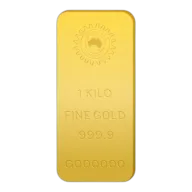
The 1 kilo Gold Bullion Australia gold bar contains 1,000 grams of 999.9 fine gold, equal to 32.1507 troy ounces. The kilo is the standard metric bullion weight and the most premium-efficient retail gold format: kilo gold bars typically trade at just 1-2% over spot, against 1-4% for 1 oz minted bars and 15-25% for 1g bars. On a six-figure allocation, choosing kilo bars over coins can save $2,000-$4,000 in premiums alone. That arithmetic is the whole reason this format exists at the retail level.
A kilo bar buyer is optimising for the lowest cost per gram, not flexibility. Each bar is an all-or-nothing sale, so an investor who may need to raise smaller amounts of cash is usually better served holding 1 oz gold bars or coins despite the higher premium. At roughly $100,000+ per bar at current prices, the format sits firmly in high-net-worth and institutional territory.
Where the bar comes from matters at this size. All major LBMA-accredited refiners produce kilo bars and those bars are interchangeable globally, sellable to any dealer in any country. Bars from refiners outside that circle remain real gold but have lower liquidity and may need assay testing at the buyer's expense before resale. For a bar carrying this much value, that verification cost and the width of the buy-sell spread should be weighed alongside the headline price when comparing dealers.
Kilo Gold Bar Specifications
| Attribute | Detail |
|---|---|
| Weight | 1 kilogram (32.1507 troy oz) |
| Metal | Gold |
| Purity | 999.9 fine (99.99%) |
| Form | Bar |
The 999.9 purity is the four-nines retail standard for gold bars, comfortably above the LBMA Good Delivery minimum of 995. A kilo of gold is extremely dense (19.32 g/cm3) and roughly the size of a small smartphone, giving bars the most compact value-to-space ratio of any gold form. Gold is soft, so kilo bars should not be stored loose together; surface scratches reduce resale appeal.
Authentication deserves real attention at this weight. Gold bars face the tungsten-core risk that coins largely avoid: tungsten's density (19.25 g/cm3) is close enough to gold's that a plated bar can pass weight and dimension checks, and XRF surface testing only penetrates 10-50 microns. Ultrasonic testing is the most reliable non-destructive method, since gold's sound velocity (3,240 m/s) differs sharply from tungsten's (5,170 m/s). The practical defence is simpler: buy from authorised dealers, keep the bar in its sealed packaging, and for bars of 250g and up request ultrasonic verification.
Tax Treatment of Kilo Gold Bars by Country
Investment gold is the most tax-favoured metal almost everywhere, and a 999.9 fine kilo bar qualifies in every major jurisdiction.
- UK: 0% VAT (investment gold at 995+ fineness). Bars are not CGT-exempt, however; only UK legal tender coins are. Gains above the £3,000 annual allowance are taxed at 18-24%, and on a bar worth $100,000+ that liability can dwarf the premium saved at purchase. Gold bullion is SIPP-eligible.
- US: No federal sales tax; most states exempt bullion, and several threshold states (California over $2,000, New York over $1,000) easily clear at this value. Long-term gains taxed at the collectibles rate of up to 28%. At 99.5%+ purity from an accredited refiner, kilo bars can be held in a self-directed IRA via an approved depository.
- Canada: 0% GST/HST at 99.5%+ purity.
- EU: 0% VAT under the Investment Gold Directive (bars at 995+ fineness). CGT varies by country; Germany taxes nothing after a 12-month hold.
- Australia: 0% GST for investment-grade gold at 99.5%+ purity. CGT applies with a 50% discount after 12 months.
- New Zealand: GST-exempt at 99.5%+ purity. No formal capital gains tax.
- Singapore and Hong Kong: No GST (Singapore IPM scheme) or sales tax (Hong Kong), and no capital gains tax in either. The kilo is the standard retail gold bar weight across Asian markets.
Kilo Bars vs Smaller Bars and Refiner Alternatives
The kilo bar competes on premium and loses on everything else, so the comparison is really about what you are willing to trade. Stepping down to 100g bars raises the premium to roughly 2-4%; 1 oz bars at 1-4% are the sweet spot for resale liquidity, accepted by dealers globally in sealed assay cards. The kilo bar's 1-2% premium is the floor of the retail market, but the buyer pool at a $100,000+ price point narrows to institutions, refiners, and dealers rather than retail stackers. Valcambi's CombiBar takes the opposite approach: a divisible grid that can be snapped into smaller segments for partial liquidation, at a higher cost per gram.
Against the established kilo bar producers, brand is the differentiator. PAMP Suisse, Valcambi, Argor-Heraeus, Heraeus, Metalor, Perth Mint, and the Royal Canadian Mint all produce LBMA-accredited kilo bars, and PAMP's Fortuna design commands a modest premium over generic refiner bars purely on recognition. A bar from a smaller name has to be cheaper at purchase to justify the wider spread and possible assay cost at sale.
The other comparison is bars versus coins. Sovereign gold coins carry higher premiums and stronger brand recognition, and in the UK legal tender coins add CGT exemption that no bar can match. In zero-CGT jurisdictions like Singapore and Hong Kong that advantage disappears, and the kilo bar's raw premium efficiency makes it the straightforward choice for large allocations.
1 Kilo Gold Bullion Australia Gold Bar: frequently asked questions
-
The lowest listed price for the 1kg Gold Bullion Australia gold bar on this page is $143,440.51. A one-kilogram bar holds approximately 32.15 troy ounces of 999.9 fine gold, so its value moves closely with the gold spot price of $4,408.10 multiplied by that weight.
-
A 1kg gold bar represents a significant sum, so storage deserves careful thought. A quality home safe, bolted to a floor or wall, provides a basic level of protection. Many buyers prefer third-party allocated vault storage, which typically includes insurance. If you store at home, check your home insurance policy explicitly covers bullion, as standard policies often exclude or cap precious metal coverage.
-
Start by checking the hallmark, weight declaration, and assay certificate that should accompany the bar. A density test (using water displacement) can rule out tungsten cores. XRF (X-ray fluorescence) testing, offered by many dealers and assayers, confirms purity non-destructively. For a bar at this value, professional verification before purchase is a reasonable precaution.