1 listing
Filters
| Product | /oz | Premium | Price | |
|---|---|---|---|---|

 BullionStar
|
$4,418.25 | +1.42% |
$142,051.70
S$181,599
|
View Deal |
Prices are fetched automatically and may not reflect current merchant prices. Currency conversions and tax treatment are approximate. Rankings are based solely on price. We are not a dealer and accept no responsibility for transactions with listed merchants. Past performance is not indicative of future results. This site does not provide investment advice. Full disclaimer
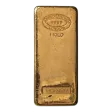
About the 1 Kilo Johnson Matthey Gold Bar
The Johnson Matthey 1 Kilo Gold Bar
The 1 Kilo Johnson Matthey gold bar contains 32.15 troy ounces of 999.9 fine gold from one of the most historically significant names in precious metals refining. Johnson Matthey, a British company founded in London in 1817, was an LBMA Good Delivery refiner for over a century and one of the five members of the London Gold Fix from 1919 until 2004. The company exited precious metals refining in 2015, selling its gold and silver refining operations in Salt Lake City and Brampton, Ontario to Asahi Refining.
Because Johnson Matthey bars are no longer produced, every piece available on the market is secondary-market inventory. This scarcity, combined with the JM brand's deep institutional reputation, means that Johnson Matthey kilo bars sometimes carry a modest premium above currently produced bars of equivalent weight and purity. The premium is not large, particularly at the kilo scale where buyers are overwhelmingly focused on metal content per dollar, but it exists and reflects collector and brand-loyalty demand.
The JM hallmark was one of the most trusted refiner stamps in the global bullion industry for nearly two centuries. Dealers worldwide recognise Johnson Matthey bars immediately, and their liquidity on the secondary market remains excellent. For buyers who view bullion ownership as partly about provenance and institutional heritage, the Johnson Matthey kilo bar carries a credibility that active refiner bars can match on quality but not on history.
1 Kilo Johnson Matthey Gold Bar Specifications
| Attribute | Value |
|---|---|
| Weight | 1 kilogram (1,000 grams / 32.1507 troy oz) |
| Purity | 999.9 fine gold (24 karat) |
| Manufacturer | Johnson Matthey (London, UK / Salt Lake City, USA / Brampton, Canada) |
| LBMA accredited | Was accredited (operations sold 2015) |
| Face value | None (not legal tender) |
| Serial number | Individually serialised |
| Packaging | Sealed assay card (original packaging, if intact) |
| Status | No longer produced; secondary market only |
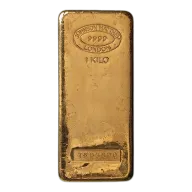
Johnson Matthey bars carry the JM hallmark, individual serial number, and stamped weight and purity markings. Bars still in their original sealed assay packaging command stronger resale prices than those with broken seals, as re-assaying may be required for unsealed bars. The quality of the JM hallmark and the precision of the stamping remain distinctive and immediately recognisable to experienced dealers.
The 999.9 purity meets all international thresholds for investment gold. Despite the company's exit from refining, the bars themselves are unchanged in composition and continue to be accepted by dealers globally as high-quality LBMA-standard product.
Tax Treatment of the 1 Kilo Johnson Matthey Gold Bar
The discontinued status of Johnson Matthey bars does not affect their tax treatment. The relevant factors are the 999.9 gold purity and the bar's origin from a formerly LBMA-accredited refiner.
Purchase Tax
- United Kingdom: VAT-free. Investment gold bars of 995+ fineness are exempt from 20% VAT regardless of the refiner's current operating status.
- United States: No federal sales tax. Most states exempt precious metals. All threshold-based state exemptions are cleared at the kilo price point.
- Canada: GST/HST exempt for gold of 99.5%+ purity. Johnson Matthey's Brampton facility produced many of the JM bars circulating in the Canadian market.
- Australia: GST-free for investment-grade gold (99.5%+ purity).
- European Union: VAT-exempt under the EU Investment Gold Directive for bars of 995+ fineness.
- Singapore: GST-exempt as an Investment Precious Metal (99.5%+ purity bars from recognised refiners).
- Hong Kong: No sales tax or import duty.
- New Zealand: GST-exempt for gold of 99.5%+ purity.
Capital Gains
Standard gold bar CGT rules apply. No legal tender status means no CGT exemptions. UK gains above GBP 3,000 taxed at 18-24%. US collectibles rate of 28% maximum on long-term gains. Germany: tax-free after 12 months holding. The discontinued status of the bar has no bearing on capital gains treatment.
IRA-eligible in the US and SIPP-eligible in the UK, subject to the standard purity and custodian requirements.
Johnson Matthey vs Other 1 Kilo Gold Bars
Comparing a discontinued bar to actively produced alternatives requires acknowledging the fundamental difference: Johnson Matthey kilo bars exist in a fixed, shrinking supply, while competing bars are produced to demand. This creates a secondary-market dynamic where JM bars occasionally trade at a slight premium above their active-production equivalents.
The 1 Kilo Asahi Refining bar is the direct successor product, manufactured in the same Salt Lake City and Brampton facilities that Johnson Matthey sold to Asahi in 2015. The equipment, workforce, and LBMA accreditation transferred with the sale. For buyers who value the manufacturing heritage rather than the specific brand name, an Asahi bar delivers effectively the same product at a lower premium.
The 1 Kilo Heraeus bar is the closest comparison in terms of market positioning: a major European refiner with over a century of history and competitive pricing. Heraeus bars are actively produced and carry lower premiums than JM secondary-market bars, making them the pragmatic choice for pure metal accumulation.
The 1 Kilo PAMP Fortuna and 1 Kilo Royal Canadian Mint bar both offer advanced security features (VeriScan and Bullion DNA respectively) that Johnson Matthey bars lack. For buyers concerned about authentication, particularly for bars that may have been outside sealed packaging, these modern security systems provide verification that JM bars cannot match.
A discontinued bar's value proposition rests on brand heritage and secondary-market liquidity, both of which Johnson Matthey has in abundance. The JM hallmark remains one of the most globally recognised stamps in the bullion industry, and dealers will accept JM bars without hesitation. For buyers who place value on owning a piece of precious metals refining history, the JM kilo bar is singular. For buyers focused solely on cost per gram of gold, active-production alternatives from LBMA-accredited refiners offer better value.
1 Kilo Johnson Matthey Gold Bar: frequently asked questions
-
The cheapest Johnson Matthey 1 kilo gold bar listed on our comparison table is $142,051.70. At 999.9 fine gold, the bar tracks the $4,408.10 gold spot price closely, with dealer premiums added on top. Because Johnson Matthey no longer produces new bars, availability depends on secondary-market supply.
-
Johnson Matthey sold its precious metals business in the mid-2010s, ending new bar production. Johnson Matthey bars remain widely available on the secondary market and are still accepted by major dealers, but they are no longer manufactured.
-
A Johnson Matthey 1 kilo gold bar weighs exactly 1 Kilo and is 999.9 fine gold (99.99% pure). That equates to 32.1507 troy ounces of pure gold. The bar carries a unique serial number and is stamped with the JM hallmark, weight, and purity.
-
Check the unique serial number stamped on the bar against any original assay certificate. Genuine bars have consistent weight, dimensions, and crisp engraving. Counterfeit JM bars exist, so for high-value bars an XRF (X-ray fluorescence) test or specific-gravity test from a dealer or assayer provides reliable confirmation beyond visual inspection alone.