1 listing
Filters
| Product | /oz | Premium | Price | |
|---|---|---|---|---|

 Suisse Gold
Out of Stock
Suisse Gold
Out of Stock
|
$4,455.58 | +2.53% |
$143,255.01
€125,004
|
View Deal |
Prices are fetched automatically and may not reflect current merchant prices. Currency conversions and tax treatment are approximate. Rankings are based solely on price. We are not a dealer and accept no responsibility for transactions with listed merchants. Past performance is not indicative of future results. This site does not provide investment advice. Full disclaimer
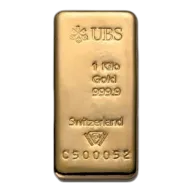
About the 1 Kilo UBS Gold Bar
The 1 Kilo UBS Gold Bar
This bar contains one kilogram (1,000 grams, or 32.1507 troy ounces) of 999.9 fine gold. The kilo is the most premium-efficient retail gold format: kilo gold bars typically trade at just 1-2% over spot, against 1-4% for 1 oz minted bars and far more for small fractional pieces. At current prices a kilo bar represents roughly $100,000 or more of gold in a single object, which puts it firmly in high-net-worth and institutional territory.
The format is recognised globally, and it dominates Asian markets in particular. The kilo is the standard retail gold bar weight in Singapore, Hong Kong, and mainland China, where kilobars trade on the Shanghai Gold Exchange and through the Singapore Bullion Market Association. In Europe, metric weights are the norm and the kilo sits at the top of the retail range; in North America it is most common among institutional buyers.
The trade-off for the rock-bottom premium is concentration. A kilo bar is an all-or-nothing sale, with no way to liquidate partially, and the buyer pool at this price point is narrower than for gold bars in 1 oz or 100g sizes, even though institutional buyers and refiners readily accept them. Kilo buyers are optimising for the lowest cost per gram, not flexibility.
1 Kilo UBS Gold Bar Specifications
| Attribute | Detail |
|---|---|
| Metal | Gold |
| Weight | 1 kilogram (1,000 g / 32.1507 troy oz) |
| Purity | 999.9 fine gold |
| Form | Bar |
999.9 (four nines) is the standard purity for retail gold bars; the LBMA Good Delivery minimum is 995. Gold bars are produced either as cast bars, where molten gold is poured into moulds for a rougher finish and lower premium, or as minted bars, cut from rolled sheet and polished. A kilo of gold is extremely dense (19.32 g/cm3) and the bar is roughly the size of a small smartphone, making it easy to store despite the value it concentrates.
Authentication matters more at this size than any other. Tungsten has a density of 19.25 g/cm3, close enough to gold that a plated tungsten core can pass weight and dimension checks, and XRF readers only penetrate 10-50 microns of surface. Ultrasonic testing is the most reliable non-destructive method, since gold's sound velocity (3,240 m/s) differs sharply from tungsten's (5,170 m/s). For bars of 250g and above, requesting ultrasonic verification is best practice, and kilo bars should not be stored loose together because gold is soft enough to pick up surface scratches that hurt resale appeal.
Kilo Gold Bar Tax Treatment by Country
At 999.9 fineness this bar comfortably exceeds the 995 threshold that defines investment gold in most jurisdictions, so the purchase is sales-tax-free almost everywhere.
- UK: 0% VAT as investment gold. Bars are not CGT-exempt, however; only UK legal tender coins are. Gains above the £3,000 annual allowance are taxed at 18-24% depending on income, and on a bar this size the potential gain is substantial.
- US: No federal sales tax and most states exempt bullion, though several apply thresholds a kilo bar easily clears. Long-term gains are taxed at the collectibles rate of up to 28%. Gold of 99.5%+ purity from an accredited refiner is IRA-eligible when held at an approved depository.
- Canada: 0% GST/HST at 99.5%+ purity.
- Australia: GST-free as investment-grade gold (99.5%+ purity).
- New Zealand: GST-exempt at 99.5%+ gold purity; no formal capital gains tax.
- Singapore: 0% GST under the Investment Precious Metals scheme and no capital gains tax, one reason the kilo format is standard there.
- Hong Kong: no sales tax, no import duty, no capital gains tax.
- EU: investment gold at 995+ fineness is VAT-exempt across all member states; capital gains rules vary by country (Germany, for instance, taxes nothing after a one-year hold).
Kilo Bars vs 1 oz Bars, 100g Bars, and Kilo Coins
Against 1 oz gold bars, the kilo wins on cost and loses on everything else. Kilo bars at 1-2% over spot undercut 1 oz minted bars at 1-4%, and across a $100,000 allocation the premium difference between bars and smaller formats can amount to thousands of dollars. The 1 oz gold bar remains the sweet spot for most buyers because it balances premium efficiency with the widest resale market; thirty-two 1 oz bars can be sold one at a time, a kilo bar cannot.
Against 100g gold bars, the gap narrows. 100g bars run roughly 2-4% over spot, so the kilo still saves on percentage premium, but the 100g format splits the same capital into ten separately saleable units. Buyers weighing the two are deciding how much liquidity granularity is worth a percentage point or so of premium.
Against kilo gold coins, there is no real contest on price. Where kilo coins exist they carry collector premiums above bar prices, and the bar format from an LBMA-accredited refiner is interchangeable globally and can be sold to any dealer in any country. The case for a coin at this weight is aesthetic rather than financial.