
 Ainslie Bullion


Prices are fetched automatically and may not reflect current merchant prices. Currency conversions and tax treatment are approximate. Rankings are based solely on price. We are not a dealer and accept no responsibility for transactions with listed merchants. Past performance is not indicative of future results. This site does not provide investment advice. Full disclaimer
About the 1 oz Ainslie Gold Bar
The 1 oz Gold Bar Sweet Spot
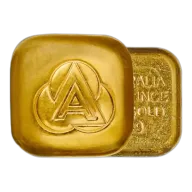
The 1 oz Ainslie gold bar contains one troy ounce (31.1035 g) of 999.9 fine gold in bar form. One ounce is the benchmark weight for bullion worldwide, and at this size the bar format delivers its core advantage: premiums of roughly 2 to 4% over spot, against 3 to 5% for 1 oz sovereign coins. The saving comes from simpler manufacturing; a bar has no legal tender status, no face value, and none of the production overhead a coin carries.
The 1 oz size is also widely regarded as the sweet spot in the gold bar range, offering the best balance of premium efficiency and resale liquidity. Smaller gram bars carry sharply higher percentage premiums (1g bars can run 15 to 25% over spot), while larger bars like the 100g or kilo shave premiums further but narrow the pool of retail buyers and remove the ability to sell in one-ounce increments.
The trade-offs versus coins are worth weighing before choosing the bar. Coins retain more of their premium at resale, carry sovereign mint security features, and in the UK legal tender coins add CGT exemption that no bar can offer. Buyers focused purely on maximum metal per dollar will prefer the bar; those expecting to resell into retail channels may find a 1oz gold coin recovers more at exit.
1 oz Gold Bar Specifications
| Attribute | Value |
|---|---|
| Metal | Gold |
| Purity | 999.9 fine (four nines) |
| Weight | 1 troy oz (31.1035 g) |
| Format | Bar |
| Manufacturer | Ainslie |
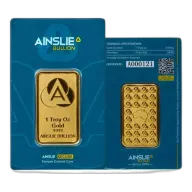
999.9 is the standard fineness for retail gold bars, above the 995 minimum that the LBMA Good Delivery standard requires and that investment gold tax rules in the UK and EU reference. Retail bars are typically supplied sealed in tamper-evident assay packaging carrying the bar's weight, purity, and the refiner's hallmark; keeping that packaging intact matters, because breaking a seal can mean the bar needs re-assaying before a dealer pays full buyback.
Authentication deserves attention with gold bars specifically. Tungsten's density (19.25 g/cm3) is close enough to gold's (19.32 g/cm3) that a plated tungsten fake can pass weight and dimension checks, and XRF testing only reads the surface. The risk is concentrated in larger bars of 100g and up; for a 1 oz bar bought new from an authorised dealer in sealed packaging, it is effectively eliminated, and devices like the Sigma Metalytics verifier work well at this size. Storage is trivial: a 1 oz bar in its card is flat, thin, and stacks efficiently. Store cards flat rather than on edge, as they are fragile.
Tax on 1 oz Gold Bars by Country
Gold's privileged tax status means this bar buys cleanly almost everywhere, with the caveats arriving at disposal.
- UK: VAT-exempt as investment gold (995+ fineness). Bars are not CGT-exempt, though; only UK legal tender coins qualify, so gains above the £3,000 annual allowance are taxed at 10 to 20%. For UK buyers expecting large gains, the CGT saving on a Britannia can outweigh the bar's lower purchase premium.
- EU: VAT-exempt as investment gold across all member states. Germany adds a notable bonus: gains are tax-free after a 12-month holding period.
- US: No federal sales tax; roughly 35 states exempt bullion, and a 1 oz gold bar clears the threshold rules in states like New York and California. Long-term gains are taxed at the 28% collectibles rate. The bar is IRA-eligible if produced by an accredited refiner and held at an approved depository.
- Canada: GST/HST exempt at 99.5%+ purity.
- Australia: GST-free as investment-grade gold; CGT applies with a 50% discount after 12 months.
- New Zealand: GST-exempt at 99.5%+ purity, with no general capital gains tax.
- Singapore and Hong Kong: No GST or sales tax respectively, and no capital gains tax in either, making bars the straightforward cost-efficient choice in both.
1 oz Bar vs Coins and Other Bar Sizes
Against the major 1 oz sovereign coins, the bar competes on price and concedes on everything else. Coins like the 1oz gold Britannia, Maple Leaf, and Krugerrand carry 3 to 5% premiums against the bar's 2 to 4%, but they bring government-backed purity guarantees, tight global recognition, and the narrowest bid-ask spreads in retail gold. Coins also retain more premium at resale. For UK buyers the Britannia adds CGT exemption, which on a meaningful gain dwarfs the upfront saving on any bar.
Within the bar market, the comparison is between divisibility and efficiency. Stepping up to a 100g gold bar drops premiums to roughly 2 to 4% at a much larger outlay, and kilo bars reach 1 to 2%, the lowest percentage premium in retail gold. Stepping down to gram sizes moves the other way fast. The 1 oz bar holds the middle: liquid enough that any dealer will buy a recognised-brand example in a sealed card, large enough that fabrication cost is a small fraction of value.
Brand matters more for bars than for coins. Bars from LBMA-accredited refiners enjoy universal recognition, while bars from less prominent producers may trade on metal value with wider spreads or require assay verification at resale. Whatever the brand, the rule is the same: keep the bar sealed in its original packaging, buy from reputable dealers, and the 1 oz bar remains one of the most efficient ways to hold gold.
1 oz Ainslie Gold Bar: frequently asked questions
-
The cheapest Ainslie 1oz gold bar listed on this page is $4,491.53, sitting around 3.3% above the current $4,408.10 gold spot price. Prices update in near real-time as dealers adjust their listings.
-
The Ainslie 1oz gold bar is a 31.1g bar of 999.9 fine (four-nines) gold produced by Ainslie Bullion, an Australian bullion refinery. At 99.99% purity it meets the standard for investment-grade gold.
-
A 1oz gold bar is small enough to store in a compact home safe bolted to a floor or wall. Keep it in its original sealed assay card or capsule to protect the surface and preserve resale value. For larger holdings, a specialist vault or bank safe-deposit box reduces insurance risk.