1 listing
Filters
| Product | /oz | Premium | Price | |
|---|---|---|---|---|

 IDC Coin and Bullion
|
$4,609.22 | +4.56% | $4,609.22 | View Deal |
Prices are fetched automatically and may not reflect current merchant prices. Currency conversions and tax treatment are approximate. Rankings are based solely on price. We are not a dealer and accept no responsibility for transactions with listed merchants. Past performance is not indicative of future results. This site does not provide investment advice. Full disclaimer
About the 1 oz Engelhard Bar Gold Bar
Engelhard Gold Bars: Varied Designs and Conditions
This listing covers 1 oz Engelhard Gold Bars available in varied designs and conditions across dealers. Engelhard Corporation, founded in 1902 in Newark, New Jersey, was the world's largest precious metals smelter by the 1950s. The company produced retail bullion bars from the late 1960s through approximately 1986, then shifted its focus entirely to industrial catalysts and materials science. BASF acquired Engelhard in 2006 for US$5 billion, and no new Engelhard retail bars have been produced since the mid-1980s.
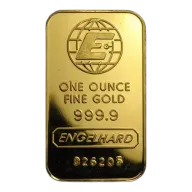
Every Engelhard bar on the market today is a secondary-market product, and the "varied design" description reflects the reality of Engelhard's production history. The company produced bars across multiple decades, facilities, and design generations. Landscape-format bars date from the earliest production in the late 1960s; portrait-format bars with the distinctive globe logo and Eagle logo came from the 1981-1986 period. Canadian varieties carry "Engelhard Industries of Canada" stampings, and Australian-marked bars exist from Engelhard's international operations. Each bar contains the same .999 fine gold, but the exterior appearance and hallmark style vary by era and facility.
For buyers, the practical implication is straightforward: all of these bars contain 1 troy ounce of .999 gold regardless of which design variety arrives. Dealers who list "varied design" or "random design" are drawing from mixed inventory of different production years and styles. The metal value is identical; the collector value varies by variety, with rarer production types commanding premiums above more common versions. Buyers who are indifferent to the specific variety will typically pay less than those seeking a particular design from a particular era.
Charles Engelhard Jr., who consolidated the family's holdings into Engelhard Industries Inc. in 1958, is widely cited as the inspiration for Ian Fleming's James Bond villain Auric Goldfinger. The company's legacy extends beyond bullion: Engelhard processed gold for the US Treasury and refined South African gold during the apartheid era, making it one of the most historically significant names in precious metals.
Engelhard Gold Bar Details
| Attribute | Detail |
|---|---|
| Weight | 1 troy oz (31.1035 g) |
| Purity | .999 fine gold (three nines) |
| Manufacturer | Engelhard Corporation |
| Production Period | Late 1960s to mid-1980s |
| Serial Numbers | Present on nearly all varieties |
| Production Methods | Cast (poured) and pressed (minted) |
| Face Value | None (bar format) |
| Production Status | Discontinued |
Engelhard's gold bar production paralleled its more extensively documented silver bar programme. The same hallmark evolution applies: early bars used elongated octagon hallmarks, mid-period bars introduced the bull-and-bear commercial logo, and later production (1981-1986) featured the 'E' globe logo in multiple size variations, culminating in the Eagle logo on the final 1986 production run.
Authentication relies on serial number format verification, font consistency for the claimed production era, hallmark positioning, and edge finish. The AllEngelhard.com collector community maintains the definitive reference for identifying and authenticating Engelhard products across all sizes and metals. Counterfeits do exist, and buyers should purchase from established dealers who verify authenticity.
When dealers list these bars with assay cards, the assay packaging comes from the selling dealer rather than from Engelhard's original production (Engelhard did not use modern tamper-evident assay cards during its production era). The serial number on the bar itself is the primary provenance marker.
Tax Treatment of Engelhard Gold Bars
Engelhard gold bars at .999 fineness qualify for investment gold tax treatment in all major markets. The bars' discontinued status has no bearing on tax classification.
United Kingdom
Gold bars at 995+ purity are VAT-exempt on purchase. Subject to CGT on disposal at the investor's marginal rate (18% or 24%), with the £3,000 annual allowance. Not CGT-exempt, as bars are not legal tender. Any collector premium paid above metal value is factored into the cost basis for CGT purposes. Eligible for SIPP inclusion.
United States
Engelhard bars at .999 purity meet the IRA fineness requirement (99.5%+ gold). Some dealers specifically list Engelhard gold bars as IRA-eligible, though custodian acceptance varies. Capital gains taxed at the collectibles rate of up to 28%. State sales tax exemptions apply in approximately 35 states.
Canada
GST/HST exempt at 99.5%+ purity. Capital gains taxed at a 50% inclusion rate. The Listed Personal Property rule applies to items bought and sold under $1,000 CAD.
Australia and New Zealand
GST-free as investment-grade gold at 99.5%+ purity. No distinction between current and discontinued production for tax purposes.
European Union
VAT-exempt as investment gold at 995+ fineness under Directive 98/80/EC. Germany's one-year holding exemption from capital gains tax applies.
Singapore and Hong Kong
GST-exempt in Singapore under the IPM scheme. No tax in Hong Kong.
Engelhard Gold Bars in the Secondary Market
Engelhard gold bars compete in two markets simultaneously: the standard gold bar market (where they are evaluated on metal content and premium efficiency) and the collector market (where they are evaluated on rarity, provenance, and design variety). The buyer's motivation determines which comparison is most relevant.
For metal-value buyers, the standard 1 oz Engelhard gold bar listing and this varied-design listing represent the same underlying product. The varied-design listing may offer a slight cost advantage because the buyer accepts whichever design the dealer has in stock, removing the ability to cherry-pick preferred varieties. Both contain .999 fine gold in equal quantity.
Against currently produced bars from PAMP Suisse or Valcambi, Engelhard bars carry a collector premium that pushes their cost above modern alternatives. A buyer purely seeking gold exposure at the lowest per-ounce cost should choose a current-production LBMA bar. The Engelhard premium represents a bet on the continuing appreciation of a finite-supply collector product.
Johnson Matthey (JM) bars are the nearest equivalent in the discontinued-refiner category. Both companies ceased retail bullion production and have been absorbed by larger corporations (BASF and Asahi, respectively). Engelhard bars generally command higher collector premiums than JM equivalents, driven by greater production variety, the more extensive collector documentation, and the Goldfinger cultural association. For buyers choosing between the two, Engelhard is the stronger collector brand; JM is typically available at a marginally lower premium.
1 oz Engelhard Bar Gold Bar: frequently asked questions
-
The lowest listed price for a 1oz Engelhard gold bar is $4,609.22 from IDC Coin and Bullion, about 4.6% over the $4,408.10 gold spot price. Because Engelhard ceased bar production in the 1980s, these bars trade on the secondary market and typically carry a premium above what a new generic 1oz bar would cost.
-
Engelhard exited the retail bullion market in the late 1980s to focus on industrial catalysts and materials. The company was then acquired by BASF in 2006 for US$5 billion and renamed BASF Catalysts LLC on 1 August 2006. No new Engelhard bullion bars have been produced since the mid-1980s, making all examples on the market today secondary-market pieces.
-
Engelhard bars command a collector premium because production ended decades ago, supplying a fixed and declining pool of surviving bars. The Engelhard name carries strong recognition among stackers and collectors, and the company's historical significance adds to demand. Unlike modern generic bars, no new Engelhard bars can enter the market, so prices reflect both metal content and scarcity of supply.
-
In the UK, gold bars are subject to Capital Gains Tax on disposal, with gains above the £3,000 annual exempt amount taxed at 18% or 24% depending on your income. In the US, gold bars are taxed as collectibles at up to 28% on long-term gains. In Canada, 50% of any capital gain is included in taxable income. Reporting requirements differ by country; consult a tax adviser for your situation.