6 listings
Filters
| Product | /oz | Premium | Price | |
|---|---|---|---|---|

 Camino Coin Company
|
$4,443.22 | +0.80% | $4,443.22 | View Deal |
 BullionStar US
|
$4,444.59 | +0.83% | $4,444.59 | View Deal |
 Golden Eagle Coins
|
$4,501.75 | +2.12% | $4,501.75 | View Deal |
 IDC Coin and Bullion
|
$4,579.38 | +3.89% | $4,579.38 | View Deal |

 Gold Stock Canada
|
$4,622.29 | +6.38% |
$4,622.36
CA$6,476
|
View Deal |
 SD Bullion
|
$4,728.03 | +7.26% | $4,728.03 | View Deal |
Prices are fetched automatically and may not reflect current merchant prices. Currency conversions and tax treatment are approximate. Rankings are based solely on price. We are not a dealer and accept no responsibility for transactions with listed merchants. Past performance is not indicative of future results. This site does not provide investment advice. Full disclaimer
About the 1 oz Johnson Matthey Gold Bar
A Discontinued Classic That Still Trades
The 1 oz Johnson Matthey gold bar carries one troy ounce (31.1035g) of 999.9 fine gold from one of Britain's most historic precious metals refineries. Johnson Matthey (JM) held LBMA Good Delivery accreditation and produced gold bars for over a century before selling its refining operations to Asahi Refining in 2015. No new JM gold bars have been produced since that sale, making every bar on the market today a secondary-market piece from existing stock.
The discontinued status creates an unusual dynamic. JM bars remain fully liquid because of the refinery's long LBMA history and universal dealer recognition. Any reputable bullion dealer will buy back a JM bar without hesitation. At the same time, the finite supply means JM bars occasionally command a small premium above comparable in-production bars, particularly among collectors and long-term holders who value the provenance of a historic British refinery. That premium is modest; buyers primarily interested in metal content per dollar should compare JM pricing against currently-produced alternatives before purchasing.
Johnson Matthey's significance in precious metals history is substantial. Founded in 1817 in London, the company refined gold and silver for the Bank of England and other central banks, and was a founding member of the London Gold Fix in 1919. The 1 oz bar represents the most accessible format from a refinery whose 400 oz Good Delivery bars sat in central bank vaults around the world. For buyers who appreciate that lineage, the JM bar is a piece of bullion history at a modest cost difference from generic alternatives.
Johnson Matthey 1 oz Gold Bar Specifications
| Attribute | Value |
|---|---|
| Weight | 1 troy ounce (31.1035g) |
| Purity | 999.9 fine gold (24 karat) |
| Manufacturer | Johnson Matthey, United Kingdom |
| Production status | Discontinued (refining sold to Asahi in 2015) |
| Type | Minted bar |
| Accreditation | LBMA Good Delivery (historic) |
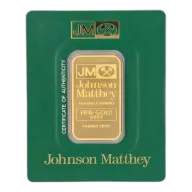
| Packaging | Sealed assay card with serial number |
| Face value | None (not legal tender) |
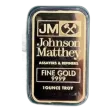
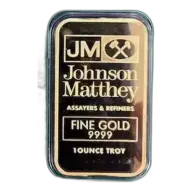
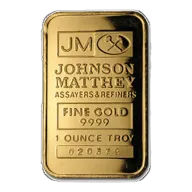
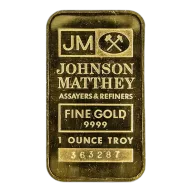
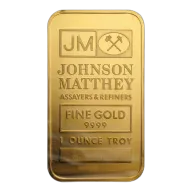
JM produced minted gold bars in sizes ranging from 1g to 1kg, plus the institutional 400 oz Good Delivery format. The 1 oz bar features the Johnson Matthey logo, weight and purity markings, and a unique serial number on the obverse. The design is functional and restrained, consistent with the British industrial tradition. Bars were sealed in tamper-evident assay card packaging confirming weight, purity, and serial number.
Because all JM bars are now secondary market, packaging condition varies. Bars in original sealed assay cards command stronger buyback prices than loose bars. A loose JM bar may require independent verification (weight, dimensions, or Sigma Metalytics test) before some dealers accept it, which adds friction. Buyers should prioritise sealed packaging when purchasing.
Tax Treatment of the 1 oz Johnson Matthey Gold Bar
The JM bar's tax treatment is identical to any other 999.9 fine gold bar from an LBMA-accredited refinery. The discontinued production status has no effect on tax classification.
- United Kingdom: VAT-exempt as investment gold (purity exceeds 995). Subject to Capital Gains Tax on profits. Not CGT-exempt because gold bars are not UK legal tender. The annual CGT allowance (£3,000) applies.
- United States: No federal sales tax; state exemptions vary (approximately 35 states exempt bullion). IRA-eligible: the 999.9 purity exceeds the IRS 99.5% minimum, and JM's historic LBMA accreditation qualifies the bars. Capital gains taxed at the collectibles rate (28% maximum for long-term holdings).
- European Union: VAT-exempt as investment gold under EU Council Directive 98/80/EC. Capital gains vary by country; Germany exempts gains on gold held over one year.
- Canada: GST/HST-exempt for gold at 99.5%+ purity. RRSP-eligible when held through an approved custodian.
- Australia: GST-free as investment-grade gold (99.5%+ purity). Subject to CGT with a 50% discount for assets held over 12 months.
- Singapore: GST-exempt under the IPM scheme. No capital gains tax.
- Hong Kong: No sales tax, no import duties, no capital gains tax.
From London's Gold Refiners to Asahi's Acquisition
Johnson Matthey was founded in 1817 by Percival Norton Johnson in Hatton Garden, London's jewellery quarter. The company initially operated as an assayer and refiner of gold and silver, serving London's bullion market. George Matthey joined as a partner in 1851, and the firm became Johnson Matthey and Company. By the late nineteenth century, JM had established itself as one of London's premier precious metals refineries.
The company's role expanded significantly when it became one of the five founding members of the London Gold Fix in 1919, alongside N.M. Rothschild & Sons, Mocatta & Goldsmid, Sharps & Wilkins, and Samuel Montagu & Co. The Fix, held in the offices of N.M. Rothschild until 2004, set the global benchmark gold price twice daily. JM's participation placed it at the centre of the international gold market for nearly a century.
JM also served as an official refiner for the Bank of England, producing 400 oz Good Delivery bars that underpinned the London bullion market. The company's assay mark became one of the most trusted hallmarks in precious metals, recognised by central banks, bullion dealers, and institutional investors globally. JM bars are still held in the Bank of England's vaults today.
In 2015, Johnson Matthey sold its gold and silver refining operations to Asahi Holdings, a Japanese precious metals company. The sale reflected JM's strategic shift toward technology and automotive catalysis, away from commodity refining. Asahi Refining now operates the former JM facilities and produces its own branded bars, but no new Johnson Matthey bars have been manufactured since the transition. The JM name continues in the technology and chemicals sector, but its presence in the bullion market is now exclusively through secondary-market bars.
The historical weight of the JM name means its bars retain strong liquidity despite the production halt. Dealers treat JM bars identically to bars from active LBMA refineries. For some buyers, the discontinued status adds a dimension of collectibility; for others, it is simply a well-made gold bar from a refinery that no longer exists in its original form.
Johnson Matthey vs Asahi, PAMP, and Perth Mint at 1 oz
The most direct comparison is between the JM bar and the 1 oz Asahi Refining bar, since Asahi acquired JM's refining operations and now produces bars from the same facilities. Both are 999.9 fine gold with LBMA accreditation. Asahi bars are currently produced and typically cheaper than JM bars on the secondary market. Buyers who want the lowest premium per ounce should consider Asahi. Buyers who value the JM provenance and the potential for its discontinued status to maintain or increase collector interest should consider the JM bar.
Against the 1 oz PAMP Fortuna bar, the JM bar lacks PAMP's decorative design, Veriscan authentication, and ongoing production. PAMP bars command higher premiums across most markets, reflecting stronger brand recognition and the Lady Fortuna design's iconic status. The JM bar competes on a different axis: historic provenance from a founding member of the London Gold Fix, rather than contemporary branding and technology.
The 1 oz Perth Mint bar offers sovereign government backing and current production at 999.9 purity. Perth Mint bars are widely available and carry consistent premiums. The JM bar, by contrast, is supply-constrained. In markets where JM bars are readily available at comparable prices, the choice is largely one of preference. In markets where JM bars carry a noticeable premium over Perth Mint, the Perth Mint bar offers better value for pure metal accumulation.
Among other legacy bars, the 1 oz Engelhard bar occupies a similar niche. Engelhard, another historic refinery, ceased operations in 2006 (acquired by BASF). Engelhard bars have developed a more pronounced collector premium than JM bars in some markets, particularly in the United States. Both represent secondary-market opportunities from refineries with deep institutional histories.
1 oz Johnson Matthey Gold Bar: frequently asked questions
-
The lowest price in our comparison is $4,443.22, currently 0.8% over the gold spot price. Camino Coin Company is the most competitive dealer listed. Because these bars no longer enter new production, prices reflect secondary-market supply and may vary more between dealers than for a currently minted 1oz bar.
-
Johnson Matthey sold its gold and silver refining business and ended all new retail bullion bar production. Bars already in the market continue to circulate as secondary-market pieces. Johnson Matthey bars carry recognised hallmarks and remain accepted by major bullion dealers.
-
The bar contains one troy ounce of gold (1 oz, or 31.1035g) at a purity of 999.9 fine gold (24 carat). Each bar is stamped with the JM mark, its weight, and purity.
-
Check that the bar carries hallmarks showing weight and 999.9 purity. Weigh it on a precision scale: a genuine 1oz bar should be 31.10g. Purchasing from a reputable dealer who guarantees authenticity is strongly recommended for any secondary-market bar.