1 listing
Filters
| Product | /oz | Premium | Price | |
|---|---|---|---|---|

 Australian Bullion Company
|
$4,839.08 | +11.25% |
$4,839.17
A$6,797
|
View Deal |
Prices are fetched automatically and may not reflect current merchant prices. Currency conversions and tax treatment are approximate. Rankings are based solely on price. We are not a dealer and accept no responsibility for transactions with listed merchants. Past performance is not indicative of future results. This site does not provide investment advice. Full disclaimer
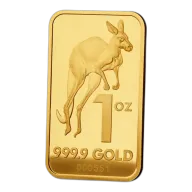
About the 1 oz Melbourne Mint Gold Bar
The 1 oz Melbourne Mint Gold Bar
This bar contains one troy ounce (31.1035 g) of gold in the single most traded bullion weight in the world. The 1 oz size is the benchmark against which all premiums are quoted, and for bars it is widely regarded as the sweet spot: the best balance of premium efficiency and resale liquidity in the gold bar market. Minted 1 oz bars typically run 1-4% over spot, below the 3-5% typical of 1oz gold coins, because a bar's simpler production avoids the costs of legal tender striking and sovereign-mint security features.
The case for a 1 oz bar over a larger one is flexibility. A 100g or kilo bar shaves a little more off the percentage premium, but selling it is an all-or-nothing transaction; ten separate 1 oz bars can be liquidated one at a time as needs arise. The case for a bar over a coin is pure cost per gram of gold: buyers who do not need legal tender status, and who are not chasing the UK's coin-specific CGT exemption, simply get more metal for their money in bar form.
Practical handling notes apply to any branded bar. Minted bars typically ship sealed in tamper-evident assay card packaging carrying the bar's serial number, weight, and purity, and keeping that seal intact matters: a bar removed from its card may need re-assaying at resale, and sealed bars consistently command better buyback prices. The cards are flat and thin, so a stack of 1oz gold bars stores a large value in very little space.
Tax on a 1 oz Gold Bar by Country
Gold bars enjoy broad purchase-tax exemptions worldwide, with the recurring proviso that exemptions hinge on investment-grade purity, typically 995 thousandths or better. The one consistent disadvantage versus coins arises in the UK.
- UK: Investment gold bars at 995+ fineness are VAT-exempt, the same as coins. Bars are never CGT-exempt, however; only UK legal tender coins qualify. Gains above the £3,000 annual allowance are taxable, so for buyers expecting large gains a CGT-exempt Britannia can beat a bar on total lifecycle cost despite the bar's lower purchase premium.
- US: No federal sales tax; most states exempt bullion, while a minority tax it and several apply thresholds (California exempts purchases over $2,000, which a 1 oz gold bar clears on its own). IRA eligibility requires 99.5%+ purity from an LBMA/COMEX-accredited refiner with approved-depository storage. Long-term gains are taxed at the collectibles rate of up to 28%.
- EU: VAT-exempt as investment gold at 995+ purity. Germany adds a notable sweetener: gains on bars held over 12 months are tax-free.
- Australia: GST-free as investment-grade gold at 99.5%+ purity from accredited refiners; CGT applies with a 50% discount after 12 months.
- Canada and New Zealand: GST/HST-free and GST-free respectively at 99.5%+ purity; New Zealand has no formal CGT.
- Singapore and Hong Kong: No sales tax on qualifying investment gold and no capital gains tax in either.
1 oz Bar vs Refiner Rivals, Coins, and Larger Bars
The 1 oz gold bar market is crowded with established names: PAMP Suisse's Fortuna, Valcambi, Royal Mint, Perth Mint, and Credit Suisse all produce at this weight. Among them, LBMA-accredited refiners enjoy universal recognition and the tightest spreads, with PAMP's Fortuna commanding a modest brand premium over plainer bars. For any given bar, the practical comparison is price on the day against recognition at resale; bars from lesser-known producers must be cheaper to compete, because dealers may discount or re-assay unfamiliar brands. That makes a comparison site's per-listing premium figures the most useful data point for this product.
Against a 1oz gold coin, the bar wins on entry price (1-4% premiums versus 3-8% for sovereign coins) and loses on liquidity and recognition: coins like the Krugerrand and Maple Leaf are bought instantly by any dealer worldwide, and a coin bought at a 5% premium might sell back at 2-4% over spot, keeping the round trip surprisingly narrow. UK buyers have the additional CGT consideration that favours Britannias and Sovereigns.
Up the weight scale, 100g bars (3.215 oz) drop premiums to roughly 2-4% and kilo bars to 1-2%. The saving is real but comes with concentration risk in a single sellable unit. A common middle path is accumulating multiple 1 oz bars: near-optimal premiums with the option to sell in single-ounce increments.
1 oz Melbourne Mint Gold Bar: frequently asked questions
-
The cheapest 1oz Melbourne Mint gold bar tracked on BullionFerret is $4,839.17 from Australian Bullion Company, sitting around 11.3% over the $4,408.10 gold spot price. Use the comparison table above to see all current dealer offers side by side.
-
No. The Perth Mint is a government-owned refinery and mint, while Melbourne Mint is a separate, private bullion company based in Melbourne, Victoria. They are distinct businesses with no shared ownership or operational connection.
-
Yes. Melbourne Mint sells bullion directly to retail customers, and any adult can purchase gold bars without special qualifications. You can buy through their website or via bullion dealers who stock their products. No licence or account is required; standard identity checks apply for larger purchases under anti-money-laundering rules.