1 listing
Filters
| Product | /oz | Premium | Price | |
|---|---|---|---|---|

 Suisse Gold
Out of Stock
Suisse Gold
Out of Stock
|
$4,587.14 | +5.55% |
$4,587.00
€4,003
|
View Deal |
Prices are fetched automatically and may not reflect current merchant prices. Currency conversions and tax treatment are approximate. Rankings are based solely on price. We are not a dealer and accept no responsibility for transactions with listed merchants. Past performance is not indicative of future results. This site does not provide investment advice. Full disclaimer
About the 1 oz UBS Gold Bar
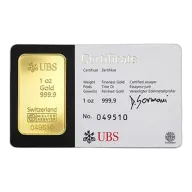
The 1 oz UBS Gold Bar
This bar contains one troy ounce of 999.9 fine gold, which is 31.1035 grams of metal in the single most traded bullion denomination in the world. Spot prices are quoted per troy ounce, so a 1 oz bar maps directly onto the headline gold price with no mental arithmetic, and every dealer worldwide buys and sells at this weight without needing extra verification.
The 1 oz size is widely regarded as the sweet spot in gold bars: it balances premium efficiency against resale liquidity better than any other weight. Minted 1 oz gold bars typically trade at 2 to 4 percent over spot, lower than 1 oz coins at 3 to 5 percent because bar manufacturing is simpler, and far lower per gram than small fractional bars. Larger bars shave the premium further but narrow the pool of buyers when it comes time to sell.
Like most minted bars at this weight, 1 oz bars are normally supplied sealed in a tamper-evident assay card recording the serial number, weight, purity and refiner hallmark. Keeping that seal intact matters: bars in their original assay packaging achieve the best buyback prices, while a loose bar may need re-assaying at the seller's expense. Buyers wanting government backing or the UK CGT exemption should look at 1 oz gold coins instead, accepting the higher premium that comes with them.
1 oz UBS Gold Bar Specifications
| Attribute | Detail |
|---|---|
| Metal | Gold |
| Weight | 1 troy oz (31.1035 g) |
| Purity | 999.9 fine (24 carat) |
| Form | Bar |
| Legal tender | No face value; bars are not legal tender |
The 999.9 fineness is the standard for retail gold bars and clears every investment-gold purity threshold in use: the 995 floor that defines VAT-exempt investment gold in the UK and EU, and the 99.5 percent minimum applied by Canada, Australia, New Zealand, Singapore and the US IRA rules.
Minted bars at this weight are flat, thin and stack efficiently, and the sealed assay card doubles as both certificate and protective packaging. Cards are fragile relative to the bar itself, so store them flat rather than standing on edge, and resist the temptation to open one: breaking the seal can reduce the resale value of an otherwise perfect bar.
Tax Treatment of the 1 oz UBS Gold Bar
Gold bars of this purity are treated as investment gold almost everywhere, but the capital gains position differs from coins in one important market.
- UK: 0% VAT on purchase, since 995+ fineness bars qualify as investment gold. Bars carry CGT liability on sale though; only UK legal tender coins are CGT-exempt. Gains above the £3,000 annual allowance are taxed at 10 or 20 percent depending on income, which can outweigh the initial premium saving versus a CGT-free Britannia for larger holdings.
- EU: 0% VAT in all member states for bars of 995+ fineness. Capital gains rules vary by country; Germany taxes nothing on bullion held longer than a year.
- US: Sales tax depends on the state, with around 35 states exempting bullion outright. Long-term gains fall under the 28 percent collectibles rate. The bar meets the 99.5 percent IRA purity requirement, though IRA rules also demand an accredited refiner and approved depository storage.
- Canada: 0% GST/HST at 99.5 percent purity or better. Qualifying bullion can be held in RRSP and TFSA accounts.
- Australia and New Zealand: 0% GST for investment-grade gold of 99.5 percent purity or better.
- Singapore and Hong Kong: No GST or sales tax on investment-grade gold, and no capital gains tax in either jurisdiction.
1 oz Bars vs 1 oz Coins and Branded Alternatives
The first comparison is form. A 1 oz gold coin such as the 1 oz gold Britannia or Krugerrand costs more, typically 3 to 5 percent over spot against 2 to 4 percent for a minted bar, but buys government-backed purity, the tightest bid-ask spreads at resale, and in the Britannia's case CGT exemption for UK investors. Coins also retain more of their premium when sold. Bars win on pure metal per dollar, which is why investors focused on maximising ounces rather than tax planning or quick resale tend to choose them.
Within 1 oz bars, the established names are the PAMP Suisse Fortuna, Valcambi, Royal Mint, Perth Mint and Credit Suisse bars. The Fortuna commands a modest premium over generic refiner bars on the strength of its recognised design, while Valcambi is frequently the keenest-priced Swiss option. Bars from LBMA-accredited refiners enjoy universal dealer recognition; bars without that pedigree can be harder to sell internationally and may need assay testing at the buyer's expense.
On size, moving up to 100g or 1 kilo gold bars cuts the percentage premium further, at the cost of a narrower retail buyer pool and chunkier exit positions. Moving down to 20g or smaller raises the per-gram cost steadily. The 1 oz bar remains the default for a reason: it is the most liquid bar weight in existence.