1 listing
Filters
| Product | /oz | Premium | Price | |
|---|---|---|---|---|

 Suisse Gold
Out of Stock
Suisse Gold
Out of Stock
|
$4,542.98 | +4.54% |
$36,515.99
€31,864
|
View Deal |
Prices are fetched automatically and may not reflect current merchant prices. Currency conversions and tax treatment are approximate. Rankings are based solely on price. We are not a dealer and accept no responsibility for transactions with listed merchants. Past performance is not indicative of future results. This site does not provide investment advice. Full disclaimer
About the 250g UBS Gold Bar
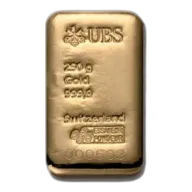
The 250g UBS Gold Bar
The 250g UBS Gold Bar contains a quarter kilogram of 999.9 fine gold, equivalent to 8.038 troy ounces. The 250g weight sits in a useful position on the gold bar ladder: premiums at this size run approximately 2-4% over spot, a clear step down from the 4-6% typical of 100g gold bars and approaching the institutional-grade pricing of 500g and kilo bars. That makes the quarter-kilo format a common choice for buyers who want low per-gram cost without committing the roughly $50,000-plus a 500g bar demands.
The 250g denomination belongs to the metric gold bar tradition. It is a standard size in continental Europe and Asia, stocked by banks and specialist dealers in Germany, Switzerland and Austria, and universally recognised in metric gold markets. In troy-ounce markets such as the US, the weight is less common; the nearest troy equivalent of 8 oz is not a standard denomination, so American dealers may quote slightly wider spreads on it than on a 10 oz gold bar.
Physically, a 250g gold bar is compact for its value, roughly the size of a small smartphone, so it stores easily in a personal safe or bank vault. The value density also makes allocated vault storage with insurance a practical alternative to home delivery, and many European dealers offer exactly that. At this price point, buyers are typically serious accumulators or wealth-preservation investors rather than first-time stackers: at 2026 gold prices a 250g bar represents an outlay in the region of $26,500. For that commitment the reward is one of the lowest premium rates available to a private buyer, with tight dealer buyback spreads on bars from recognised refiners, typically 1-2% below spot.
250g UBS Gold Bar Specifications
| Specification | Value |
|---|---|
| Metal | Gold |
| Weight | 250 grams (8.038 troy oz) |
| Purity | 999.9 fine (four nines) |
| Form | Bar |
The 999.9 purity is the standard for retail gold bars and comfortably exceeds the 995 minimum that defines investment gold in the UK and EU and the LBMA Good Delivery floor. 250g bars are generally serialised and sold with assay documentation; minted bars at smaller weights often come sealed in tamper-evident assay cards, while quarter-kilo bars are sold individually rather than in tubes or multi-bar packaging.
One practical note on larger bars: gold bars from 100g upward are the formats where tungsten-core counterfeits are a realistic secondary-market concern, because tungsten's density (19.25 g/cm3) is close to gold's (19.32 g/cm3). XRF testing only reads the surface, so for bars of 250g and above, ultrasonic testing is the most reliable non-destructive verification. Buying from an established dealer and keeping any original packaging intact avoids the issue for retail buyers and protects resale value.
250g Gold Bar Tax Treatment by Country
A 999.9 fine gold bar qualifies as investment gold in every major jurisdiction, so purchase taxes are rarely an issue. Disposal taxes are where bars differ from coins.
- UK: 0% VAT as investment gold (995+ purity). Bars are not CGT-exempt; only UK legal tender coins are. Gains above the £3,000 annual allowance are taxed at 18-24% depending on income.
- EU: 0% VAT on investment gold bars at 995+ purity under the EU Investment Gold Directive. Capital gains rules vary by country; Germany taxes nothing on bars held over a year.
- US: No federal sales tax; most states exempt bullion, some with thresholds. A 250g bar's value clears every state threshold. Long-term gains are taxed at the 28% collectibles rate. IRA eligibility requires 99.5%+ purity from an LBMA/COMEX/NYMEX-accredited refiner, held at an approved depository.
- Canada: 0% GST/HST at 99.5%+ purity, which a 999.9 bar meets.
- Australia: 0% GST on investment-grade gold at 99.5%+ purity.
- New Zealand: GST-exempt at 99.5%+ purity.
- Singapore and Hong Kong: no GST on qualifying investment gold in Singapore, no sales tax of any kind in Hong Kong, and no capital gains tax in either.
For UK buyers the CGT position is the key planning point: the bar's low purchase premium can be outweighed at disposal by CGT that a Britannia would have avoided entirely.
250g UBS Bar vs Other Quarter-Kilo and Large Gold Bars
The most direct alternatives are 250g bars from the major Swiss refiners. The Valcambi 250g cast bar is often the lowest-premium Swiss option at this weight, while the PAMP Suisse 250g bar is available in both cast and minted versions, the minted carrying the Lady Fortuna design and a modest brand premium. Argor-Heraeus and Heraeus also produce popular 250g cast bars, and the Perth Mint and Royal Mint offer the weight as well. Across all of them the specification is identical at 999.9 fine; the buying decision comes down to premium, finish (cast versus minted) and how widely the refiner's name is recognised where you expect to sell.
Against neighbouring weights, the trade-off is premium versus flexibility. A 250g bar at roughly 2-4% over spot is cheaper per gram than a 100g bar at 4-6%, but it can only be sold as a single unit, so partial liquidation is impossible. Stepping up, 500g and 1 kilo gold bars push premiums lower still at 1-2%, at double and quadruple the outlay. The 10 oz bar (311g) is the closest troy-ounce competitor: premium differences between the two are minimal, so the sensible choice follows your market. Buyers in metric markets, or anyone planning to resell in Europe or Asia, are better served by the 250g format; buyers in the US, UK or Australia will find the 10 oz weight more familiar to local dealers.