1 listing
Filters
| Product | /oz | Premium | Price | |
|---|---|---|---|---|

 Suisse Gold
Out of Stock
Suisse Gold
Out of Stock
|
$5,460.53 | +25.64% |
$351.11
€306
|
View Deal |
Prices are fetched automatically and may not reflect current merchant prices. Currency conversions and tax treatment are approximate. Rankings are based solely on price. We are not a dealer and accept no responsibility for transactions with listed merchants. Past performance is not indicative of future results. This site does not provide investment advice. Full disclaimer
About the 2g UBS Gold Bar
The 2g UBS Gold Bar: An Uncommon Metric Denomination
The 2g UBS gold bar contains 2 grams of 999.9 fine gold, equivalent to 0.0643 troy ounces, roughly one fifteenth of a standard ounce. The 2 gram size sits between the standardised steps of the metric gram series. The conventional progression runs 1g, 2.5g, 5g, 10g, and the 2g is produced by fewer refiners, which makes it an uncommon find in most dealer inventories.
The denomination exists primarily because some markets prefer round gram numbers. Turkish and Middle Eastern gold buying habits favour exact gram weights, and gram-denominated gold is also the standard in India. In Western markets the 2.5g is far more common, and US and Canadian buyers typically choose either a 1/20 oz piece or a 2.5g bar instead.
For buyers deciding between sizes, the practical question is whether the 2g denomination specifically matters to you. The neighbouring 2.5g gold bars are more widely produced, more consistently stocked, and easier to resell, at a barely higher outlay. The 2g makes sense where the round gram figure aligns with local custom or a precise gifting budget; otherwise the more standard sizes offer better value and liquidity.
2g Gold Bar Specifications
| Attribute | Value |
|---|---|
| Metal | Gold |
| Purity | 999.9 fine |
| Weight | 2 g (0.0643 troy oz) |
| Format | Minted bar |
| Packaging | Sealed assay card |
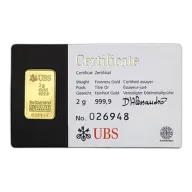
Like other small metric bars, the 2g size is supplied sealed in a tamper-evident assay card, with the card carrying the certificate details: weight, purity, and the refiner's hallmark. The card itself is roughly credit-card sized, with the bar a small rectangle within it, so storage requirements amount to nothing more than protecting the card from damage. Store flat rather than on edge, as assay cards are fragile.
Keeping the seal intact matters more than the storage method. Breaking an assay card seal reduces resale value because the bar may then need re-assaying before a dealer will pay full buyback rates. At this weight the gold content is modest in absolute terms, so any re-assay cost or shipping charge eats a meaningful share of the bar's value; combining small bars into a single sale is the economical approach.
Tax Treatment of Small Gold Bars
At 999.9 fineness, this bar clears every major jurisdiction's investment gold threshold, so purchase taxes are rarely an issue despite the small size.
- UK: VAT-exempt as investment gold (995+ purity). Bars are not CGT-exempt though; only UK legal tender coins qualify, so gains above the £3,000 annual allowance are taxable.
- EU: VAT-exempt as investment gold under the EU directive covering bars and wafers of 995 fineness or higher.
- US: No federal sales tax; most states exempt bullion, though a few tax it and several apply minimum transaction thresholds ($1,000 in New York, Louisiana, and Massachusetts; $2,000 in California) that a single 2g bar will not meet, so state tax can apply where you might not expect it. Long-term capital gains are taxed at the collectibles rate of up to 28%.
- Canada: GST/HST exempt at 99.5%+ purity.
- Australia and New Zealand: GST-free as investment-grade gold at 99.5%+ purity.
- Singapore: GST-exempt as an Investment Precious Metal; no capital gains tax.
- Hong Kong: No sales tax, no import duty, no capital gains tax.
The US threshold states are the one genuine trap at this weight: a small bar bought alone can attract sales tax that the same metal bought as part of a larger order would avoid.
2g vs 1g and 2.5g Gold Bars
The 2g sits in an awkward gap between two better-established sizes, and the comparison mostly runs against it. Premiums on 2g bars run roughly 10 to 20% over spot depending on brand, similar to or slightly higher than 2.5g bars, because fewer refiners produce the size and there is less competition keeping markups down. It lands in a worst-of-both-worlds zone: too small for efficient pricing, yet not different enough from its neighbours to justify the denomination on cost grounds.
Against the 1g gold bar, the 2g doubles the metal content but loses the 1g size's popularity as a gift and novelty item, which keeps the smaller bar more consistently stocked and quicker to resell.
Against the 2.5g, the standard fractional denomination in Western markets, the 2g concedes on almost every measure: the 2.5g is more widely produced, more commonly stocked, and has better liquidity. Recognisable 2.5g bars are also barely more expensive, which is why they are usually the better gifting choice as well.
Resale for the 2g is moderate rather than poor. Dealers will buy recognisable small bars in sealed assay cards at or near spot, but the non-standard denomination means it may not be immediately priced in dealer inventories, and at roughly $212 of gold content at 2026 prices, selling one bar on its own is rarely economical once shipping is factored in.