

Prices are fetched automatically and may not reflect current merchant prices. Currency conversions and tax treatment are approximate. Rankings are based solely on price. We are not a dealer and accept no responsibility for transactions with listed merchants. Past performance is not indicative of future results. This site does not provide investment advice. Full disclaimer
About 2 oz Gold Bars
2oz Gold Bars: An Unusual Step on the Bar Ladder
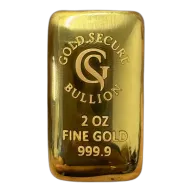
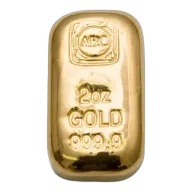
A 2oz gold bar contains two troy ounces of gold, equal to 62.207 grams. Unlike 1oz or 100g, this is not a traditional bullion standard. Two ounces is a relatively modern weight, and within the bar market it sits in a gap: most refiners jump straight from 1oz to 5oz or 10oz in their gold ranges, so 2oz bars are uncommon and tend to come from private mints rather than the big-name refiners.
The buyer this weight suits is one who wants a single piece holding twice the metal of a standard ounce without committing to a 5oz or 10oz purchase. Standard retail gold bars are produced to 999.9 fineness, and the same cast versus minted split applies here as elsewhere in the bar market: cast bars are poured into moulds with a rougher finish and lower premiums, while minted bars are cut from rolled sheet, polished, and usually sealed in a tamper-evident assay card carrying the serial number, weight, purity, and refiner's hallmark.
The trade-off to weigh up is product choice. At two ounces, the gold market is dominated by coins rather than bars; the Perth Mint produces 2oz gold coins across its Lunar, Kangaroo, and Koala ranges, while the bar shelf at this weight is sparse. UK buyers should also note the tax position that applies to all gold bars: investment-grade bars of 995+ purity are VAT-exempt on purchase, but bars are not CGT-exempt because the exemption applies only to UK legal tender coins. Gains above the GBP 3,000 annual allowance are taxable at 18-24% depending on income.
Where 2oz Sits on the Gold Bar Premium Curve
Gold bars carry the lowest premiums of any gold form, and premiums scale inversely with size. The published reference points run from 15-25% over spot for 1g bars, through 1-4% for 1oz minted bars (1-3% for cast), down to 2-4% for 100g bars and 1-2% for 1kg bars. A 2oz bar sits between the 1oz and 100g points on that curve, so the percentage saving over buying two separate ounces is modest rather than dramatic; the steep part of the curve is at the small fractional sizes, not between one and two ounces.
Two factors complicate the picture at this specific weight. First, because 2oz is not a standard bar denomination and most refiners skip it, there are fewer products competing for your order, and thin product ranges work against the buyer on price. Second, manufacturing method matters as much as weight: a cast 2oz bar from a private mint will price below a minted, assay-carded equivalent, since cast production is simpler and the finish rougher.
Compared with coins at the same weight, bars keep their usual edge. 2oz gold coins carry premiums of roughly 3-6%, similar to 1oz coins but with fewer product options. Buyers who want the lowest cost per ounce and are happy to scale up will find the bar market better served at 10oz and other standard denominations, where competition between LBMA-accredited refiners keeps pricing tight. For a UK buyer, the premium saving on any bar must also be set against the CGT liability that coins with legal tender status avoid.
What Is Actually Available at Two Ounces
The honest summary from the research: 2oz bars exist from some private mints but are uncommon, and two ounces is not a standard bar weight. The major LBMA-accredited refiners that define the gold bar market, names like PAMP Suisse, Valcambi, Argor-Heraeus, Heraeus, the Perth Mint, and the Royal Canadian Mint, build their core ranges around sizes such as 1g, 5g, 10g, 20g, 50g, 100g, 250g, 500g, 1kg, 1oz, and 10oz. Two ounces does not appear on that standard list, which is why the shelf at this weight is thin and stock varies from dealer to dealer.
What you will encounter instead are private-mint pieces, typically cast rather than minted, without the assay-card presentation that accompanies mainstream refiner bars. The features worth checking on any 2oz bar are the same ones that matter across the bar market: 999.9 fineness for retail bars, a recognisable hallmark, and ideally tamper-evident packaging with a serial number and certificate of authenticity.
The contrast with coins at this weight is stark. The Perth Mint produces 2oz gold coins in its Lunar series and its Kangaroo and Koala ranges, with the 2oz Kangaroo often appearing as a proof or high-relief collector piece. Buyers drawn to the two-ounce format for its own sake will find far more choice in the 2oz gold coin aisle, while buyers who simply want bar-format gold are usually better served by 1oz gold bars, where every major refiner competes.
Reselling a 2oz Gold Bar
Liquidity for gold bars rests heavily on the refiner's name and the condition of the packaging. Bars from LBMA-accredited refiners in sealed assay cards are highly liquid and widely accepted by dealers globally. Generic or unbranded bars, and bars from non-LBMA refiners, have lower liquidity and may require assay testing at the buyer's expense before resale. Since most 2oz bars come from private mints rather than the major accredited refiners, a 2oz bar is more likely to fall into the harder-to-sell category than a standard 1oz piece, and recognised mint products hold a clear resale advantage over generic bars at any uncommon weight.
The handling rules are the same as for any bar. If your bar came sealed in a tamper-evident assay card, keep it sealed: breaking the seal reduces resale value because the bar may then need re-assaying. Bars also carry slightly wider buy-sell spreads than well-known sovereign mint coins at retail, because coins have stronger brand recognition and a standardised appearance.
On storage, two ounces of gold is a compact holding however it is shaped. Minted bars in assay cards are flat and stack efficiently, though the cards are fragile and should be stored flat rather than standing on edge. Cast bars are less uniform, so they stack slightly less neatly. There is no tube or box convention to know at this weight; 2oz pieces are not sold in tubes as a standard packaging unit, and the coin equivalents from the Perth Mint are supplied in individual capsules or assay cards, so single-piece storage is the norm across the whole two-ounce format.
2 oz Gold Bars: frequently asked questions
-
A 2 oz gold bar's metal value is approximately 2 multiplied by $4,408.10 per troy oz. Retail prices add a dealer premium on top of that. We compare 8 listings from 6 dealers on this page so you can see the spread and find the keenest price.
-
A 2 troy oz gold bar weighs 62.207 g. Troy ounces are slightly heavier than the avoirdupois ounces used in everyday measure (31.1035 g vs 28.35 g), so it is important to use the troy figure when calculating metal value or comparing specifications.
-
Most countries require travellers to declare cash and monetary instruments above a threshold when crossing borders, and gold bullion can fall within those rules. The specific thresholds and definitions vary by country and by what you are carrying, so it is worth checking the customs rules for both your departure country and your destination before travelling with bullion.
-
Most Western countries impose no personal gold ownership limit. A small number of countries do restrict or require registration of large bullion holdings, so it is worth checking local rules if you are based outside the major Western markets.