1 listing
Filters
| Product | /oz | Premium | Price | |
|---|---|---|---|---|

 Ainslie Bullion
|
$4,470.20 | +2.77% |
$71,862.32
A$100,931
|
View Deal |
Prices are fetched automatically and may not reflect current merchant prices. Currency conversions and tax treatment are approximate. Rankings are based solely on price. We are not a dealer and accept no responsibility for transactions with listed merchants. Past performance is not indicative of future results. This site does not provide investment advice. Full disclaimer
About the 500g Ainslie Gold Bar
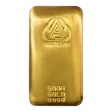
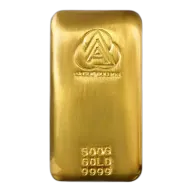
The 500g Ainslie Gold Bar: Half a Kilo at Near-Institutional Pricing
A 500 gram gold bar holds 16.075 troy ounces, roughly $53,000 or more of gold at 2026 prices, and sits in one of the most efficient pricing bands in the retail bar market. Premiums on 500g gold bars run approximately 1.5-3% over spot, lower than 1 oz or 100g bars and only slightly above full kilo bars. The premium compression from 100g to 500g is meaningful, roughly halving the percentage premium, which is why the half-kilo format appeals to buyers consolidating a position without committing to a full kilo in one transaction.
This Ainslie bar is struck at 999.9 fine gold, the standard purity for retail gold bars, and like other gold bars it carries no face value and is not legal tender. The half-kilo format is most at home in metric markets; in Australia, where Ainslie bars are sold, metric bars sit alongside Perth Mint's 500g cast bars, though kilo bars are the more popular large format locally.
The main consideration at this weight is the buyer pool. A 500g gold bar must be sold whole, and its high absolute value narrows resale to serious investors, dealers, and institutions. Buyers who anticipate selling in stages often prefer two 250g bars or five 100g bars, accepting a modestly higher premium for the divisibility. Conversely, the 500g bar beats the kilo on exactly that measure: it lets you liquidate half of a kilo-sized position without breaking anything up.
500g Ainslie Gold Bar Specifications
| Attribute | Value |
|---|---|
| Weight | 500 g (16.075 troy oz) |
| Purity | 999.9 fine gold |
| Metal | Gold |
| Form | Bar |
| Face value | None (not legal tender) |
A 500g gold bar is compact for its value, roughly the size of a small smartphone, and fits easily in any safe or deposit box; professional vault storage is common at this value level. Gold is soft, so bars of this size should not be stored loose against each other, since surface scratches reduce resale appeal.
Counterfeiting is the standing caution with larger gold bars. Tungsten's density (19.25 g/cm3) is close enough to gold's (19.32 g/cm3) that a plated tungsten core can pass weight and dimension checks, and XRF testing only reads the surface. Ultrasonic testing is the most reliable non-destructive check at this size, since gold and tungsten transmit sound at very different velocities. Buying from an authorised dealer and keeping the bar in its original packaging with any accompanying certificate is the practical safeguard for retail buyers.
500g Gold Bar Tax Treatment by Country
- Australia: GST-free as investment-grade gold, which the ATO defines as 99.5%+ purity in a tradeable form. Bullion held as an investment is subject to CGT, with a 50% discount for individuals holding longer than 12 months.
- UK: 0% VAT as investment gold (bars at 995+ fineness qualify). Bars are not legal tender, so gains above the annual CGT allowance (currently 3,000 pounds) are taxable, unlike CGT-exempt Britannias and Sovereigns.
- EU: VAT-exempt under the Investment Gold Directive for bars at 995+ fineness.
- US: No federal sales tax; most states exempt bullion, though some apply thresholds. Long-term gains are taxed at the collectibles rate of up to 28%.
- Canada: 0% GST/HST for gold refined to 99.5%+ in bar form.
- New Zealand: GST-exempt at 99.5%+ purity for gold.
- Singapore and Hong Kong: No GST (Singapore's Investment Precious Metals scheme covers gold at 99.5%+) and no capital gains tax in either jurisdiction.
500g vs 250g, Kilo, and Branded Half-Kilo Bars
The half-kilo decision is mostly about where you want to sit on the premium-versus-divisibility curve. Stepping down, smaller bars carry higher percentage premiums but can be sold piecemeal; stepping up, a 1 kilo gold bar achieves the lowest retail premium of any commonly traded bar but is an all-or-nothing sale. The 500g bar's premium penalty against the kilo is small, and the ability to sell half a kilo-sized position is the standard argument for choosing it.
Brand is the other axis. The established 500g gold bars come from LBMA-accredited refiners: Heraeus and Umicore (the German-speaking and Benelux favourites), PAMP Suisse and Valcambi cast bars from Switzerland, Argor-Heraeus, and Perth Mint's cast bar for the Australian and Asian markets. Bars from these refiners are universally accepted by dealers worldwide; bars from refiners without that accreditation may need assay verification at resale and can trade at melt value with wider spreads. Buyers should weigh any purchase saving on a non-LBMA bar against that resale friction, especially at a value where the buyer pool is already narrow.
Regionally, the 500g format is strongest in Germany, Switzerland, and Austria, where metric gold investment is the tradition. In the US and Canada, troy-ounce bars dominate and half-kilo bars are a niche, which matters if you expect to resell into a North American market.
500g Ainslie Gold Bar: frequently asked questions
-
The cheapest Ainslie 500g gold bar on this page is $71,862.32, around 2.8% over the $4,408.10 spot price. At half a kilogram, this is a large bar suited to investors prioritising low per-gram premiums over the liquidity of smaller sizes.
-
The Ainslie 500g gold bar weighs 500g and is 999.9 fine gold (24 carat). It is produced by Ainslie, an Australian precious metals company. At this size it offers straightforward bullion content at a lower premium per gram than smaller formats.
-
For any large gold bar, third-party testing offers the strongest assurance: XRF (X-ray fluorescence) confirms surface purity, while ultrasonic testing can detect a tungsten core. Keeping the bar in its original packaging preserves whatever documentation the maker provides. If purchasing second-hand, buy only from established dealers who can vouch for provenance.