1 listing
Filters
| Product | /oz | Premium | Price | |
|---|---|---|---|---|

 Sharps Pixley
Out of Stock
Sharps Pixley
Out of Stock
|
$4,451.84 | +2.46% |
$71,566.21
£53,631
|
View Deal |
Prices are fetched automatically and may not reflect current merchant prices. Currency conversions and tax treatment are approximate. Rankings are based solely on price. We are not a dealer and accept no responsibility for transactions with listed merchants. Past performance is not indicative of future results. This site does not provide investment advice. Full disclaimer
About the 500g Degussa Gold Bar
A Half-Kilo Gold Bar from One of the Most Recognised Names in European Precious Metals
The 500g Degussa gold bar carries one of the most recognisable brands in the precious metals industry. The Degussa name traces back to 1843, when Friedrich Ernst Roessler began operating the Frankfurt Mint's refinery as a private enterprise. The company, formally known as Deutsche Gold- und Silber-Scheideanstalt (German Gold and Silver Separation Works), became one of the first refineries accredited by the LBMA in 1930. That original refining operation ran continuously until the precious metals division was sold to OM Group in 2001 and subsequently acquired by Umicore in 2003.
The modern Degussa is a separate entity. The brand was revived in 2010 by the von Finck family, and retail operations launched in November 2011. By 2016, the revived Degussa had become Europe's largest gold retailer, selling 42.5 tonnes of physical gold that year alone. The company operates 12 retail stores across Germany plus locations in Geneva, Zurich, Madrid, and London. This is a retailer, not a refinery: modern Degussa-branded bars are manufactured by partner refineries rather than produced in-house.
The 500g size is produced as a cast bar, refined to 999.9 fine gold. At 16.075 troy ounces, this represents a substantial investment. The half-kilo weight is a natural fit for the German and European markets where metric weights are standard. Premiums at this size are compressed compared to smaller denominations, typically ranging from 1.5% to 3% over spot, and the cast production method keeps costs below minted equivalents.
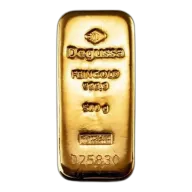
The bar features Degussa's iconic sun-moon-diamond logo, one of the most established trademarks in precious metals. Each bar carries a serial number and ships in sealed tamper-evident packaging. The Degussa brand recognition, particularly in German-speaking markets, means these bars trade with strong confidence among dealers familiar with the name.
500g Degussa Cast Gold Bar Specifications
| Property | Detail |
|---|---|
| Weight | 500 grams (16.075 troy oz) |
| Purity | 999.9 fine gold (24 carat) |
| Type | Cast bar |
| Brand | Degussa |
| Country of origin | Germany (manufactured by partner refinery) |
| Serial number | Yes (unique per bar) |
| Packaging | Sealed tamper-evident packaging |
| Logo | Sun-moon-diamond trademark |
| Face value | None (not legal tender) |
The 500g Degussa bar is produced exclusively in cast form. Cast bars are made by pouring molten gold into a mould, producing a slightly rougher surface than minted bars. This manufacturing method is standard for bars at 250g and above, where the reduced production cost translates to lower premiums for the buyer.
It is worth distinguishing between modern Degussa-branded bars and historic Degussa AG bars. The original Degussa AG produced cast and minted bars from the 1840s through 2005. Historic cast bars, particularly those from the Frankfurt production era, carry collector premiums on the secondary market. Modern Degussa bars are manufactured by LBMA-accredited partner refineries and sold through the Degussa retail network. Both carry the distinctive sun-moon-diamond logo, but they come from entirely separate production lineages.
Tax Treatment of the 500g Degussa Gold Bar
At 999.9 fineness, the Degussa 500g gold bar qualifies as investment gold in all major markets. Tax treatment is determined by the metal's purity and the buyer's jurisdiction, not by the brand.
United Kingdom
VAT: Exempt. Investment gold bars at 995+ fineness carry 0% VAT. CGT: Gold bars are liable for Capital Gains Tax because they are not legal tender. Gains above the annual exempt amount (£3,000) are taxed at 18% (basic rate) or 24% (higher rate). Gold held in a SIPP or SSAS pension is CGT-exempt, and 999.9 bars meet the 99.5% purity threshold for pension eligibility.
Germany
Investment gold is VAT-exempt. Capital gains are tax-free after a one-year holding period, making Germany one of the most favourable jurisdictions for gold bar investment. Degussa's strong retail presence across Germany (12 stores) makes buying and selling convenient. The Degussa brand is particularly well-known among German investors.
European Union
VAT-exempt across all EU member states under the Investment Gold Directive for bars at 995+ fineness. Capital gains rules vary by country. Belgium has no CGT on personal capital gains. France applies a flat rate or a progressive regime. Spain applies exit tax provisions for long-term residents.
United States
State sales tax varies; roughly 35 states exempt bullion. The bar's purity exceeds the 99.5% threshold for IRA eligibility under Section 408(m), provided it is stored at an approved depository. Federal capital gains on gold are taxed at the collectibles rate (up to 28% for long-term holdings).
Other Markets
The bar is GST/HST-exempt in Canada (gold at 99.5%+), GST-exempt in Australia and New Zealand (gold at 99.5%+), and GST-exempt under Singapore's IPM scheme. Hong Kong has no sales tax or CGT on gold.
From Frankfurt Mint to Modern Retail Empire
The Degussa story begins in 1843, when Friedrich Ernst Roessler, Keeper of the Frankfurt Mint, was authorised to operate the Mint's precious metals refinery as a private business. The timing was significant: after the Franco-Prussian War of 1871, Germany needed refining capacity to convert from a silver-backed to a gold-backed currency. The old Frankfurt Mint was chosen as the facility, giving Degussa a foundational role in Germany's monetary transition.
The company was incorporated as a joint-stock company in 1873 under the full name Deutsche Gold- und Silber-Scheideanstalt vormals Roessler, shortened to Degussa in the 1920s. LBMA accreditation followed in 1930. The Frankfurt refinery operated until 1975, when production moved to Hanau and Pforzheim. Degussa also had LBMA-accredited subsidiaries in the Netherlands (Schone Edelmetaal), Brazil, Singapore, and Canada.
The original company's precious metals division was sold to OM Group in 2001 and then acquired by Umicore in 2003. Umicore continued issuing bars with the Degussa stamp until the end of 2005, after which all production was rebranded to Umicore. The parent company itself was renamed Evonik in 2005.
The brand was revived in 2010 when the von Finck family acquired the Degussa name and launched a retail precious metals business. The first store opened in November 2011. Growth was rapid: by 2016, the company had sold 42.5 tonnes of gold, operated over a dozen stores across Germany, and expanded internationally to Geneva, Zurich, Madrid, and London. Roughly 25% of sales came through online channels. The modern Degussa offers over 1,500 products including bars, coins, jewellery, and watches.
This dual history creates an unusual situation in the bar market. Historic Degussa AG bars (produced before 2006) are collected as vintage items with premiums above their metal value, particularly the cast bars from the Frankfurt era. Modern Degussa bars, manufactured by partner refineries, trade at standard investment premiums. Both carry the sun-moon-diamond logo, but they represent fundamentally different products from separate entities.
Degussa vs Other 500g Gold Bars
The 500g gold bar category is well-served by established LBMA refiners. The 500g Valcambi has the widest dealer availability, followed by 500g Metalor, 500g Umicore, and 500g Heraeus. All share 999.9 purity and LBMA credentials. The practical differences are brand recognition, dealer availability, and premium levels.
The Degussa 500g bar has limited dealer availability outside the Degussa retail network itself. With only one dealer currently listing this product, buyers have less opportunity to compare prices than they would with a Valcambi or Heraeus bar that appears across dozens of dealers. This concentrated distribution is a feature of the Degussa retail model, which sells primarily through its own stores and website rather than through third-party dealer networks.
Brand recognition is the Degussa bar's strongest asset, particularly in Germany and German-speaking Europe. The name carries weight with European investors in a way that translates to confidence at resale. Outside Europe, the brand is less familiar. A buyer in the US or Asia looking for maximum resale flexibility would be better served by a Swiss refiner like Valcambi or PAMP, whose bars are stocked by dealers worldwide.
The connection to Umicore is worth noting for comparison shoppers. The 500g Umicore bar is produced by the company that actually acquired Degussa's original refining operations. Functionally, Umicore is the industrial successor to old Degussa. Umicore bars are more widely distributed internationally and carry LBMA accreditation in their own right. For a buyer choosing between a modern Degussa-branded bar and a Umicore bar, the Umicore offers broader liquidity while the Degussa offers stronger brand cachet in the German market.
500g Degussa Gold Bar: frequently asked questions
-
Degussa Goldhandel is a German precious metals retailer that produces minted gold bars in a range of sizes, including the 500g bar. Each bar is supplied with an individual assay card and serial number confirming its 999.9 fine gold content.
-
The 500g Degussa gold bar contains 500g of 999.9 fine gold. It is a minted bar with an individual serial number and an assay card certifying purity. At 999.9 fineness it qualifies as investment-grade gold, which is VAT-exempt in the UK and eligible for gold SIPP holdings.