1 listing
Filters
| Product | /oz | Premium | Price | |
|---|---|---|---|---|

 Go Gold
|
$4,470.82 | +3.97% |
$71,867.97
NZ$125,848
|
View Deal |
Prices are fetched automatically and may not reflect current merchant prices. Currency conversions and tax treatment are approximate. Rankings are based solely on price. We are not a dealer and accept no responsibility for transactions with listed merchants. Past performance is not indicative of future results. This site does not provide investment advice. Full disclaimer
About the 500g Go Gold Bar
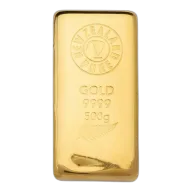
The 500g Go Gold Bar
This bar contains 500 grams of 999.9 fine gold, half a kilogram, or 16.075 troy ounces. At 2026 prices that is a position worth roughly $53,000 or more in a single piece, which places it firmly in the serious-investor bracket: the half-kilo format is bought by people consolidating a substantial allocation rather than accumulating gradually. Its appeal is near-institutional pricing at a more accessible capital outlay than a full kilo. Premiums on 500g gold bars run approximately 1.5% to 3% over spot, lower than 1 oz or 100g bars and only slightly above kilo bars.
The premium compression on the way up to this size is meaningful. Moving from 100g to 500g roughly halves the percentage premium in gold, so a buyer deploying tens of thousands of dollars keeps a visibly larger share of it in metal by choosing the larger format. The trade-off, as with all large gold bars, is divisibility: you sell the whole bar or none of it.
Physically the format is unremarkable in the best way. A 500g gold bar is roughly the size of a small smartphone, fits in any safe or vault despite its value, and is typically serialised, assayed, and sealed with a certificate. Professional vault storage is common at this value level. Bars of this size are a core product in the German-speaking markets, where metric gold investment is a long tradition, and they trade readily among European dealers and international bullion banks.
500g Gold Bar Specifications
| Attribute | Detail |
|---|---|
| Weight | 500 g (16.075 troy oz) |
| Purity | 999.9 fine gold |
| Legal tender | None; bars carry no face value |
| Typical presentation | Serialised and assayed, sealed with certificate |
A point of terminology worth getting right: a 500g bar is not an LBMA Good Delivery bar. The Good Delivery standard for gold specifies bars of roughly 350 to 430 troy ounces (10.9 to 13.4 kg). What a 500g bar from an LBMA-accredited refiner carries is the refiner's Good Delivery credentials, which is the credential that actually matters for dealer acceptance and international resale.
Authentication deserves more attention at this size than at retail weights. The tungsten-core counterfeit risk is most relevant for larger bars, because tungsten's density (19.25 g/cm3) sits close enough to gold's (19.32) to pass weight and dimension checks, and XRF surface testing only penetrates 10 to 50 microns, so a thick gold shell can defeat it. Ultrasonic testing is the most reliable non-destructive method: gold's sound velocity of 3,240 m/s differs sharply from tungsten's 5,170 m/s, exposing a core substitution immediately. For bars of 250g and up, the sensible practice is to buy from authorised dealers and request ultrasonic verification on secondary-market pieces.
Tax Treatment of the 500g Gold Bar
At 999.9 fineness the bar qualifies as investment gold everywhere the category exists, so the purchase is untaxed in nearly every major market; with roughly $53,000 at stake, the disposal rules deserve the most attention.
- United Kingdom: 0% VAT on investment gold (995 fine or better). No CGT exemption, since bars are not legal tender, and at this bar's value almost any meaningful gain will exceed the £3,000 annual allowance, leaving the excess taxed at 18% or 24%. UK buyers planning a long hold should price that against CGT-exempt legal tender coins. Gold bullion is SIPP-eligible.
- United States: No federal sales tax; most states exempt bullion, and a purchase of this size clears every state threshold-based exemption. Long-term gains are taxed at the collectibles rate of up to 28%. The bar exceeds the 99.5% IRA purity floor; IRA-held gold must come from an accredited refiner and sit with an approved custodian.
- EU: 0% VAT on investment gold in all member states. Germany, a core market for this weight, taxes nothing on gold held longer than a year.
- Canada, Australia, New Zealand: All exempt gold of 99.5%+ purity from GST/HST or GST.
- Singapore and Hong Kong: No purchase tax and no capital gains tax in either jurisdiction.
500g vs the Kilo, the 100g, and the Big Refiner Bars
The defining comparison is with the 1 kilo gold bar. The kilo has the lowest retail premium of any commonly traded bar, but it must be sold whole. The 500g bar accepts a small premium penalty in exchange for divisibility: holding two half-kilo bars instead of one kilo means you can liquidate half a position without touching the rest. For investors who may want staged exits, that flexibility is usually worth the difference.
Looking down the scale, the 100g gold bar is the other reference point. The step from 100g to 500g roughly halves the percentage premium, one of the larger efficiency gains in the metric range, so buyers with the capital who do not need 100g-sized granularity give up real money by staying small.
Within the 500g class, the established names are Heraeus (popular in Germany and Europe), Umicore (Belgian, serialised with certificate), PAMP Suisse (hand-poured cast bars), Valcambi (minted and cast), Argor-Heraeus, and the Perth Mint. All are LBMA-accredited and universally accepted by dealers, which is the practical benchmark any bar at this value level should be measured against: brand recognition determines how quickly and at what spread a $53,000 bar finds its next buyer. The main liquidity constraint at this size is not the brand but the price point itself, which narrows the buyer pool to serious investors, wealth managers, and institutions, and makes the US market, where troy-ounce formats dominate, a slower venue than Europe for metric half-kilo bars.
500g Go Gold Bar: frequently asked questions
-
The cheapest 500g Go Gold bar tracked across dealers is $71,867.97, currently around 4.0% over spot. Prices shift with the gold spot price throughout the trading day, so the figure on the comparison table is always the most current. Go Gold is showing the lowest price right now.
-
The Go Gold 500g bar contains 500 grams of 999.9 fine gold, equivalent to 24 carat. That purity level means the bar is effectively pure gold with only trace impurities. Go Gold produces bars across a range of gram weights for investors who prefer metric sizing.
-
1 dealer in our comparison currently lists the 500g Go Gold bar. Fewer dealers carry this weight than 1 oz or 100g bars, so checking the comparison table for availability and the best price is worthwhile before buying.
-
Gold melts at around 1,064°C; most house fires peak between 600°C and 800°C, so a bar may survive the heat but can deform or fuse to surrounding materials. For a bar of this value, a high-quality fire-rated safe bolted to the structure is the minimum sensible option. Many buyers prefer allocated vault storage or insured home coverage instead.