1 listing
Filters
| Product | /oz | Premium | Price | |
|---|---|---|---|---|

 Suisse Gold
Out of Stock
Suisse Gold
Out of Stock
|
$4,477.66 | +3.03% |
$71,978.62
€62,809
|
View Deal |
Prices are fetched automatically and may not reflect current merchant prices. Currency conversions and tax treatment are approximate. Rankings are based solely on price. We are not a dealer and accept no responsibility for transactions with listed merchants. Past performance is not indicative of future results. This site does not provide investment advice. Full disclaimer
About the 500g UBS Gold Bar
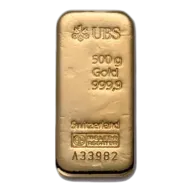
The 500g UBS Gold Bar
This bar carries the UBS name and contains 500 grams of 999.9 fine gold, equal to 16.075 troy ounces. The half-kilo format is one of the most cost-efficient ways to hold gold: premiums on 500g bars run approximately 1.5-3% over spot, below 1 oz or 100g bars and only slightly above full kilo bars. The premium compression from 100g up to 500g is meaningful, roughly halving the percentage premium, so this size delivers near-institutional pricing at a smaller capital outlay than a kilo.
A 500g gold bar is a significant purchase, representing around $53,000 or more at 2026 prices, and that absolute value shapes who buys it. The buyer pool is mostly serious investors, wealth managers, and institutions, which is the main constraint on liquidity at this size. The format is strongest in Europe, where metric bar weights are the standard and German-speaking markets in particular have a long tradition of metric gold bar investment; in the US and Canada, troy-ounce bars dominate and 500g pieces are less commonly traded. Physically the bar is compact, roughly the size of a small smartphone despite its value, and professional vault storage is common at this level. Buyers who want the lowest possible premium with the option to sell in halves will find 500g the practical compromise between 100g gold bars and a full kilo.
Tax Treatment of 500g Gold Bars
At 999.9 fineness, a 500g gold bar comfortably exceeds the 995 purity threshold that defines investment gold in most jurisdictions, so purchase taxes are rarely an issue. Disposal taxes are where the differences appear.
- United Kingdom: VAT-exempt on purchase as investment gold. Not CGT-exempt, since only UK legal tender coins qualify; gains above the £3,000 annual allowance are taxable at 18-24% depending on income. On a bar of this value, a single strong price move can produce a taxable gain, which is the key lifecycle cost against CGT-free coins.
- European Union: 0% VAT across all member states under the Investment Gold Directive for bars of 995+ fineness. Capital gains rules vary by country; Germany taxes nothing on bars held over one year, which makes large low-premium bars especially attractive there.
- United States: Most states exempt bullion from sales tax, with threshold rules in a few (California exempts over $2,000, which a 500g bar clears easily). Long-term gains are taxed at the collectibles rate of up to 28%. IRA-eligible bars must be 99.5%+ purity from accredited refiners and held at an approved depository.
- Canada and Australia: GST/HST-free and GST-free respectively at 99.5%+ purity. Australia additionally requires accredited-refiner provenance for investment-grade status.
- Singapore and Hong Kong: Singapore exempts qualifying gold from GST and levies no CGT; Hong Kong has no sales tax, import duty, or CGT at all.
500g Bars vs Kilo Bars, 100g Bars, and Coins
The decision most buyers face is 500g versus 1 kilo. The kilo gold bar carries the lowest retail premium of any commonly traded bar, typically 1-2% over spot, but it must be sold as a single unit. The 500g bar accepts a small premium penalty in exchange for divisibility: holding two half-kilo bars instead of one kilo means half the position can be liquidated while the rest stays put. For buyers in Asia and the Middle East, where kilo bars dominate, 500g is sometimes seen as an awkward middle ground; in Europe it is a standard, widely stocked weight.
Stepping down to 100g bars buys more flexibility at a real cost. Premiums on 100g gold run 2-4%, and the percentage premium roughly halves between 100g and 500g. Anyone planning piecemeal sales over time may still prefer several smaller bars despite the higher entry cost.
Against coins, the comparison is the familiar bars-versus-coins trade. Sovereign coins like the 1 oz gold Britannia carry higher premiums but offer stronger retail liquidity, and for UK buyers the Britannia's CGT exemption can outweigh a bar's lower purchase premium once gains exceed the annual allowance. One practical note specific to large bars: gold-plated tungsten counterfeits are a documented risk for bars of 100g and above because tungsten's density nearly matches gold's, so secondary-market buyers of 250g+ bars should request ultrasonic testing, the most reliable non-destructive verification method.