
 Ainslie Bullion


Prices are fetched automatically and may not reflect current merchant prices. Currency conversions and tax treatment are approximate. Rankings are based solely on price. We are not a dealer and accept no responsibility for transactions with listed merchants. Past performance is not indicative of future results. This site does not provide investment advice. Full disclaimer
About the 50g Ainslie Gold Bar
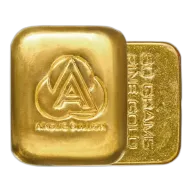
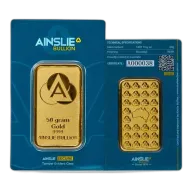
The 50g Ainslie Gold Bar
This is a 50 gram gold bar struck in 999.9 fine gold, containing 1.6075 troy ounces of metal. Fifty grams is the inflection point of the gram-bar premium curve: typical premiums of 3-6% over spot represent a sharp drop from the 8-12% common on 10g bars, because at this size the fixed costs of minting, packaging, and certification become a small fraction of the metal value. Multiple dealers describe 50g as the sweet spot of the metric range, delivering most of the premium efficiency of a 100g bar at a substantially lower outlay, around $5,000-$5,500 at 2026 gold prices.
Compared with the ubiquitous 1 oz bar, a 50g bar contains 1.6 times the gold at comparable or slightly lower premium percentages, so a buyer who can manage the larger single purchase gets marginally more efficiency. The trade-off is divisibility: one 50g bar must be sold whole, where a stack of 1oz gold bars can be liquidated in steps.
Physically, a 50g bar is highly portable, roughly 44mm x 24mm x 3.5mm in typical minted form, and fits easily in a small safe or deposit box. Like all gold bars it carries no face value and no legal tender status. If the bar is supplied in sealed assay packaging, keep it sealed; intact factory packaging from a recognised producer is what supports a clean buyback at resale, while a loose bar may face assay checks at the buyer's expense.
Tax Treatment of a 50g 999.9 Gold Bar
At 999.9 fineness this bar exceeds every major jurisdiction's investment-gold purity threshold, so the purchase is tax-free almost everywhere that matters. The standing caveat for bars is capital gains: with no legal tender status, a bar can never use coin-specific CGT exemptions.
- Australia: GST-free as investment-grade gold; the ATO threshold is 99.5% purity in a form commonly traded on commodity markets, which a 999.9 bar meets. Bullion held as an investment is subject to CGT, with a 50% discount for individuals holding longer than 12 months.
- UK: VAT-free as investment gold (995+ fineness for bars), but gains above the GBP 3,000 annual allowance attract Capital Gains Tax; only UK legal tender coins are CGT-exempt.
- EU: 0% VAT under the Investment Gold Directive.
- US: no federal sales tax; most states exempt bullion, and at roughly $5,000 this bar clears every state threshold exemption. Long-term gains taxed at the collectibles rate of up to 28%.
- Canada: 0% GST/HST at 99.5%+ purity.
- New Zealand: GST-exempt for gold bars at 99.5%+ purity.
- Singapore and Hong Kong: no GST or sales tax on qualifying investment gold, and no capital gains tax in either jurisdiction.
50g Bar vs the Swiss Names, 1oz Bars, and 100g
Every major LBMA-accredited refiner produces a 50g gold bar: PAMP Suisse (Fortuna design), Valcambi, Argor-Heraeus, Heraeus, the Perth Mint, and the Royal Mint, typically as minted bars in sealed assay cards. Those names carry universal dealer recognition and command the best buyback prices, so a 50g bar from any other producer competes primarily on purchase price. The gap matters more at exit than entry: bars from refiners without international accreditation can require assay testing before a dealer outside their home market will buy, which eats into whatever was saved upfront. Comparing the live premium here against a 50g PAMP Suisse bar shows what the brand discount or premium actually is on any given day.
On weight, the decision brackets are clear. Down at 1 oz, premiums are similar (3-5%) and divisibility is better, making it the safer choice for anyone who may need to sell in increments. Up at 100g, premiums improve by perhaps 1-2 percentage points (2-4% over spot), a modest gain for doubling the outlay, which is exactly why 50g is often recommended to first-time buyers seeking low premiums without committing to a larger bar.
Regionally, 50g is a core accumulation weight in Germany, Switzerland, and Austria, and a traditional savings denomination in Middle Eastern gold markets, while US buyers default to troy-ounce sizes. In ounce-dominated markets a 50g bar remains perfectly sellable through major dealers; it is simply less of a house standard than the 1oz formats.
50g Ainslie Gold Bar: frequently asked questions
-
The cheapest Ainslie 50g gold bar on this page is $7,208.29, approximately 3.1% over the current $4,408.10 gold spot price. Prices are updated in near real-time from dealer listings.
-
Ainslie Bullion is a private Australian bullion refinery and dealer. It operates as an independent refiner and retailer selling gold, silver, and platinum products directly to investors.
-
The Ainslie 50g gold bar is 999.9 fine gold, also expressed as 24-carat or four-nines purity. At 99.99% gold content it meets the investment-grade threshold in most markets, including the UK, Australia, Canada, and the EU.