6 listings
Filters
| Product | /oz | Premium | Price | |
|---|---|---|---|---|
|
50
 Elite Rare Coins
Out of Stock
Elite Rare Coins
Out of Stock
|
$4,411.39 | +0.07% | $7,091.47 | View Deal |
|
50
The Bullion Bank
Out of Stock
|
$4,412.05 | +0.09% | $7,092.53 | View Deal |
|
50
A Coin Shop
Out of Stock
|
$4,416.39 | +0.19% | $7,099.51 | View Deal |
|
50
AU Capital Management
Out of Stock
|
$4,420.05 | +0.27% | $7,105.39 | View Deal |
|
50
 Gold Stock Canada
Out of Stock
Gold Stock Canada
Out of Stock
|
$4,602.70 | +5.92% |
$7,398.85
CA$10,366
|
View Deal |
 IDC Coin and Bullion
Out of Stock
IDC Coin and Bullion
Out of Stock
|
$4,695.58 | +6.52% | $7,548.31 | View Deal |
Prices are fetched automatically and may not reflect current merchant prices. Currency conversions and tax treatment are approximate. Rankings are based solely on price. We are not a dealer and accept no responsibility for transactions with listed merchants. Past performance is not indicative of future results. This site does not provide investment advice. Full disclaimer
About the 50g Engelhard Gold Bar
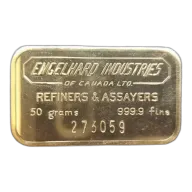
The 50g Engelhard Gold Bar
Engelhard is one of the most historically significant names in precious metals refining. Founded in 1902 by Charles W. Engelhard Sr. in Newark, New Jersey, the company grew to become the world's largest precious metals smelter by the 1950s. Engelhard exited the retail bullion market in the late 1980s to focus on industrial catalysts and materials, and the company was acquired by BASF in 2006 for $5 billion. No new Engelhard bars have been produced since the mid-1980s.
The 50g Engelhard gold bar is a vintage product. Bars in circulation were manufactured decades ago, and surviving examples carry a collector premium above their metal value. Engelhard's gold bars are less well-documented than its silver bars (which have an extensive collector community centred on the AllEngelhard.com catalogue), but they share the same manufacturing provenance and historical significance. Gold bars from Engelhard are typically .999 or .9999 fine, serialised, and stamped with the Engelhard hallmark.
For investors considering this bar, the distinction between bullion value and collector value is important. A 50g bar from a current LBMA refiner like Heraeus or PAMP Suisse trades near bullion premiums (3 to 6% over spot). An Engelhard bar may carry a higher premium reflecting the brand's discontinuation, historical significance, and collector interest. The gold content is the same; the additional cost buys provenance and scarcity.
Engelhard held LBMA Good Delivery accreditation during its operating years. Dealers generally accept Engelhard bars based on the hallmark and serial number, though some may request verification for vintage bars without original packaging. The brand name carries recognition across the US, where Engelhard was headquartered, and internationally among collectors and dealers familiar with the company's history.
50g Engelhard Gold Bar Specifications
| Property | Detail |
|---|---|
| Weight | 50 grams (1.608 troy ounces) |
| Purity | .999 to .9999 fine gold |
| Manufacturer | Engelhard Industries (now BASF), Newark, New Jersey, USA |
| Production era | Late 1960s through mid-1980s |
| Status | Discontinued; no new production since the late 1980s |
| Serial number | Yes (nearly all Engelhard bars are serialised) |
| Hallmarks | Engelhard name, weight, purity, serial number |
| Legal tender | No |
| Face value | None |
Engelhard bars were produced in cast (poured) and pressed formats. Surface finish and dimensions vary between production eras and methods. The serial number is the primary authentication marker for vintage Engelhard bars. Genuine bars exhibit consistent fonts and spacing specific to their production period, and the distinctive Engelhard hallmarks (including the 'E' globe logo used on later production) are key identifiers.
Charles Engelhard Jr., who consolidated the family business into Engelhard Industries in 1958, is widely cited as the inspiration for Ian Fleming's James Bond villain Auric Goldfinger. The company grew to become the world's largest precious metals smelter by the 1950s and processed gold for the US Treasury. BASF acquired the company in 2006, ending the Engelhard name in the precious metals industry. Surviving bars are finite in supply and carry collector interest alongside their bullion value.
Tax Treatment of the 50g Engelhard Gold Bar
The vintage status of Engelhard bars does not change their tax classification. They are gold bars and are treated as such in every jurisdiction. The potential collector premium above metal value does not reclassify them as numismatic items for tax purposes in most markets (though individual tax situations may vary).
United States
Engelhard's home market. No federal sales tax. State sales tax varies. Capital gains taxed at the 28% collectibles rate for long-term holdings. Engelhard bars at .999+ purity from an LBMA-accredited refiner (at the time of production) may meet IRA requirements, though custodians may have specific policies about vintage or discontinued products. Confirm with the custodian before purchasing for IRA inclusion.
United Kingdom
VAT-exempt on purchase as investment gold (995+ fineness). Subject to CGT on disposal at 18% or 24%. If the bar were classified as a collector's item rather than investment gold, it could fall outside the investment gold exemption. In practice, gold bars at .999+ purity are treated as investment gold by UK dealers regardless of vintage.
European Union
VAT-exempt under the Investment Gold Directive for bars at 995+ fineness. Capital gains treatment varies by country.
Canada, Australia, and Asia-Pacific
Canada: GST/HST exempt at 99.5%+ purity. Australia: GST-free as investment-grade gold. Singapore: GST-exempt under IPM. Hong Kong: no sales tax or CGT.
Engelhard vs Modern 50g Gold Bars
The comparison between an Engelhard 50g bar and a current-production bar from Heraeus, PAMP Suisse, or Valcambi is straightforward on the metal side: all contain approximately the same weight of high-purity gold. The divergence is in premiums and liquidity characteristics.
Modern LBMA bars in sealed assay cards trade at predictable premiums (3 to 6% over spot at 50g) and are universally accepted by dealers worldwide. Engelhard bars, being discontinued, trade at variable premiums that reflect collector demand as well as metal value. The collector premium can be modest or substantial depending on the specific bar variety and condition. An investor buying purely for gold exposure will get more gold per dollar from a modern bar.
The case for Engelhard is historical provenance. The company's name carries weight among collectors and bullion enthusiasts, and the discontinued status means surviving bars become relatively scarcer over time (particularly since some were melted during previous price spikes). For buyers who view their gold holding as part collection and part investment, the Engelhard premium may be worth paying. For pure bullion accumulation, a modern LBMA refiner bar is more efficient.
Authentication is another consideration. Modern bars in sealed assay cards can be verified non-destructively through the packaging. Vintage Engelhard bars require inspection of the hallmark, serial number format, font consistency, and weight. The AllEngelhard.com community maintains detailed catalogues of genuine bar varieties, which is the standard reference for authentication. Counterfeiting of Engelhard bars is documented, particularly at larger sizes. Buying from a reputable dealer with expertise in vintage bullion reduces this risk.
50g Engelhard Gold Bar: frequently asked questions
-
Engelhard ceased precious metals fabrication after the company was acquired and closed down its bullion operations. No new Engelhard bullion bars have been produced since then. All 50g Engelhard gold bars on the market today are vintage secondary-market pieces from original production runs, which is a key reason they often trade at a premium above freshly minted bars.
-
Engelhard's discontinued status means no new bars enter the supply chain, so existing inventory is finite. The hallmark carries strong brand recognition among collectors and stackers, creating demand that goes beyond pure metal value. This combination of scarcity and collector appeal pushes Engelhard bars to trade at higher premiums than comparable generic bars from active refineries.
-
Genuine Engelhard bars carry a stamped serial number, a fineness mark (999.9), and the Engelhard name and logo. Check that the bar's weight matches 50g precisely on an accurate scale. The assay stamp and serial number allow specialist dealers to cross-reference authenticity. For added certainty, an acid test or professional XRF assay will confirm metal content before purchase.