1 listing
Filters
| Product | /oz | Premium | Price | |
|---|---|---|---|---|

 Suisse Gold
Out of Stock
Suisse Gold
Out of Stock
|
$4,586.83 | +5.54% |
$7,373.42
€6,434
|
View Deal |
Prices are fetched automatically and may not reflect current merchant prices. Currency conversions and tax treatment are approximate. Rankings are based solely on price. We are not a dealer and accept no responsibility for transactions with listed merchants. Past performance is not indicative of future results. This site does not provide investment advice. Full disclaimer
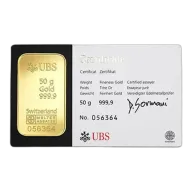
About the 50g UBS Gold Bar
The 50g UBS Gold Bar: Where the Premium Curve Flattens
At 50 grams (1.6075 troy oz), this bar sits at the point dealers repeatedly describe as the sweet spot of the metric bar range. Premiums on 50g gold bars typically run 3-6% over spot, a sharp drop from the 8-12% common on 10g bars, because at this size the fixed costs of manufacturing become a small fraction of the metal value. Stepping up further to a 100g bar saves only another 1-2 percentage points, so buyers who stop at 50g capture most of the premium benefit at roughly half the outlay.
The bar contains 999.9 fine gold, the standard retail purity, and at recent gold prices represents a purchase of roughly $5,000-$5,500. That makes it a substantial but not extreme single position; several dealers position 50g as a suitable first bar for buyers who want low premiums without committing to 100g or a kilo. Compared with a 1 oz gold bar, the 50g carries a similar or slightly lower percentage premium while holding 1.6 times the gold.
The 50g weight is a natural metric denomination, most popular in Germany, Switzerland, and Austria as a core accumulation size, and a traditional savings denomination in Middle Eastern gold markets. In the US it is available from major online dealers but is not a default weight, since troy-ounce bars dominate there; that regional preference is worth bearing in mind if you expect to resell into a North American market.
50g UBS Gold Bar Specifications
| Attribute | Value |
|---|---|
| Weight | 50 g (1.6075 troy oz) |
| Purity | 999.9 fine gold |
| Metal | Gold |
| Form | Bar |
| Face value | None (not legal tender) |
A typical 50g gold bar measures approximately 44mm x 24mm x 3.5mm, compact enough to fit any small safe or safety deposit box, and light enough to be highly portable. Bars sold in assay card packaging take on roughly credit-card dimensions and should be stored flat to prevent bending; keeping packaging sealed and intact preserves the chain of custody and the best buyback price, since a bar without its original packaging may need re-verification at resale.
Standard gold bar authentication applies. Weight and dimension checks catch crude fakes, while a Sigma Metalytics electromagnetic verifier is effective on bars up to about 100g, so a 50g bar is well within its reliable range. Tungsten-core substitution is mainly a concern for larger bars bought on the secondary market; purchasing from a reputable dealer avoids the issue for retail buyers.
50g Gold Bar Tax Treatment by Country
At 999.9 fine, the bar clears the investment-gold purity threshold in every major jurisdiction, so purchase tax is rarely a factor. Disposal tax is where bars and coins part ways.
- UK: 0% VAT as investment gold (bars must be 995+ fine). Not legal tender, so gains above the annual CGT allowance (currently 3,000 pounds) are taxable at the holder's CGT rate, unlike Britannias and Sovereigns.
- EU: VAT-exempt across member states under the Investment Gold Directive. In Germany, gains on bullion held for more than one year are tax-free, which combined with the low bar premium makes bars a favoured German format.
- US: No federal sales tax; most states exempt bullion. Long-term gains taxed at the collectibles rate of up to 28%.
- Canada: 0% GST/HST for gold refined to 99.5%+ purity in bar form.
- Australia: GST-free as investment-grade gold (99.5%+ purity).
- Switzerland: Investment gold is VAT-exempt.
- Singapore and Hong Kong: No GST or sales tax on investment-grade gold, and no capital gains tax in either jurisdiction.
50g Bars vs 1 oz, 100g, and the Branded Alternatives
Within the metric range, the 50g bar's nearest rivals are the 10g below it and the 100g gold bar above. The jump from 10g to 50g is the biggest premium improvement in the gram-bar range, from 8-12% down to 3-6%, while the further step to 100g (2-4%) saves comparatively little. For buyers choosing between them, the question is simply how much capital to concentrate in a single piece that must be sold whole.
Against the 1 oz bar, the trade is efficiency versus flexibility. The 1 oz format has maximum global liquidity and lets a position be liquidated in smaller increments; the 50g bar packs 1.6 times the gold into one piece at a comparable or slightly better percentage premium. Stackers in troy-ounce markets (US, UK) generally default to ounces, while metric-market buyers default to grams.
Brand recognition affects resale at this weight. The widely stocked 50g gold bars come from LBMA-accredited refiners: the PAMP Suisse Fortuna, Valcambi, Argor-Heraeus, Heraeus, Perth Mint, and Royal Mint all produce the weight, and bars from these names in sealed assay cards command the best buyback prices. Bars from refiners outside that circle can trade at wider spreads or require assay testing before a dealer will buy, so any purchase discount should be weighed against the resale friction.