3 listings
Filters

 Elite Rare Coins


Prices are fetched automatically and may not reflect current merchant prices. Currency conversions and tax treatment are approximate. Rankings are based solely on price. We are not a dealer and accept no responsibility for transactions with listed merchants. Past performance is not indicative of future results. This site does not provide investment advice. Full disclaimer
About the 50 oz Perth Mint Gold Bar
The 50 oz Perth Mint Gold Bar
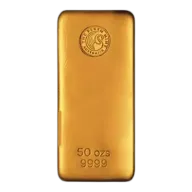
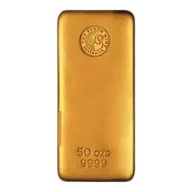
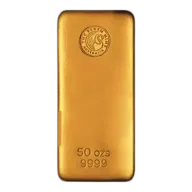
The 50 oz Perth Mint gold bar is a large-format gold bar for serious accumulators. At 1,555.17 grams (1.555 kg), this bar contains roughly $165,000 worth of gold at 2026 prices, placing it firmly in the institutional and high-net-worth investor category. The 50 troy ounce denomination is uncommon in the gold bar market, sitting between the widely traded 10 oz and 100 oz (or kilo) formats.
The Perth Mint is the sovereign mint of Western Australia, established in 1899 and owned by the Western Australian Government. It holds LBMA Good Delivery accreditation, making it one of only two sovereign mints with that status (the other being the Royal Canadian Mint). Perth Mint products carry sovereign government backing, which provides institutional-grade trust that private refiners cannot replicate. The bar is produced at 999.9 fine purity.
Premium efficiency at this weight is strong. Large-format gold bars typically command premiums of 1-3% over spot, significantly below the 3-6% range on 50g bars and the 8-12% on small metric bars. The 50 oz format captures most of the premium efficiency of a 100 oz bar at a lower total outlay, though the non-standard denomination means fewer refiners produce at this exact weight.
The practical considerations for a bar of this size are different from smaller products. Storage requirements are modest relative to the value (the bar is physically manageable at 1.555 kg), but insurance and security become more significant. The buyer pool for 50 oz gold bars is narrower than for 1 oz or kilo bars, which may affect resale speed.
50 oz Perth Mint Gold Bar Specifications
| Attribute | Value |
|---|---|
| Weight | 50 troy ounces (1,555.17 grams / 1.555 kg / 3.43 lbs) |
| Purity | 999.9 (24 karat) |
| Manufacturer | Perth Mint |
| Country of origin | Australia (Western Australia) |
| Mint type | Government-owned sovereign mint (est. 1899) |
| Format | Cast bar |
| Serialisation | Individual serial number |
| Accreditation | LBMA Good Delivery |
| Face value | None (not legal tender) |
Large-format Perth Mint bars are typically produced as cast bars rather than minted bars. Cast bars are made by pouring molten gold into moulds, resulting in a rougher surface finish than the polished minted bars common at smaller weights. This simpler production process contributes to the lower premium per ounce. Each bar is individually serialised with the Perth Mint's hallmark, weight, and purity stamped into the surface.
At 1.555 kg (3.43 lbs), the bar is substantial but manageable for storage. It is roughly the same weight as a standard hardcover book but far denser, occupying a much smaller volume due to gold's density of 19.32 g/cm3. Home safes rated for this value level, safety deposit boxes at banks, and professional vaulting services (including Perth Mint's own allocated storage programme) are all viable storage options. Insurance is strongly recommended at this value, as a single bar represents a significant concentration of wealth.
Tax Treatment for the 50 oz Perth Mint Gold Bar
As a 999.9 fine gold bar from an LBMA-accredited sovereign mint, the Perth Mint 50 oz bar qualifies for investment gold tax exemptions across all major jurisdictions. The high value of this bar makes tax treatment particularly impactful in absolute dollar terms.
- Australia: GST-free for investment-grade gold at 99.5%+ purity on first supply. Perth Mint is the domestic sovereign mint and its bars are the standard domestic product. Capital gains subject to CGT with a 50% discount for assets held over 12 months (for individuals). At approximately $165,000 per bar, even modest percentage gains can produce significant taxable events.
- United Kingdom: VAT-exempt on purchase as investment gold. Subject to Capital Gains Tax at 18-24% on disposal, with a £3,000 annual CGT allowance. Not CGT-exempt. SIPP-eligible for pension investment, though the high per-bar value may require a substantial pension fund.
- United States: IRA-eligible, as Perth Mint is LBMA-accredited and the bar exceeds the 99.5% purity threshold. Most states exempt bullion from sales tax. Long-term gains taxed at the 28% collectibles rate. Sales of this value will trigger Form 1099-B dealer reporting requirements.
- European Union: VAT-exempt as investment gold under EU Directive 98/80/EC.
- Canada: GST/HST-exempt at 99.5%+ purity.
- Singapore: GST-exempt under the Investment Precious Metals (IPM) scheme. No capital gains tax.
- Hong Kong: No sales tax, no import duty, no capital gains tax.
- New Zealand: GST-exempt for gold at 99.5%+ purity.
- South Africa: Gold bullion is zero-rated for VAT.
50 oz Perth Mint Bar vs Kilo Bars and Other Large Formats
The 50 troy ounce denomination is unusual in the gold market. Most buyers at this price point face a choice between several large-format options that differ in weight convention, liquidity, and availability.
The 1 kilo gold bar (32.15 troy ounces) is the nearest standard metric format below 50 oz. Kilo bars are the global standard for large-format gold trading, widely produced by PAMP, Valcambi, Argor-Heraeus, Heraeus, and Perth Mint itself. The kilo format has broader international liquidity than 50 oz, particularly in European and Asian markets where metric weights dominate. A 50 oz bar contains roughly 56% more gold than a kilo bar, which means a higher total outlay but fewer individual pieces to manage for the same position size.
The 100 oz gold bar (3.11 kg) is the next standard denomination up. At roughly $330,000, the 100 oz bar is a significant jump from the 50 oz bar's approximate $165,000. Premiums on 100 oz bars are marginally lower per ounce, but the doubled capital commitment makes the 50 oz bar a more practical step for investors who want large-format premium efficiency without the extreme concentration of a 100 oz bar. The 100 oz format also has better institutional liquidity, as it is a standard COMEX deliverable size.
Perth Mint's own kilo gold bar is the most direct alternative from the same refiner. Both carry the same sovereign government backing, LBMA accreditation, and 999.9 purity. The kilo bar has better global liquidity as a standard trading weight. The 50 oz bar delivers more gold per piece at a comparable premium-per-ounce, but in a denomination that is less universally recognised.
For Australian buyers, Perth Mint bars of any size benefit from being the domestic product with local dealer networks, straightforward tax treatment, and no import considerations. For international buyers, the choice between a Perth Mint 50 oz bar and a Swiss-refined kilo bar may come down to dealer availability and the premium quoted on the day.
50 oz Perth Mint Gold Bar: frequently asked questions
-
At 50 troy ounces, the fixed costs of production and handling are spread across a large quantity of metal, pushing the per-ounce premium down. Large gold bars from established government-backed mints also benefit from high global liquidity, as they are widely accepted by bullion dealers and institutions worldwide, which keeps margins competitive.
-
Standard verification methods for minted gold bars apply: check that the bar's weight and dimensions match the stated specifications, examine the hallmarks for clean, sharp stamping, and inspect the assay certificate if one is supplied. Purchasing from an authorised or reputable dealer is the most reliable safeguard against counterfeits.