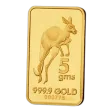
1 listing
Filters
| Product | /oz | Premium | Price | |
|---|---|---|---|---|

 Australian Bullion Company
|
$5,347.31 | +22.93% |
$859.59
A$1,207
|
View Deal |
Prices are fetched automatically and may not reflect current merchant prices. Currency conversions and tax treatment are approximate. Rankings are based solely on price. We are not a dealer and accept no responsibility for transactions with listed merchants. Past performance is not indicative of future results. This site does not provide investment advice. Full disclaimer
About the 5g Melbourne Mint Gold Bar
The 5g Melbourne Mint Gold Bar as a Small-Format Entry Point
The 5g Melbourne Mint Gold Bar contains five grams of gold, equal to 0.1607 troy ounces. It sits in the small metric bar bracket, a step up from 1g and 2.5g bars in both metal content and premium efficiency, and a step below the 10g and 1 oz sizes where per-gram costs fall further. Bars at this weight are produced primarily as minted bars sealed in assay cards, and in that packaging the whole unit is roughly credit-card sized, which makes multiple bars easy to store flat and stack.
The economics of the 5g size are straightforward. Premiums on 5g gold bars typically run 8-12% over spot. That is lower than the premiums charged on 1g bars but still well above the 1-4% typical for 1 oz minted bars, because the fixed costs of minting, packaging, and certification are spread across far less metal. Buyers choose this size for the lower absolute price point rather than for premium efficiency: a 5g gold bar costs approximately $500-$550, putting it in the same bracket as a 1/10 oz gold coin from a sovereign mint.
That price overlap frames the core decision. A 1/10 oz sovereign coin such as an Eagle, Britannia, or Maple Leaf offers stronger liquidity and brand recognition at roughly the same outlay, whereas a small minted bar may carry a somewhat lower premium. The choice often comes down to a preference for coins versus bars. For buyers committed to the bar format, the 5g size is more liquid than 1g or 2.5g bars but less liquid than 10g or 1 oz products, and buyback prices per gram are less favourable than on larger bars, so the high acquisition premium is not fully recoverable on resale.
Storage and handling are simple at this weight. Keep the bar sealed in its assay card: the card protects the bar from contact damage and preserves the chain of custody, and assay card preservation matters for resale value. The cards themselves are fragile, so store them flat rather than standing on edge. For metric-market buyers who want a small, affordable gold position, a 5g bar is a practical holding; buyers saving toward a 10g or 50g bar will get noticeably better value per gram by waiting and buying the larger size in one purchase.
Tax Treatment of 5g Gold Bars by Country
Standard retail minted gold bars are struck at 999.9 fineness, which clears the investment-gold purity thresholds in every major market. The summary below applies to gold bars meeting those thresholds.
- United Kingdom: Investment gold bars of 995+ fineness are VAT-exempt. Bars are not CGT-exempt, since that exemption covers only UK legal tender coins; gains above the GBP 3,000 annual allowance are taxable at 18-24% depending on income.
- United States: No federal sales tax, and most states exempt bullion bars from state sales tax. Long-term capital gains on bullion are taxed at the 28% collectibles rate. IRA eligibility requires 99.5%+ purity from an LBMA/COMEX/NYMEX-accredited refiner with storage at an approved depository.
- European Union: Gold bars of 995+ fineness qualify as investment gold and are VAT-exempt across all member states. Capital gains rules vary by country; Germany taxes no gain on bullion held over 12 months.
- Australia: Gold of 99.5%+ purity in a form commonly traded on commodity markets, including bars, is GST-free. Bullion held as an investment is subject to CGT, with a 50% discount for individuals holding longer than 12 months.
- Canada: Gold bars of 99.5%+ purity are GST/HST exempt.
- New Zealand: Gold bars of 99.5%+ purity are GST-exempt.
- Singapore: Gold bars of 99.5%+ purity from LBMA-accredited refiners qualify as Investment Precious Metals and are GST-exempt. There is no capital gains tax.
- Hong Kong: No VAT, no import duties, and no capital gains tax on bullion.
For UK buyers the bar-versus-coin distinction matters most: a gold bar is VAT-efficient on purchase but CGT-liable on sale, so for gains above the annual allowance the tax cost can outweigh the initial premium savings against CGT-exempt coins.
5g Melbourne Mint Bar vs PAMP, Valcambi, and Perth Mint 5g Bars
All the major LBMA-accredited refiners produce a 5g gold bar, so the Melbourne Mint bar competes directly with the 5g PAMP Suisse Fortuna, the 5g Valcambi bar, and the 5g Perth Mint bar, along with 5g bars from Argor-Heraeus, Heraeus, and the Royal Mint. Metal content is identical across all of them, so the comparison comes down to brand recognition, premium, and resale.
Brand recognition is where the Swiss refiners lead. PAMP and Valcambi bars in sealed assay cards show good liquidity and are recognised globally, and dealers universally accept sealed bars from LBMA-accredited refiners. The PAMP Fortuna also commands a modest premium over generic refiner bars because of that recognition and its iconic Fortuna design. The Perth Mint bar adds government backing from the Western Australian Government and its kangaroo design. Argor-Heraeus bars carry kinebar holographic security, and PAMP and Valcambi include VeriScan verification technology in their packaging.
The practical takeaway for a buyer weighing the Melbourne Mint bar against these alternatives is resale. Bars from refiners with universal recognition sell on without friction, whereas bars from less widely recognised producers may face a narrower buyer pool or require assay testing at the buyer's expense before a dealer accepts them. At the 5g size, where buyback prices per gram are already less favourable than on larger bars, recognition matters proportionally more. If the Melbourne Mint bar is priced below the Swiss-refiner equivalents, that discount needs to be weighed against the smoother exit the better-known names offer.
The other comparison worth making is against coins rather than bars. A 5g gold bar costs about the same as a 1/10 oz gold coin, and at that price point sovereign coins such as the Eagle, Britannia, or Maple Leaf carry better liquidity and brand recognition, with the small bar's advantage being a potentially lower premium. Buyers who simply want the cheapest gram of gold in this price bracket should price both formats; buyers who expect to sell back to a dealer in future should weight the coin's recognition advantage more heavily.
5g Melbourne Mint Gold Bar: frequently asked questions
-
The cheapest Melbourne Mint 5g gold bar currently listed on BullionFerret is $859.59, based on 1 dealer offers. The spot value of 5g of gold is $4,408.10; the bar trades at a premium above that to cover manufacturing and distribution costs.
-
Dealers are currently charging around 22.9% over the gold spot price for this bar, with the cheapest offer from Australian Bullion Company at $859.59. Small bars like this 5g size carry higher percentage premiums than larger bars because minting and handling costs are spread over less metal.
-
Melbourne Mint is an Australian bullion company based in Melbourne, Victoria. They produce gold and silver bars sold through their own retail channels and via third-party dealers. They are separate from government-linked operations such as the Perth Mint or the Royal Australian Mint.
-
Minting a bar involves fixed costs for fabrication, assay, packaging, and handling that do not scale proportionally with weight. Spread across 5 grams of gold rather than 100 grams, those same fixed costs consume a larger share of the metal's value, pushing the percentage premium higher. Larger bars dilute those costs across more metal, making them more cost-efficient per gram.