1 listing
Filters
| Product | /oz | Premium | Price | |
|---|---|---|---|---|

 Suisse Gold
Out of Stock
Suisse Gold
Out of Stock
|
$5,460.53 | +25.64% |
$877.79
€766
|
View Deal |
Prices are fetched automatically and may not reflect current merchant prices. Currency conversions and tax treatment are approximate. Rankings are based solely on price. We are not a dealer and accept no responsibility for transactions with listed merchants. Past performance is not indicative of future results. This site does not provide investment advice. Full disclaimer
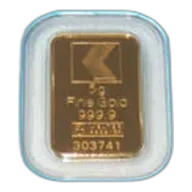
About the 5g Swiss Kantonalbank Gold Bar
A 5g Gold Bar at the Metric Entry Point
The 5g Swiss Kantonalbank gold bar contains 5 grams of 999.9 fine gold, which works out to 0.1607 troy oz. Five grams is one of the standard small metric bar weights, produced primarily as minted bars sealed in assay cards, and it occupies a similar price bracket to a 1/10 oz gold coin. For buyers in metric-system markets, particularly Germany, Switzerland, and Austria, 5g is a common entry-level size sold through banks and bullion dealers alike.
The economics of small bars are straightforward: fixed manufacturing overhead per bar drives premiums well above what larger formats carry. Typical 5g gold bar premiums run 8 to 12 percent over spot, lower than 1g bars but still significantly above the 2 to 4 percent typical of a 100g gold bar or the 1 oz level. The trade-off buys affordability and divisibility. A position built from 5g bars can be sold off in small increments, something a single large bar cannot offer.
Storage is trivial. A 5g bar in its assay card is roughly credit-card sized, stores flat, and stacks easily with others. Keeping the assay card sealed and intact matters for resale, since dealers pay best prices for sealed bars from recognised refiners. Buyers comparing this bar against alternatives at the same budget should weigh it against 1/10 oz gold coins from sovereign mints, which cost roughly the same but carry stronger brand recognition on the secondary market.
Tax Treatment of 5g Gold Bars by Country
Gold bars at 999.9 fineness comfortably clear the investment gold thresholds that most jurisdictions apply, so this bar receives favourable sales tax treatment in nearly every market BullionFerret covers.
- UK: 0% VAT. Investment gold bars at 995 fineness or above are VAT-exempt. Bars are not CGT-exempt, however; that exemption applies only to UK legal tender coins, so gains above the £3,000 annual allowance are taxable.
- EU: 0% VAT across all member states under the Investment Gold Directive, which covers gold bars and wafers at 995 fineness or above.
- US: No federal sales tax; state treatment varies. Around 35 states exempt bullion entirely, while some apply thresholds: California exempts purchases over $2,000 and Florida over $500, levels a single 5g bar will not reach on its own. Long-term capital gains are taxed at the collectibles rate of up to 28%.
- Canada: 0% GST/HST on gold refined to 99.5% purity or higher, which this bar exceeds.
- Australia: 0% GST on investment-grade gold at 99.5% purity or above.
- New Zealand: GST-exempt for gold at 99.5% purity or above.
- Singapore and Hong Kong: No GST on qualifying investment precious metals in Singapore; Hong Kong levies no sales tax or duty on bullion at all, and neither jurisdiction taxes capital gains.
5g Bar vs 1/10 oz Coins and Larger Bars
The most direct alternative at this price point is a 1/10 oz gold coin from a sovereign mint. Both cost roughly the same, but the comparison cuts both ways. Fractional sovereign coins such as the 1/10 oz gold Britannia carry premiums of 10 to 18 percent, often higher than a 5g bar, yet they enjoy better liquidity and near-universal brand recognition. A 5g bar from an LBMA-accredited refiner may be cheaper to acquire, but dealers' buyback prices for small bars are less favourable per gram, so the acquisition premium is not fully recoverable either way.
Against other small bars, 5g sits in the middle of the gram range. It is meaningfully more efficient than 1g bars, where premiums are steepest, and more liquid than 1g or 2.5g formats. Step up to a 10g gold bar and the premium per gram improves again as manufacturing costs spread across more metal; the pattern continues through 50g and 100g, where premiums fall to the 2 to 4 percent range.
The practical question is whether the buyer values small increments or cost efficiency. Buyers accumulating gradually and wanting the option to sell in small pieces are the natural audience for 5g bars. Buyers saving toward a larger single purchase will get significantly better value per gram by waiting and buying a 50g or 100g bar instead. In the US and UK, where troy-ounce sizing dominates retail bullion, fractional coins tend to be the more familiar product; in continental Europe, metric bars like this one are the default.