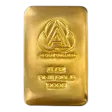
1 listing
Filters
| Product | /oz | Premium | Price | |
|---|---|---|---|---|

 Ainslie Bullion
|
$4,474.86 | +2.88% |
$22,375.04
A$31,426
|
View Deal |
Prices are fetched automatically and may not reflect current merchant prices. Currency conversions and tax treatment are approximate. Rankings are based solely on price. We are not a dealer and accept no responsibility for transactions with listed merchants. Past performance is not indicative of future results. This site does not provide investment advice. Full disclaimer
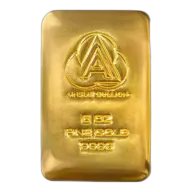
About the 5 oz Ainslie Gold Bar
Five Ounces of Gold in a Single Bar
This Ainslie bar contains 5 troy ounces (155.517 g) of .9999 fine gold, a serious single purchase: at current gold prices a 5 oz bar represents $15,000 or more, which is why the format is uncommon outside institutional and high-net-worth buying. The 5 oz denomination itself is a troy-weight middle ground between the ubiquitous 1 oz bar and the metric large formats; in Europe and Asia, where metric weights rule, buyers reach for 100g, 250g, or 500g bars instead, so 5 oz gold bars are a relatively niche product globally, produced by names such as PAMP Suisse, Valcambi, and Perth Mint.
The case for consolidating into a bar this size is the usual gold-bar arithmetic taken further. Bars carry the lowest premiums of any gold form because they skip the minting complexity and legal tender overhead of coins, and premium percentage falls as bar size rises, from 1-4% at 1 oz down toward the 1-2% of kilo bars. Five ounces in one bar buys most of that large-bar efficiency while remaining a manageable physical object, far smaller than the equivalent value in silver.
The trade-offs are concentration and divisibility. The bar sells as one piece, so partial liquidation is impossible, and the buyer pool for a $15,000+ single item is narrower than for 1 oz gold bars, which remain the sweet spot for balancing premium efficiency against resale flexibility.
Ainslie 5 oz Gold Bar Specifications
| Attribute | Value |
|---|---|
| Weight | 5 troy oz (155.517 g) |
| Purity | .9999 fine gold |
| Form | Bar |
| Fine gold content | 5 troy oz |
The four-nines fineness is the retail bar standard and clears every purity threshold that matters: the 995 floor for UK and EU investment gold, the 99.5% lines for Canadian GST/HST exemption and Australian, New Zealand, and Singaporean GST relief, and the 99.5% IRA purity rule in the US (IRA eligibility additionally requires the producer to be an accredited refiner and the bar to be held at an approved depository).
A 5 oz gold bar is small and dense, easy to store anywhere, and gold needs no atmospheric precautions since it does not tarnish. Two handling points matter at this value level. First, authentication: gold bars face the tungsten-core counterfeiting risk, which becomes more relevant as bars get larger because plated cores can pass weight and dimension checks; XRF testing only reads the surface, so ultrasonic testing is the reliable non-destructive check for substantial bars, and electromagnetic verifiers work for bars up to about 100g (this bar's 155g sits beyond that comfort zone). Second, packaging: where the bar comes sealed with assay documentation, keeping the seal intact preserves full buyback value, since opened bars may need re-assaying before a dealer pays top price.
Tax Treatment of a 5 oz .9999 Gold Bar
Investment gold is the most tax-favoured metal almost everywhere, and a high-value bar makes the remaining differences material.
- Australia: GST-free as investment-grade gold at 99.5%+ purity. CGT applies on disposal, with the 50% discount for individuals holding over 12 months.
- United Kingdom: VAT-free at 995+ fineness, but bars are not CGT-exempt; with no legal tender status, gains above the £3,000 annual allowance are taxed at 18-24%. On a bar this size the potential gain is large, which is why UK buyers often weigh bars against CGT-exempt coins.
- EU: 0% VAT on investment gold bars. Germany taxes no gains after a one-year hold.
- United States: no federal sales tax; most states exempt bullion, and a 5 oz gold bar exceeds every state's exemption threshold. Long-term gains are taxed at the collectibles rate of up to 28%, and large dealer sales can involve Form 1099-B reporting.
- Canada: GST/HST exempt at 99.5%+ purity in bar form.
- New Zealand: GST-exempt at 99.5%+ gold purity; no capital gains tax regime, though gains can be taxed as income if bullion was bought for resale.
- Singapore: 0% GST as an Investment Precious Metal; no capital gains tax.
- Hong Kong: no sales tax, no duty, no capital gains tax.
5 oz Bar vs Coins, Smaller Bars, and Metric Formats
The coin route to the same exposure is five 1 oz sovereign coins. Those cost more, coins run roughly 3-8% over spot against the lower bar premiums, but they sell one at a time, enjoy the strongest dealer recognition in the market, and in the UK the legal tender options (Britannia, Sovereign) add CGT exemption that no bar can match. A 1 oz gold Britannia position is the standard UK alternative for exactly that reason. For buyers in no-CGT jurisdictions like Singapore and Hong Kong, that coin advantage disappears and the bar's lower premium stands unopposed.
Within bars, the comparison runs in both directions. Five 1 oz bars cost slightly more per ounce but restore divisibility; a 100g bar (3.215 oz) or a kilo bar pushes premiums lower still for buyers who keep scaling. The metric formats also matter for resale geography: 100g and 250g bars are the familiar units to European dealers, while 5 oz reads most naturally in troy-ounce markets.
Brand is the final variable. LBMA-accredited refiner bars carry universal recognition and the tightest spreads internationally; bars from producers outside that list can be perfectly good metal but may need assay verification at resale, particularly abroad. At a $15,000+ price point, checking how the specific brand trades in your local market before buying is worth the effort.
5 oz Ainslie Gold Bar: frequently asked questions
-
The cheapest Ainslie 5oz gold bar tracked on this page is $22,375.04, sitting around 2.9% over the $4,408.10 spot price. Five troy ounces is a popular bulk-stacking size, and the premium per ounce is typically lower than fractional bars because the production cost is spread across more metal.
-
The Ainslie 5oz gold bar contains 5 oz of fine gold, equal to roughly 155.5 grams. At that size it sits firmly in the mid-tier range for stackers: larger than fractional wafers but smaller than a kilo bar. Exact physical dimensions vary by production run, but expect a chunky, solid bar that handles noticeably more weight than a 1oz piece.
-
The Ainslie 5oz gold bar is 999.9 fine gold, equivalent to 24 carat. This four-nines purity matches the standard used across the other Ainslie gold bar sizes.