1 product · 1 deal

Prices are fetched automatically and may not reflect current merchant prices. Currency conversions and tax treatment are approximate. Rankings are based solely on price. We are not a dealer and accept no responsibility for transactions with listed merchants. Past performance is not indicative of future results. This site does not provide investment advice. Full disclaimer
About the Battle of the Coral Sea Gold
Perth Mint's WWII Commemorative Gold Coin
The Battle of the Coral Sea coin is part of Perth Mint's "War in the Pacific" series, commemorating Allied campaigns in the Pacific Theatre during World War II. The gold version was issued in 2014 and 2015 in 1/10 oz and 1/4 oz denominations at .9999 fine gold purity. These are Australian legal tender coins struck under the Australian Currency Act, with face values of $15 AUD (1/10 oz) and $25 AUD (1/4 oz).
The Battle of the Coral Sea (4-8 May 1942) holds particular significance in both Australian and American military history. It was the first naval engagement fought entirely through carrier-based aircraft, with the opposing ships never directly sighting or firing upon each other. The battle halted the Japanese advance toward Port Moresby in Papua New Guinea, protecting Australia's northern coastline. It is sometimes described as "the battle that saved Australia," and the Australia-US alliance forged during that campaign remains a cornerstone of both nations' defence relationships.
Perth Mint struck these coins as bullion-grade products at competitive pricing, not as high-premium numismatic pieces. The WWII theme occupies a unique niche in the gold bullion market, where nature themes, national symbols, and historical figures dominate. Few mints produce WWII commemoratives in bullion format; most war-themed coins are proof issues at much higher premiums. The Battle of the Coral Sea coin offered historical significance at accessible bullion-level pricing.
The series was produced for two years only (2014-2015), making it a short-lived programme. Remaining inventory circulates on the secondary market through dealers who stocked the original production runs.
Battle of the Coral Sea Gold Specifications
| Attribute | 1/10 oz Gold | 1/4 oz Gold |
|---|---|---|
| Fine weight | 3.11g (1/10 troy oz) | 7.78g (1/4 troy oz) |
| Purity | .9999 fine gold | .9999 fine gold |
| Diameter | Approximately 16 mm | Approximately 20 mm |
| Face value | $15 AUD | $25 AUD |
| Edge | Reeded | Reeded |
| Years minted | 2014, 2015 | 2015 |
| Finish | Brilliant Uncirculated / Proof | Brilliant Uncirculated |
| Mint | Perth Mint | Perth Mint |
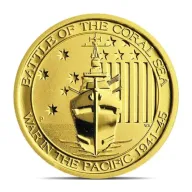
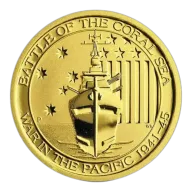
The reverse, designed by Wade Robinson, depicts a WWII-era battleship with guns raised, sailing before the Southern Cross constellation. The flags of Australia and the United States are shown together, symbolising the Allied partnership that defined the Pacific campaign. Inscriptions read "BATTLE IN THE CORAL SEA" and "WAR IN THE PACIFIC 1941-1945." The Perth Mint "P" mintmark appears on the reverse along with weight and purity specifications.
The obverse carries Ian Rank-Broadley's fourth-generation portrait of Queen Elizabeth II (1998 design), with inscriptions "ELIZABETH II," "AUSTRALIA," the face value, and date. The 2014 gold proof version (1/10 oz, mintage 2,500) was individually encapsulated with a numbered certificate of authenticity.
Tax Treatment of the Battle of the Coral Sea Gold
As Australian legal tender coins at .9999 fine gold purity, the Battle of the Coral Sea gold coins qualify for investment gold tax exemptions across all major markets.
Australia: GST-exempt as investment-grade precious metal under the Australian Currency Act. Capital gains tax applies, with a 50% CGT discount for holdings over 12 months.
United States: IRA-eligible. The .9999 purity exceeds the IRS minimum requirement for precious metals IRAs. No federal sales tax; state exemptions apply in most states. The WWII Australia-US alliance theme gives the coin particular appeal for American collectors and investors. Long-term gains taxed at the 28% collectibles rate.
United Kingdom: VAT-exempt as investment gold (sovereign-issued legal tender coin at .9999 purity). Subject to capital gains tax on profits, as the coin is not UK legal tender. The gold Britannia provides CGT exemption that Perth Mint products do not.
Canada: GST/HST-exempt at 99.5%+ purity. Capital gains subject to the 50% inclusion rate.
Singapore: Qualifies for IPM GST exemption as a legal tender coin at 99.5%+ purity. No capital gains tax.
Hong Kong: No sales tax, no import duty, no capital gains tax.
New Zealand: GST-exempt as fine gold at 99.5%+ purity. No formal capital gains tax, though profits may be taxable if the IRD determines the purchase was speculative.
Commemorating the First Carrier Battle
The Battle of the Coral Sea ran from 4 to 8 May 1942, and its outcome reshaped the course of the Pacific War. Japanese forces planned to capture Port Moresby on the southern coast of Papua New Guinea, which would have given them air superiority over the Torres Strait and threatened Australia's northern coastline. Allied intelligence, including codebreaking of Japanese naval communications, allowed the US Pacific Fleet and the Royal Australian Navy to intercept the Japanese task force in the Coral Sea.
The engagement was a watershed in naval warfare. For the first time in history, two opposing fleets fought without their ships ever coming within direct line of sight. All offensive action was conducted through carrier-launched aircraft. The Japanese lost the light carrier Shoho and had the fleet carrier Shokaku heavily damaged. The Americans lost the fleet carrier USS Lexington ("Lady Lex") and the destroyer USS Sims. Tactically, the battle was a draw. Strategically, it was an Allied victory: the Japanese abandoned the Port Moresby operation and never attempted it again by sea.
The Coral Sea engagement directly set up the decisive Battle of Midway one month later. The damage to Shokaku and the aircraft losses aboard Zuikaku meant both carriers were unavailable for Midway, tipping the balance in favour of the US Navy in what became the turning point of the Pacific War.
Perth Mint's coin captures this history on the reverse, with the battleship design and twin Australian-American flags reflecting the joint operation. The annual Coral Sea commemorative dinner remains one of the most significant events in the Australia-US defence relationship, underscoring the enduring importance of the battle to both nations' military identities.
The War in the Pacific series produced coins for two years (2014-2015) before being discontinued. The silver version was struck in the less common 1/2 oz format, a deliberate choice to offer a lower entry point than the standard 1 oz sovereign silver coin. The gold versions at 1/10 oz and 1/4 oz similarly targeted the fractional market.
Battle of the Coral Sea vs Other Fractional Gold
The Battle of the Coral Sea gold coins are fractional pieces (1/10 oz and 1/4 oz), so the comparison is primarily against other fractional gold from Perth Mint and competing mints.
Within Perth Mint's own catalogue, the gold Kangaroo is available in matching fractional sizes (1/10 oz and 1/4 oz) with effectively unlimited mintage and annual design changes. The Kangaroo carries deeper liquidity and lower premiums on the secondary market. The Battle of the Coral Sea, being a two-year limited programme, trades at higher premiums but offers the distinctive WWII commemorative angle that the Kangaroo lacks. Perth Mint's Lunar series also offers fractional gold, with stronger collector demand driven by Chinese zodiac themes.
Against the 1/10 oz Canadian Maple Leaf and 1/10 oz Britannia, the Coral Sea coin is at a disadvantage on liquidity and availability. Both the Maple Leaf and Britannia are continuously produced in large volumes and can be purchased from any dealer worldwide. The Coral Sea is secondary-market only, which limits supply and can mean wider bid-ask spreads.
The WWII theme is the coin's unique selling point. Few bullion-grade products commemorate specific military engagements. Most war-themed coins are proof issues priced well above their metal value. The Battle of the Coral Sea coin offered WWII history at bullion pricing, making it unusual in the market. For buyers with a connection to Australian or American military history, or the Coral Sea specifically, the coin carries personal significance that a generic fractional gold coin cannot match.
Fractional gold of any type carries higher premiums per ounce than 1oz gold coins. The premium penalty on a 1/10 oz coin can run 10-20% above spot versus 3-7% for a full ounce. Buyers focused on gold accumulation at the lowest cost per gram should favour full-ounce products. Fractional coins serve buyers who want lower per-unit outlay or are building a varied collection.
Battle of the Coral Sea Gold: frequently asked questions
-
Prices are driven by the live metal price: the silver half-ounce coins track silver spot, while the gold fractional coins follow gold spot. We track 2 listings across 2 dealers, so the comparison table above shows current prices from all available sources.
-
The silver was produced in a 1/2 oz format only, which is less common than the standard 1 oz size and offered a lower entry price. Gold versions came in 1/10 oz and 1/4 oz. The series was minted in 2014 and 2015 only, so current supply comes from dealer stock rather than new production.
-
The series is produced by the Perth Mint in Western Australia, part of its "War in the Pacific" programme commemorating Allied campaigns in the Pacific Theatre. Perth Mint coins carry the "P" mintmark and are issued as Australian legal tender under the Australian Currency Act.
-
The series commemorates the Battle of the Coral Sea, fought 4-8 May 1942 between Allied and Japanese forces in the South Pacific. It was the first naval battle conducted entirely by carrier-based aircraft, with opposing ships never coming within sight of each other. The battle halted the Japanese advance toward Port Moresby, Papua New Guinea, and is considered a pivotal strategic Allied victory. The coin design depicts a WWII battleship alongside the flags of Australia and the United States.