0 products · 0 deals
Filters
No products match your filters.
Prices are fetched automatically and may not reflect current merchant prices. Currency conversions and tax treatment are approximate. Rankings are based solely on price. We are not a dealer and accept no responsibility for transactions with listed merchants. Past performance is not indicative of future results. This site does not provide investment advice. Full disclaimer
About the Bison Gold
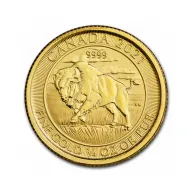
The Gold Bison from the Royal Canadian Mint
The Royal Canadian Mint's Bison series is best known for its distinctive 1.25 oz silver coin, but the programme also includes a 1/4 oz gold coin struck in .9999 fine gold. The gold Bison carries a face value backed by the Canadian government and benefits from the same advanced security features that protect the flagship Gold Maple Leaf.
The Bison's connection to Canadian identity runs deep. The wood bison (Bison bison athabascae) is native to Canada's boreal forests, with the world's largest population of approximately 10,000 animals residing in Wood Buffalo National Park. The RCM has featured bison imagery on Canadian coinage since 1967, when a bison appeared on the centennial nickel, and the theme was expanded through the Canadian Wildlife Series (2011-2013) before becoming its own dedicated programme in 2015.
Each year brings a fresh reverse design depicting the bison in a different setting or pose, making the gold Bison both a bullion investment and a rotating-design collectible. The 1/4 oz gold format places it in a popular fractional category for buyers building a position in gold without committing to a full ounce at a time. Annual design changes also mean earlier years can carry modest collector premiums above their gold content, particularly among series completists.
From 2016 onwards, every Bison coin incorporates the RCM's precision-machined radial lines and micro-laser engraved maple leaf privy mark, the same anti-counterfeiting technology used across the Maple Leaf programme. The privy mark contains the last two digits of the year of issue, visible only under magnification. The 2015 debut year predates these features, which can make it identifiable at a glance. From 2023, the obverse transitioned from Susanna Blunt's portrait of Queen Elizabeth II to Steven Rosati's effigy of King Charles III.
Gold Bison Specifications
| Attribute | 1/4 oz Gold |
|---|---|
| Weight | 1/4 troy oz (7.78 g) |
| Purity | .9999 fine gold (24 karat) |
| Face value | CAD (Canadian legal tender) |
| Edge | Reeded (serrated) |
| Finish | Bullion with radial lines |
| Legal tender | Canada |
| Mintage | Not fixed (minted to demand) |
The gold Bison matches the Gold Maple Leaf in four-nines purity, the highest standard commonly available in gold bullion. Like the silver version, the gold coin is produced on a minted-to-demand basis with no pre-set mintage ceiling, keeping it firmly in the bullion category rather than the limited-edition collector space.
Security features on the gold Bison (from 2016 onwards) include precisely machined radial lines on both faces and a micro-laser engraved maple leaf containing the two-digit year code. These features are transferred directly from the Maple Leaf programme and are extremely difficult to replicate. The 2015 debut year predates these security additions. The .9999 purity is verifiable through XRF analysis and specific gravity testing, and the reeded edge provides an additional tactile authentication point consistent across all RCM bullion products.
Gold Bison Tax Treatment by Country
As a Canadian government-issued gold coin of .9999 purity, the Bison qualifies for investment gold tax exemptions in most major markets. Its legal tender status and high purity place it in the most favourable tax category available to gold bullion.
- Canada: Exempt from GST/HST. Gold bullion coins produced by the RCM with purity of 99.5% or higher qualify for the federal precious metals exemption. RRSP-eligible through approved dealers and custodians.
- United States: No federal sales tax on bullion. State-level treatment varies: approximately 35 states fully exempt precious metals, with a handful imposing sales tax and several applying threshold-based exemptions (California above $2,000, Florida above $500, New York above $1,000). The .9999 purity from a sovereign mint meets IRS Section 408(m) requirements for inclusion in a self-directed precious metals IRA.
- United Kingdom: VAT-exempt as investment gold under the UK's implementation of the EU Investment Gold Directive. Gold coins of 99.5% or higher purity that are legal tender in their country of origin qualify. However, the gold Bison is not CGT-exempt in the UK, as only UK Royal Mint legal tender coins (Britannias and Sovereigns) carry that exemption. Gains above the annual CGT allowance are taxable at the individual's rate. SIPP-eligible as qualifying gold bullion.
- European Union: VAT-exempt across all EU member states under Council Directive 98/80/EC, which covers gold coins of 90% or higher purity that are legal tender and normally sold close to their gold value.
- Australia: GST-free as investment-grade precious metal. Gold of 99.5% purity or higher in bar, ingot, or coin form qualifies under the Australian GST exemption for investment metals.
- New Zealand: GST-exempt as fine gold bullion (99.5% purity threshold for gold).
- Singapore: GST-exempt under the Investment Precious Metals (IPM) scheme. Gold of 99.5% purity in coin or bar form qualifies.
- Hong Kong: No sales tax, no import duty, and no capital gains tax. One of the most tax-efficient jurisdictions for holding gold.
- South Africa: Gold coins are zero-rated for VAT purposes under the Value-Added Tax Act.
From Canadian Wildlife to a Dedicated Bison Programme
The RCM's relationship with bison imagery on coinage predates the Bison series by decades. In 1967, a bison appeared on Canada's centennial five-cent coin, marking one of the first times the animal featured prominently on Canadian currency. The theme resurfaced in 2013 when a wood bison design by Emily S. Damstra served as the final coin in the six-piece Canadian Wildlife Series (2011-2013), a limited-mintage programme that was the RCM's first dedicated silver bullion series outside the Maple Leaf.
The Bison series launched in 2015, initially in the unconventional 1.25 oz silver format that no other major mint had attempted. Gold versions followed, extending the programme across both metals. The series was designed as a minted-to-demand product, following the same commercial model as the Maple Leaf rather than the fixed-mintage approach used for the Canadian Wildlife Series.
Each annual release features a new bison reverse design. Early years (2015-2017) depicted the animal in full body across different landscapes: charging across grasslands, drinking at a lake's edge, and moving through a mountain valley. The 2018-2019 releases shared a close-up portrait of a bison head in right profile, departing from the earlier tradition of unique full-body compositions. From 2020 onward, the series returned to varied annual designs, with artists including Vanessa Miller contributing to the 2025 edition.
The shift from Queen Elizabeth II to King Charles III on the obverse in 2023 marked a notable transition. Steven Rosati, only the third Canadian artist to develop a monarch portrait for Canadian coinage, designed the new effigy. This change applies across all current RCM bullion programmes.
Gold Bison vs Maple Leaf and Other Fractional Gold Coins
The gold Bison's most direct competitor is the RCM's own Gold Maple Leaf, available in 1/4 oz and other fractional sizes. Both share .9999 purity, Canadian legal tender status, and identical security features (radial lines and micro-laser privy mark). The Maple Leaf has far greater global recognition and secondary market liquidity, making it the default choice for investors who prioritise ease of resale. The Bison appeals to buyers who want the same underlying quality with a rotating wildlife design and a slightly different aesthetic.
Against international fractional gold competitors, the 1/4 oz Bison competes with the 1/4 oz Gold Britannia (.999 purity, CGT-exempt in the UK), the 1/4 oz Gold Krugerrand (22 karat, .9167 purity), and the 1/4 oz Gold Kangaroo (.9999 purity, annual designs). The Bison matches the Kangaroo on purity and the rotating-design concept, but the Kangaroo benefits from the Perth Mint's stronger brand recognition in Asian and European markets.
The Krugerrand's 22-karat alloy makes it more scratch-resistant than the Bison's pure gold, a practical consideration for coins that will be handled. The Britannia's CGT exemption gives it a decisive tax advantage for UK-based investors, a benefit the Bison cannot match regardless of its other qualities.
For Canadian buyers specifically, the Bison has a home-market advantage: domestic availability, GST/HST exemption without any cross-border complications, and RRSP eligibility. The annual design changes give it a collecting dimension that static-design competitors lack, though this same quality can make resale pricing marginally less straightforward than a universally recognised Maple Leaf.