

Prices are fetched automatically and may not reflect current merchant prices. Currency conversions and tax treatment are approximate. Rankings are based solely on price. We are not a dealer and accept no responsibility for transactions with listed merchants. Past performance is not indicative of future results. This site does not provide investment advice. Full disclaimer
About 1/25 oz Gold Coins
The 1/25 oz Gold Coin: Entry-Level Gold
At 1/25 of a troy ounce, just 1.244 grams of .9999 fine gold in a coin roughly 13 mm across and 0.8 mm thick, this is among the smallest fractional gold coins commercially available. Only two major annual bullion programmes use the denomination: the Austrian Philharmonic, which added the size in 2014, and the Somali Elephant, which followed in 2016. The Austrian Mint introduced its 1/25 oz coin as an entry-level product, and demand turned it into an annual release.
The format exists for accessibility. At current gold prices, a 1/25 oz coin costs about the same as a few grams of silver, putting genuine sovereign-mint gold within reach of buyers on tight budgets. The realistic use cases are gifting, small-increment accumulation, and collecting, particularly the Somali Elephant with its annually changing design. As a pure investment the size is hard to justify: premiums at this weight are the highest of any standard bullion denomination, and every larger fractional size delivers more gold per dollar.
The natural comparison is one step up the scale. The 1/10 oz gold coin is more widely traded, more recognisable to dealers, and carries lower percentage premiums, making it the more practical fractional choice for anyone who can stretch to it. The 1/25 oz earns its place only when the absolute outlay is the binding constraint or when the coin itself, rather than the gold, is the point.
Regionally, the Philharmonic dominates in Europe and is widely available across European dealers, while both it and the Somali Elephant trade on the US secondary market. In the UK the size is available but uncommon; the Royal Mint produces no 1/25 oz coin, and Britannias and Sovereigns dominate the small-gold space there.
Premiums at 1/25 oz: The Top of the Curve
Premiums on 1/25 oz gold coins typically run 15-25% or more over spot, the highest of any standard bullion denomination. The cause is mechanical: striking a tiny coin requires nearly the same die work, quality control, and packaging as a full-ounce coin, but the gold content is one twenty-fifth of the value, so the fixed costs land on a very small amount of metal.
The rest of the fractional curve puts that figure in context. On the gold coin scale, 1/10 oz coins carry roughly 12-18% premiums, 1/4 oz around 7-10%, 1/2 oz around 5-8%, and 1 oz sovereign coins typically 3-8% in normal conditions. Each step down in size costs more per ounce, and the 1/25 oz sits at the extreme end where cost-per-ounce is significantly higher than any other standard fractional size.
The exit completes the picture. Buyback spreads at this size are correspondingly wider in both percentage and absolute terms than for larger coins, so a meaningful part of the purchase premium should be assumed unrecoverable on resale. Secondary-market random-year coins, which major dealers sell in mixed lots, are the standard way to shave a little off the entry cost, since random-year coins generally trade below current-year premiums across gold coins.
Tax treatment is the one friendly variable. At .9999 fine, both the Philharmonic and the Somali Elephant clear the investment-gold thresholds everywhere that matters: VAT-exempt in the UK and across the EU, GST/HST exempt in Canada, GST-free in Australia and New Zealand, GST-exempt in Singapore, and untaxed in Hong Kong, with most US states exempting bullion from sales tax. The premium, not the tax, is the cost of the format.
The Two Coins That Define the Denomination
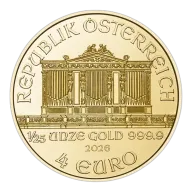
The 1/25 oz Austrian Gold Philharmonic is the flagship of the size. Introduced in 2014, it is struck in .9999 gold with a face value of EUR 4 and released annually. As the entry point to one of the world's major bullion coin programmes, it carries the Austrian Mint's recognition and is the most widely available coin at this weight, particularly across European dealers.
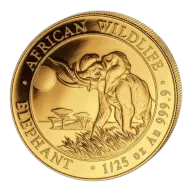
The 1/25 oz Somalia Gold Elephant is the other annual programme at this denomination. Introduced in 2016 and also struck in .9999 gold, it features an elephant design that changes every year, which gives it a collector dimension the Philharmonic lacks. The coin is minted by the Bavarian State Mint for Somalia and is not widely circulated there; its market is international collectors and small-gold buyers.
Beyond these two programmes, the denomination thins out quickly. Major US dealers, including JM Bullion, SD Bullion, Provident Metals, and Silver.com, sell random-mint secondary market lots at this size, which is typically the cheapest route in. Some dealers also sell the coins in tubes of 20 for buyers accumulating the size in quantity.
Notable absences shape the choice as much as the products themselves. The Royal Mint makes no 1/25 oz coin, so there is no CGT-exempt UK option at this weight; UK buyers wanting small sovereign-mint gold with that tax advantage look to the Britannia range or the Sovereign family instead. Buyers comparing entry-level gold formats should also weigh the 1 gram gold bar route, where small bars in assay cards compete for the same budget.
Selling and Storing 1/25 oz Coins
The resale market at this size is real but limited. Most major online dealers buy 1/25 oz coins back, but at wider spreads than they quote for mainstream fractional sizes, and the denomination is not a standard trading size at local coin shops, where recognition is lower than for 1/10, 1/4, and 1/2 oz coins. The practical consequence: these coins are best resold through specialist online bullion dealers who carry the product and know its market, rather than walked into a local shop expecting a tight bid.
Physical handling is its own consideration. At 13 mm in diameter, an individual coin is genuinely easy to lose, and the standard storage approach is individual flips or mint-sealed tubes of 20. Keeping coins in original tubes or capsules protects both the coin and its saleability. The low per-unit value also means fixed storage costs, a safe or vault allocation, represent a higher percentage of the investment than they would for larger coins, another way the format's economics penalise small size.
Against those frictions, the format does offer the standard fractional benefits in their most extreme form: maximum divisibility, the ability to liquidate in very small increments, and easy distribution across multiple storage locations. A buyer who wants those properties with materially better liquidity gets most of them from the 1/10 oz size, which every dealer recognises and quotes.
The honest summary is that the 1/25 oz coin is bought on the way in, as a gift, a collectable, or an affordable first piece of gold, and sold patiently through the right channel on the way out. Treated that way, it does its job; treated as a trading unit, the spreads will disappoint.