 Gold Secure

 BullionworX

Prices are fetched automatically and may not reflect current merchant prices. Currency conversions and tax treatment are approximate. Rankings are based solely on price. We are not a dealer and accept no responsibility for transactions with listed merchants. Past performance is not indicative of future results. This site does not provide investment advice. Full disclaimer
About the 1/2 oz South African Mint Krugerrand Gold Coin
The 1/2 oz Gold Krugerrand
The 1/2 oz Gold Krugerrand contains exactly half a troy ounce (15.552 g) of fine gold in a 22 karat (.9167) copper alloy, bringing the total coin weight to 16.965 g. Introduced in 1980, thirteen years after the 1 oz Krugerrand launched the modern bullion coin market, the half-ounce was part of a fractional range that also included 1/4 oz and 1/10 oz sizes. These fractional Krugerrands gave investors access to the series at lower price points while maintaining the same alloy, design, and legal tender status as the original.
The Krugerrand's core appeal at any weight is straightforward economics. Decades of massive production volume (over 60 million coins across all sizes by 2017) have established the deepest secondary market of any gold bullion coin series. This translates to consistently low premiums over spot and tight bid-ask spreads when selling. Among 1/2 oz gold coins, the Krugerrand typically offers the lowest cost per gram of gold delivered, though the exact gap varies by dealer and market conditions.
The 22 karat composition is a deliberate trade-off. The 8.33% copper alloy makes the coin harder and more scratch-resistant than .9999 fine alternatives like the 1/2 oz Gold Maple Leaf or 1/2 oz Gold Philharmonic. It also gives the Krugerrand its distinctive warm orange-gold colour, visibly different from the purer yellow of 24 karat coins. The practical consequence is that each coin weighs more than its stated gold content, at 16.965 g total rather than 15.552 g, with the extra mass being copper that carries negligible metal value.
Gold Krugerrands carry no face value. They are legal tender in South Africa based on their gold content value, a system similar to the British Sovereign. This distinguishes them from coins like the 1/2 oz Gold Britannia (£50 face value) or the 1/2 oz Gold Eagle ($25 face value), where the nominal denomination is symbolic but legally defined.
1/2 oz Gold Krugerrand Dimensions and Details
| Specification | Value |
|---|---|
| Fine gold content | 15.552 g (1/2 troy oz) |
| Total coin weight | 16.965 g |
| Purity | .9167 (22 karat) |
| Alloy composition | 91.67% gold, 8.33% copper |
| Diameter | 27.07 mm |
| Thickness | 2.215 mm |
| Edge serrations | 180 (bullion) / 220 (proof) |
| Face value | None (legal tender at gold value) |
| Obverse | Paul Kruger portrait by Otto Schultz |
| Reverse | Springbok antelope by Coert Steynberg |
| Mint | South African Mint (South African Reserve Bank) |
| First year of issue | 1980 |
The different serration counts between bullion (180) and proof (220) editions provide a quick authentication check when examining the edge under magnification. This is one of the few physical distinguishing features between the two grades, as both share the same obverse and reverse designs.
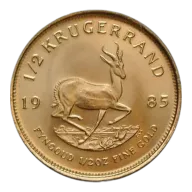
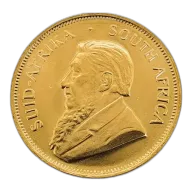
The obverse shows Paul Kruger, President of the South African Republic (1883-1900), with the bilingual inscriptions "SUID-AFRIKA" and "SOUTH AFRICA" reflecting the country's official languages. The reverse depicts a springbok antelope in mid-leap, South Africa's national animal, with "KRUGERRAND" above and the fine gold weight below. Neither design has changed since the 1 oz coin's 1967 launch; the 1/2 oz introduced in 1980 uses the same imagery at a proportionally smaller scale.
The 22 karat composition matches the historic British Sovereign's "crown gold" standard, a deliberate choice that prioritised durability for a coin intended for physical trade. The copper alloy makes the Krugerrand noticeably harder than .9999 fine coins, meaning it resists scratching and denting better during handling, storage, and transport. The trade-off is the warm orange-gold colour, visibly different from the purer yellow of 24 karat competitors.
Krugerrand Tax Treatment by Country
The Krugerrand's tax position is generally favourable for purchase taxes but carries an important limitation in the UK regarding capital gains.
- South Africa: Gold Krugerrands have been zero-rated for VAT since 1995 under s11(1)(k) of the Value-Added Tax Act. This applies to intact gold coins issued by the South African Reserve Bank. Capital gains are taxed with a 40% inclusion rate for individuals.
- United Kingdom: VAT-exempt as investment gold under UK/EU investment gold rules. Not CGT-exempt. This is the critical distinction for UK investors: only UK legal tender coins (the Britannia, Sovereign, and certain Royal Mint series) are exempt from Capital Gains Tax. Gains on Krugerrands above the £3,000 annual CGT allowance are taxable at the individual's rate (18% basic, 24% higher). The lower purchase premium on Krugerrands can be offset by the CGT liability on disposal.
- United States: IRA-eligible, specifically approved under IRS regulations. Capital gains are taxed at the collectibles rate of up to 28% outside retirement accounts. State sales tax varies by jurisdiction; roughly 35 states exempt bullion.
- Canada: GST/HST-exempt. The test applies to the precious metal content per coin, not the coin's overall composition, so the Krugerrand's pure gold content at .999+ within the alloy qualifies despite the coin being 22 karat overall. Capital gains are taxed at the 50% inclusion rate.
- European Union: Listed on the annual EU investment gold coin list and VAT-exempt in all EU member states. Capital gains treatment varies by country; notably, Germany offers tax-free gains on gold held over one year.
- Australia: GST-free as investment-grade gold. Capital gains apply with a 50% discount for holdings over 12 months.
- Singapore: GST-exempt under the Investment Precious Metals scheme. No capital gains tax.
- Hong Kong: No sales tax, import duty, or capital gains tax.
From Market Pioneer to Fractional Range
The Krugerrand's creation in 1967 was a strategic move by South Africa to market its gold reserves directly to private investors worldwide. The original 1 oz coin, first struck on 3 July 1967, was the world's first modern gold bullion coin designed specifically for investment rather than circulation. Its initial run comprised 40,000 bullion coins and 10,000 proof editions.
The fractional sizes arrived in 1980, driven by gold's dramatic price rise during the late 1970s. As gold approached $800 per ounce (equivalent to roughly $3,000 in today's terms), a single 1 oz Krugerrand became prohibitively expensive for many retail investors. The 1/2 oz, 1/4 oz, and 1/10 oz denominations made the series accessible again. By this point, Krugerrands accounted for more than 90% of the global gold coin market.
The anti-apartheid sanctions of the 1980s transformed the competitive landscape. The US import ban enacted in 1985, along with broader international restrictions, closed Western markets to new Krugerrands and created an opening that other sovereign mints moved quickly to fill. Canada had already launched the Gold Maple Leaf in 1979 specifically to capture investors looking for alternatives. The American Gold Eagle followed in 1986, and the Gold Philharmonic in 1989. Each of these programs exists, in part, because the Krugerrand's sanctions-era absence left market share available.
Following the end of apartheid and the lifting of sanctions in 1991, the Krugerrand re-entered global markets but never regained its previous dominance. By then, the Maple Leaf, Eagle, and other coins had built their own dealer networks and investor loyalty. The Krugerrand settled into a role as one of several major sovereign coins rather than the overwhelming market leader it had been. Its historical production volume (over 53 million troy ounces of gold by 2017) remains unmatched, providing a depth of secondary market supply that keeps premiums competitive.
The 22 karat composition was chosen to match the historic British Sovereign's "crown gold" standard, prioritising durability in a coin intended for handling and trade. The copper alloy gives the Krugerrand its distinctive appearance, immediately recognisable and visibly different from the purer yellow of 24 karat coins that emerged later.
1/2 oz Krugerrand vs Britannia, Eagle, and Maple Leaf
The 1/2 oz Krugerrand competes on cost efficiency rather than purity or security features. Its advantages and limitations are both direct consequences of its market position as the original bullion coin.
Against the 1/2 oz Gold Britannia, the Krugerrand's lower purchase premium is its primary selling point. The Britannia is .9999 fine gold, carries four anti-counterfeiting features (latent image, surface animation, micro-text, tincture lines from 2021), and is CGT-exempt in the UK as sterling legal tender. For UK investors with gains exceeding the £3,000 annual CGT allowance, the Britannia's tax exemption can more than offset its higher purchase premium. For investors in jurisdictions without this distinction, or whose holdings stay within the allowance, the Krugerrand's lower cost of acquisition is the stronger consideration.
The 1/2 oz Gold Eagle is the Krugerrand's closest structural counterpart: both are 22 karat (.9167 fine), both contain exactly 1/2 troy oz of fine gold, and both weigh more than their gold content due to alloying. The Eagle uses a three-metal alloy (gold, silver, and copper) compared to the Krugerrand's two-metal alloy (gold and copper), giving the Eagle a slightly different colour. The Eagle carries a $25 face value and has a specific statutory exemption for US IRA eligibility despite its 22 karat purity. In the US market, the Eagle dominates domestic demand, but the Krugerrand typically trades at slightly lower premiums internationally.
The 1/2 oz Gold Maple Leaf represents the opposite design philosophy: .9999 purity with no alloying metals. The Maple Leaf is softer and more susceptible to handling marks, but its Bullion DNA authentication system provides individual coin-level verification that the Krugerrand cannot match. The Krugerrand has no modern anti-counterfeiting features beyond its reeded edge and high-relief engraving. For buyers who prioritise authentication capability, the Maple Leaf is the stronger choice. For buyers who prioritise cost and durability, the Krugerrand holds its position.
1/2 oz South African Mint Krugerrand Gold Coin: frequently asked questions
-
The cheapest 1/2 oz Krugerrand listed here is $2,137.80, about 0.2% over spot, from Gold Secure. Because the coin contains exactly half a troy ounce of fine gold, its value tracks the gold spot price of $4,260.40 very closely, with the premium covering dealer costs and minting.
-
The 1/2 oz Krugerrand is 916.7 fine (22 carat), alloyed with copper rather than pure gold. The copper gives the coin its distinctive warm orange-gold colour and makes it more scratch-resistant than 24-carat bullion coins. Despite the alloy, each 1/2 oz coin contains exactly half a troy ounce of fine gold, so its gold value is unaffected.
-
During the South African apartheid era, the United States enacted an import ban on Krugerrands in 1985; other countries introduced similar restrictions. All such sanctions were lifted by 1991. Krugerrands are fully legal to buy and sell today in all major bullion markets, including Australia, Canada, the UK, the US, and South Africa.
-
Standard bullion half Krugerrands trade at or close to their gold content value with no meaningful year premium. Certified proof versions can attract a collector premium, but this page covers generic bullion coins where the year date does not typically affect price. When buying for investment, the premium over spot is a more useful comparison point than the coin's year.
-
Krugerrands are South African legal tender, not legal tender in the buyer's country, so they do not qualify for CGT exemption where that exemption is tied to domestic legal tender status (such as the UK's exemption for Britannias and Sovereigns). In the UK, gains are taxed at 18% or 24% above the £3,000 annual allowance. US investors pay up to 28% on long-term gains; in Canada 50% of the gain is included in taxable income.