1 listing
Filters

 A Coin Shop
Prices are fetched automatically and may not reflect current merchant prices. Currency conversions and tax treatment are approximate. Rankings are based solely on price. We are not a dealer and accept no responsibility for transactions with listed merchants. Past performance is not indicative of future results. This site does not provide investment advice. Full disclaimer
About the 1/4 oz Australian Nugget Gold Coin
The Original Perth Mint Gold Bullion Design
The 1/4 oz Australian Nugget is a fractional gold coin from the Perth Mint, part of the original 1986-1989 era of Australia's flagship gold bullion programme. Before the series adopted kangaroo imagery in 1990, each denomination featured a famous Australian gold nugget discovery. The 1/4 oz coin depicts the "Golden Eagle" nugget, a 1,135 troy ounce (35.3 kg) specimen found at Larkinsville, Western Australia, in January 1931.
The Nugget series launched in 1986 with two innovations that were unusual for bullion coins at the time: a "two-tone" frosted design effect created by selective frosting against a mirror-like background, and individual hard plastic encapsulation for each coin. At .9999 fine gold, it offered the highest purity of any major gold bullion coin at launch, directly challenging the .9167 (22 karat) Krugerrand that then dominated the market.
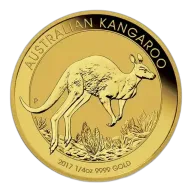
Today, 1986-1989 Nugget-design coins occupy a niche between bullion and numismatics. They are genuine bullion coins with full gold weight and Australian legal tender status, but the limited years of production and distinctive nugget imagery create collector demand that keeps premiums above the kangaroo-era coins that succeeded them. Buyers seeking the lowest-premium 1/4 oz gold from the Perth Mint should look at the 1/4 oz Gold Kangaroo, which continues the same series under the updated design.
The 1/4 oz Nugget has a face value of A$25 and a diameter of 20.1 mm, fitting standard capsules and storage systems for fractional gold coins. It is one of five original denominations ranging from 1/20 oz (A$5) up to 1 oz (A$100), with larger sizes added later in the kangaroo era.
Australian Nugget 1/4 oz Dimensions and Details
| Attribute | Value |
|---|---|
| Weight | 1/4 troy oz (7.776 g) |
| Purity | .9999 fine gold (24 karat) |
| Diameter | 20.1 mm |
| Thickness | 2.1 mm |
| Face value | A$25 |
| Edge | Reeded |
| Mint | Perth Mint (Government of Western Australia) |
| Years produced | 1986-1989 (nugget design) |
The obverse carried the Raphael Maklouf third portrait of Queen Elizabeth II (1986-1998). This portrait was later succeeded by Ian Rank-Broadley's design (1999-2018), Jody Clark's (2019-2022), and King Charles III's effigy (2023 onwards) on the kangaroo-era continuations.
The 1/4 oz denomination featured the "Golden Eagle" nugget on its reverse in 1986, with designs rotating across denominations in subsequent years. The nugget-design period (1986-1989) saw four different nuggets represented across the full range of denominations: the Welcome Stranger (the largest alluvial gold nugget ever found, at 2,316 troy oz), the Hand of Faith (the largest nugget found with a metal detector), the Golden Eagle, and the Little Hero.
The "two-tone" frosted effect was a proof-like technique applied to bullion coins, selective frosting of the raised design against a mirror background. Combined with the individual hard plastic encapsulation, this preserved the coins in near-perfect condition, a feature that was not standard practice for bullion coins in the 1980s.
Australian Nugget Tax Status by Country
The Australian Nugget is legal tender in Australia at its face value of A$25, issued by the Perth Mint (wholly owned by the Government of Western Australia). Its .9999 purity qualifies it for investment gold tax exemptions across most major markets.
Australia
GST-exempt as investment-grade gold. The Perth Mint's coins qualify under the GST Act 1999 as gold of 99.5% or higher purity in a form commonly traded on commodity markets. Capital gains tax applies to profits, with a 50% discount for assets held longer than 12 months.
United States
The .9999 purity exceeds the IRS Section 408(m) requirement of 99.5% for IRA-eligible gold. The Australian Nugget is accepted by most IRA custodians. State sales tax exemptions apply in the majority of states that exempt precious metals. Federal capital gains are taxed at the collectibles rate of up to 28%.
United Kingdom
VAT-exempt as investment gold, meeting the 995 thousandths purity threshold. Not UK legal tender, so profits are subject to Capital Gains Tax at standard rates (18-24%) above the annual £3,000 allowance. UK buyers who prioritise CGT exemption should consider the 1/4 oz Gold Britannia instead.
Canada
Exempt from GST/HST as gold exceeding the 99.5% purity threshold. Capital gains are taxable at the 50% inclusion rate (66.67% for gains above CAD $250,000 annually from June 2024).
EU, Singapore, and Hong Kong
VAT-exempt across the EU under the Investment Gold Directive as a legal tender coin exceeding 900 thousandths purity. GST-exempt in Singapore as an Investment Precious Metal meeting the 99.5% gold purity threshold. Hong Kong levies no sales tax, import duty, or capital gains tax.
From Gold Rush Heritage to Modern Bullion
The Australian Nugget series was conceived as a direct competitor to the South African Krugerrand and Canadian Maple Leaf. When it launched in 1986, the Krugerrand was facing international boycotts due to apartheid-era sanctions, and the Perth Mint saw an opportunity to capture market share with a higher-purity alternative. At .9999 fine, the Nugget matched the Canadian Maple Leaf (which had upgraded from .999 to .9999 in 1982) and surpassed the Krugerrand's .9167 purity.
The decision to depict famous Australian gold nuggets tied the coin to the country's gold rush heritage. Australia's gold rushes of the 1850s-1890s transformed the colonies from pastoral settlements into wealthy, globally significant producers. The nuggets chosen for the coins were genuine historical specimens: the Welcome Stranger (1869, Moliagul, Victoria), the Hand of Faith (1980, Kingower, Victoria), the Golden Eagle (1931, Larkinsville, Western Australia), and the Little Hero (1890, Coongan River, Western Australia).
The Hand of Faith, depicted on the 1/2 oz denomination, has a particularly vivid story. Found just 30 centimetres below the surface by a metal detectorist in 1980, the 875 troy ounce nugget was sold to the Golden Nugget Casino in Las Vegas, where it remains on display.
By 1989, market research indicated that a kangaroo was more internationally recognisable as a symbol of Australia than images of gold nuggets. The proof edition retained nugget designs for 1989, but the bullion version transitioned to kangaroo imagery for 1990. The series has since been informally known as the "Gold Kangaroo," though both names persist in dealer listings. The 1986-1989 nugget-era coins have become collector items, valued for their limited production years and the connection to Australia's mineral history.
Australian Nugget vs Other 1/4 oz Gold Coins
The most natural comparison is with the 1/4 oz Gold Kangaroo, which is the continuation of the same series under a different reverse design. Both are .9999 fine, carry the same A$25 face value, and are backed by the Government of Western Australia. The Kangaroo trades at standard bullion premiums and has broad dealer availability; the Nugget carries a collector premium due to the limited 1986-1989 production window.
Against the 1/4 oz Gold Maple Leaf, both share .9999 purity, but the Maple Leaf has been in continuous production since 1979 and benefits from the Royal Canadian Mint's Bullion DNA security system and micro-laser engraving. The Maple Leaf is more liquid and typically carries a lower premium. The Nugget's advantage is its finite supply and historical design.
The 1/4 oz Gold Britannia matches the .9999 purity and offers UK-specific advantages: CGT exemption as UK legal tender, plus advanced security features including a latent image and tincture lines. For UK buyers, the Britannia provides better tax treatment. For collectors interested in Australian gold heritage, the Nugget offers something the Britannia does not.
The 1/4 oz American Gold Eagle and 1/4 oz Krugerrand are 22 karat (.9167) coins, making the Nugget's .9999 purity a differentiator for markets that prefer pure gold. Both 22 karat coins contain the same amount of fine gold per denomination but are alloyed with copper for durability, resulting in a slightly heavier total coin weight.
1/4 oz Australian Nugget Gold Coin: frequently asked questions
-
The 1/4 oz Australian Nugget contains 1/4 oz of .9999 fine gold (24 karat). At that purity the coin is essentially all gold, with negligible alloy. The Perth Mint guarantees the weight and fineness of every coin in the series.
-
It is a refined, minted bullion coin, not a natural gold nugget. The Perth Mint has struck the series since 1986, with early issues (1986 to 1989) depicting famous Australian gold discoveries such as the Welcome Stranger on their reverse designs. The coin is .9999 fine gold and carries an Australian dollar face value, making it legal tender in Australia.
-
Tax treatment depends on where you live. In the UK, investment gold bullion coins carry no VAT, but the Australian Nugget is not UK legal tender, so standard CGT rates of 18% to 24% apply on gains above the £3,000 annual allowance. In the US, gold coins are taxed as collectibles at up to 28%. In Australia, the coin is legal tender but CGT generally applies to investment gold profits. In Canada, 50% of the gain is included in taxable income.