1 listing
Filters
| Product | /oz | Premium | Price | |
|---|---|---|---|---|

 Bullion Standard
|
$4,151.47 | +3.87% | $1,037.87 | View Deal |
Prices are fetched automatically and may not reflect current merchant prices. Currency conversions and tax treatment are approximate. Rankings are based solely on price. We are not a dealer and accept no responsibility for transactions with listed merchants. Past performance is not indicative of future results. This site does not provide investment advice. Full disclaimer
About the 1/4 oz War of 1812 Gold Coin
The 1/4 oz War of 1812 Gold Coin
The War of 1812 coins are commemorative bullion issued by the Royal Canadian Mint in 2012 to mark the 200th anniversary of the conflict. The series spanned three metals in deliberately non-standard weights: this 1/4 oz gold coin, a 1/2 oz platinum coin, and a 3/4 oz silver coin. Mintage ended in April 2013 and the series is discontinued, so every coin on the market today comes from existing dealer stock or the secondary market.
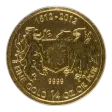
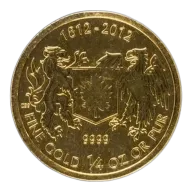
All three metals share the same reverse: an American Eagle and an English Lion face each other across a shield bearing the Canadian Maple Leaf, symbolising the two combatants and Canada's pivotal role in the conflict. The War of 1812 was a formative event in Canadian national identity; the US declared war on Britain, much of the fighting took place in what is now Canada, and the successful defence against invasion fed a distinct Canadian national consciousness. The heraldic design deliberately echoes coat-of-arms imagery to match that history.
For buyers, the coin bridges bullion and commemorative. It is struck in 999.9 fine gold with full Canadian legal tender status, sold at near-bullion prices in BU finish, and the proof version's mintage of just 2,000 makes that strike genuinely scarce. Stackers wanting maximum liquidity at this size are still better served by the 1/4 oz Gold Maple Leaf; the War of 1812 coin is for buyers who want low-mintage Canadian history at close to bullion cost.
1/4 oz War of 1812 Gold Specifications
| Attribute | Value |
|---|---|
| Metal | Gold |
| Purity | .9999 (99.99%) |
| Weight | 1/4 troy oz (7.7759 g) |
| Diameter | 20 mm |
| Thickness | 1.7 mm |
| Face value | $10 CAD |
| Edge | Reeded |
| Mintage | 2,000 (proof version) |
| Obverse designer | Susanna Blunt |
The obverse carries Susanna Blunt's fourth-generation portrait of Queen Elizabeth II with the inscriptions "ELIZABETH II" and "CANADA 10 DOLLARS". The reverse shows the eagle-and-lion heraldic design with "1812-2012" below, plus purity and weight markings. Weight and purity are guaranteed by the Royal Canadian Mint and the Canadian government. The series predates the RCM's advanced anti-counterfeiting features such as micro-engraving, which were introduced on the mint's bullion coins in later years, so authentication rests on the reeded edge, precise specifications, and straightforward assay of .9999 gold.
War of 1812 Gold Tax Treatment by Country
- Canada: GST/HST exempt as legal tender bullion refined above 99.5% purity. Capital gains on disposal are taxable at the 50% inclusion rate.
- US: No federal sales tax; most states exempt bullion. The coin's .9999 purity qualifies it for self-directed precious metals IRAs. Long-term gains are taxed at the collectibles rate of up to 28%.
- UK: VAT-free as investment gold. Not CGT-exempt, since it is Canadian rather than UK legal tender; gains above the £3,000 annual allowance are taxable, which is the standing advantage of the 1/4 oz Gold Britannia for UK buyers.
- EU: VAT-exempt as investment gold under the EU directive.
- Australia and New Zealand: GST-free in both countries as investment-grade gold at 99.5%+ purity.
- Singapore and Hong Kong: No GST on qualifying investment gold in Singapore and no capital gains tax; Hong Kong levies no sales tax or duties at all.
War of 1812 vs Maple Leaf and Other Quarter-Ounce Gold
Against the standard Gold Maple Leaf, the trade is mintage versus liquidity. The War of 1812 coin has a far lower mintage than the Maple Leaf and its commemorative status gives it collector appeal, but the Maple Leaf enjoys greater recognition and an easier resale market worldwide. Both are RCM products in .9999 gold with the same tax standing, so the decision comes down to whether scarcity or tradability matters more.
Against US Mint commemoratives, the positioning differs. American commemorative coins tend to be proof-only collector pieces priced well above metal; the War of 1812 coins were struck in BU finish and sold at near-bullion prices, sitting between bullion and commemorative in a way US issues rarely do.
Within the quarter-ounce weight class generally, premiums run higher than 1 oz coins (roughly 7-12% over spot for fractional sovereign gold versus 3-5% for full ounces) but lower than 1/10 oz pieces, making 1/4 oz a practical middle ground for regular buying. Every major world mint fields a quarter-ounce coin in its flagship series, from the Eagle and Britannia to the Krugerrand and Philharmonic, so the discontinued War of 1812 competes in a crowded weight class on the strength of its design and limited supply. The series' companion pieces are also worth knowing: the 1/2 oz platinum version is among the purest platinum bullion coins at 99.95%, and the 3/4 oz silver coin is struck in a weight almost unique in world bullion.
1/4 oz War of 1812 Gold Coin: frequently asked questions
-
The cheapest listing we track is $1,037.87 from Bullion Standard, sitting around 3.9% above the $3,996.90 gold spot price. As a discontinued commemorative with a mintage of 2,000 for the proof version, secondary market availability is limited and premiums reflect both the gold content and the coin's collectible status.
-
Each coin contains 1/4 oz of 999.9 fine gold, equivalent to one quarter troy ounce (7.7759 grams). The Royal Canadian Mint guarantees the weight and purity of this coin, which carries a $10 CAD face value.
-
The War of 1812 series was issued by the Royal Canadian Mint in 2012 to mark the 200th anniversary of the conflict. The gold coin (1/4 oz, .9999 fine) was produced alongside silver and platinum versions, all sharing a reverse design of an eagle and lion flanking a maple leaf shield. Mintage ended in April 2013, making these coins available only through secondary market dealers.