 APMEX
APMEX
1 listing
Filters
| Product | /oz | Premium | Price | |
|---|---|---|---|---|
| $4,569.29 | +9.28% | $4,569.29 | View Deal |

Prices are fetched automatically and may not reflect current merchant prices. Currency conversions and tax treatment are approximate. Rankings are based solely on price. We are not a dealer and accept no responsibility for transactions with listed merchants. Past performance is not indicative of future results. This site does not provide investment advice. Full disclaimer
About the 1 oz Cat Coin Gold Coin
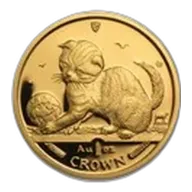
The 1 oz Isle of Man Cat Gold Coin
The Isle of Man Cat is one of the longest-running annual-design programmes in modern coinage: a different domestic cat breed every year since 1988, each design used once and then permanently retired, with the sole exception of the native Manx cat, which opened the series and returned in 2012. The 1 oz gold coin is the flagship size, a 1 Crown legal tender piece guaranteed by the Isle of Man government and originally struck by Pobjoy Mint, with production later transferring to Tower Mint.
This is a collector-leaning bullion coin rather than a stacking workhorse. Mintages are low compared with mainstream coins, the proof finish involves striking each coin four times for frosted relief against a mirror background, and the series has won "Most Popular Coin of the Year" from an international jury, with a reported collector base of over two million worldwide. The crossover appeal to cat enthusiasts broadens the buyer pool beyond the usual bullion market, an unusual property for a gold coin.
For buyers it works two ways. The retired one-year designs mean a given breed's coin is never struck again, so condition and year carry weight that a 1 oz gold Britannia never acquires. The flip side is that you pay collector pricing relative to mainstream bullion and depend on a thinner resale market. As pure gold, the maths still works: coins dated 1997 onward are .9999 fine, so a Cat coin holds a full ounce of four-nines gold whatever the breed on the reverse.
1 oz Gold Cat Specifications
| Attribute | Detail |
|---|---|
| Weight | 1 troy oz (31.103 g) |
| Purity | .999 fine gold (1988-1996); .9999 fine gold (1997 onwards) |
| Diameter | ~32.7 mm |
| Denomination | 1 Crown (Isle of Man legal tender) |
| Finish | Pobjoy Proof (struck four times) |
| Obverse | Queen Elizabeth II (Ian Rank-Broadley portrait pre-2022); King Charles III from 2022 |
The purity split is the key spec to check when buying secondary market coins: dates from 1988 to 1996 are .999 fine, while 1997 onward are .9999. Either way the coin contains a full troy ounce of gold; the difference matters mainly for purity-threshold rules in some tax systems and for IRA custodian listings.
The gold series spans five sizes, from this 1 oz coin down through 1/2 oz, 1/5 oz, and 1/10 oz to a tiny 1/25 oz piece, making the Cat one of the most fractional-friendly gold series available. Individual proof coins are supplied boxed with a certificate of authenticity, and the four-strike proof finish with its fine cat portraiture doubles as an anti-counterfeiting measure through sheer complexity of detail.
Isle of Man Cat Gold Coin Tax Treatment
The Isle of Man is a British Crown Dependency, not part of the UK, and that distinction shapes the coin's tax position in its primary market.
- United Kingdom: as investment gold, the Cat coin is VAT-free. CGT is the complication: only UK legal tender coins such as the Britannia and Sovereign are automatically CGT-exempt, and Isle of Man coins do not inherit that status. Some Isle of Man gold coins may appear on HMRC's approved investment gold coin list, but individual years should be verified against the current list rather than assumed. Buyers wanting certain CGT exemption should choose a UK coin.
- United States: most states exempt bullion coins from sales tax. Long-term gains are taxed at the 28% collectibles rate. Gold coins at .999+ purity are generally IRA-eligible, which covers the entire Cat series including pre-1997 dates.
- EU: investment gold is VAT-exempt under Directive 98/80/EC for legal tender coins post-1800 at 900+ thousandths purity priced near melt; the proof presentation and collector pricing of some Cat issues could push individual pieces outside the price-to-melt criterion, so treatment can vary by issue.
- Canada: 0% GST/HST for gold at 99.5%+ purity in legal tender coin form.
- Australia: GST-free for investment-grade gold coins at 99.5%+ purity; note that collector coins priced well above metal value can attract GST.
- New Zealand: GST-exempt at 99.5%+ gold purity, which both the .999 and .9999 versions satisfy; no CGT.
- Singapore / Hong Kong: no GST (qualifying legal tender gold) and no tax respectively; neither levies CGT.
One Breed a Year Since 1988
Pobjoy Mint, a Surrey family mint that has struck coins for over 30 countries and specialises in Crown Dependency and overseas territory issues, launched the Cat series for the Isle of Man in 1988. The choice of inaugural design was deliberate: the Manx cat, the island's famous tailless native breed, tied the new programme directly to Manx identity. From there the series worked through the world's cat breeds one year at a time: Persian in 1989, Norwegian Forest in 1991, Siamese in 1992, Maine Coon in 1993, through to Siberian, Snowshoe, and Selkirk Rex in the 2010s.
A few choices stand out from the run. The 1990 New York Alley Cat put a common mixed-breed street cat on a gold coin alongside pedigree breeds, one of the series' most unusual designs. The Manx returned in 2012, the only repeat in the programme. Over 30 breeds have featured across more than 35 years of production, and each design is retired permanently after its year.
The obverse carried Ian Rank-Broadley's portrait of Queen Elizabeth II with the legend "ELIZABETH II ISLE OF MAN" until 2022, when it was updated for King Charles III. Production also changed hands during the series' life, passing from Pobjoy Mint to Tower Mint. Through all of it the silver proof remained the one constant product every year, while the gold range gave the series its bullion dimension, and coloured versions appeared periodically as collector variants.
Cat Coin vs Britannia, Maple Leaf, and Other Isle of Man Series
Against mainstream 1 oz gold bullion, the comparison is collector programme versus commodity. A 1 oz gold Maple Leaf or Britannia is struck in volume, trades at premiums of roughly 3-8% over spot in normal conditions, carries modern anti-counterfeiting technology (Bullion DNA micro-engraving on the Maple, picosecond-laser tincture lines on the Britannia), and sells to any dealer instantly. The Cat coin has none of that infrastructure: lower mintages, a four-strike proof finish in place of security tech, and pricing that reflects collector demand for specific years and breeds. For UK buyers the Britannia adds guaranteed CGT exemption, which the Manx coin cannot match.
The closer comparisons are other annual-design programmes. The Perth Mint's Lunar series changes design yearly around the Chinese zodiac, and Canada's wildlife issues rotate animals, but the Cat is distinct in dedicating an entire programme to domestic cat breeds, one per year, permanently retired. Within the Isle of Man's own coinage, the island also issues the Angel series in gold and silver and the Noble in platinum; the Cat is the most popular and widely collected of the three.
The practical question is what you are buying gold for. As bullion-with-a-bonus, a random-year Cat coin delivers a full ounce of fine gold plus a retired design. As a pure stacking vehicle, the mainstream coins cost less over spot and exit faster. Most Cat buyers are deliberately somewhere in between.
1 oz Cat Coin Gold Coin: frequently asked questions
-
The cheapest 1 oz Isle of Man Cat gold coin listed on BullionFerret is $4,569.29 from APMEX, at around 9.3% over the $4,188.30 gold spot price. Prices vary by year and cat breed, as earlier issues in the series can carry higher premiums in the secondary market.
-
The Isle of Man Cat series is an annual coin programme launched in 1988, featuring a different domestic cat breed each year. Originally struck by Pobjoy Mint in Surrey, England, the coins are issued as Crown-denomination legal tender of the Isle of Man. The 1 oz gold version is 999.9 fine gold and is available alongside fractional sizes from 1/25 oz to 1/2 oz. Each breed design is retired after its year, with the exception of the Manx cat, which appeared in 1988 and again in 2012.
-
Isle of Man Cat coins are legal tender of the Isle of Man, a British Crown Dependency, rather than UK legal tender. Isle of Man coins are not automatically CGT-exempt in the UK; individual years should be verified against HMRC's approved list. As a general guide, UK investors may face Capital Gains Tax at 18% or 24% depending on their tax band, with the annual £3,000 allowance applying. Investment gold coins carry no VAT in the UK regardless of CGT status.
-
Store gold coins in a cool, dry environment away from humidity, which can cause spotting over time. Hard capsules sized for a 1 oz coin (typically 32-33 mm) protect against contact marks without the need to handle the coin directly. For larger holdings, a home safe or a specialist vault storage service provides additional security against loss or theft.