4 listings
Filters

 APMEX
APMEX



Prices are fetched automatically and may not reflect current merchant prices. Currency conversions and tax treatment are approximate. Rankings are based solely on price. We are not a dealer and accept no responsibility for transactions with listed merchants. Past performance is not indicative of future results. This site does not provide investment advice. Full disclaimer
About the 1/10 oz Cat Coin Gold Coin
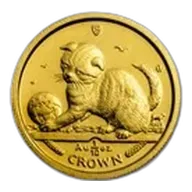
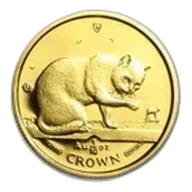
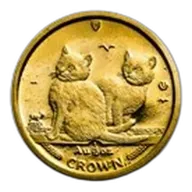
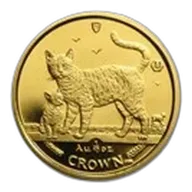
The 1/10 oz Isle of Man Cat Gold Coin
The Isle of Man Cat series is one of the longest-running themed coin programmes anywhere: an annual legal tender Crown coin featuring a different domestic cat breed each year, launched in 1988 with the island's own tailless Manx cat. Originally struck by Pobjoy Mint in Surrey, with production later transferring to Tower Mint, the series has covered more than 30 breeds, won "Most Popular Coin of the Year" from an international jury, and is reportedly owned by over two million collectors worldwide.
The 1/10 oz gold version contains 3.11 grams of fine gold with a 1/10 Crown denomination, one of five gold sizes running from 1 oz down to a tiny 1/25 oz, which makes the Cat one of the most fractional-friendly gold series available. A tenth-ounce is the classic entry weight for gold: at roughly a tenth of the outlay of a full ounce it suits gifting and small regular purchases, though it carries the highest percentage premiums of any standard bullion weight because minting costs barely shrink with the coin.
What separates the Cat from ordinary fractional gold is the collector dimension. Each breed design is used for a single year and then permanently retired (the Manx alone has appeared twice, in 1988 and 2012), so every date is a one-off. The buyer base famously spans both bullion collectors and cat enthusiasts, which broadens demand beyond the usual precious metals market. Compare it against workhorse 1/10 oz gold coins like the Britannia or Eagle before buying: the Cat trades recognition and liquidity for charm and scarcity.
Isle of Man Gold Cat Sizes and Specifications
| Attribute | Detail |
|---|---|
| Weight | 1/10 troy oz (3.110 g) |
| Metal | Gold |
| Purity | .999 fine (1988-1996); .9999 fine (1997 onwards) |
| Diameter | 17-18 mm |
| Denomination | 1/10 Crown, Isle of Man legal tender |
| Mint | Pobjoy Mint (original); later Tower Mint |
The full gold range covers five sizes: 1 oz (~32.7 mm), 1/2 oz (~27 mm), 1/5 oz (21 mm), this 1/10 oz, and 1/25 oz (13-14 mm), each denominated in fractions of a Crown. A 1 oz .999 silver proof Crown (38.6 mm, typically 10,000 mintage) has been the one constant companion product across the series, and copper-nickel Crowns serve the circulation and collector-set market.
The obverse carried Ian Rank-Broadley's portrait of Queen Elizabeth II with the legend "ELIZABETH II ISLE OF MAN" until the series updated for King Charles III after 2022. Proof issues use the Pobjoy Proof finish, struck four times to build frosted relief against mirror fields, and individual proofs come boxed with a certificate of authenticity. At 17-18 mm a tenth-ounce coin is smaller than most circulating coinage, so capsules or tubes are essential; the fine cat portraiture itself acts as a practical counterfeiting deterrent through its complexity.
Tax Treatment of the Gold Cat Coin by Country
- United Kingdom: The primary market. As investment gold, the coin is VAT-free. CGT is the nuance: the UK exemption applies automatically to UK legal tender coins, and the Isle of Man is a Crown Dependency rather than part of the UK, so Cat coins are not automatically CGT-exempt. UK investment gold coins must appear on HMRC's approved list, and individual years should be verified against the current list before assuming exemption. Buyers for whom CGT certainty matters should note that a 1/10 oz gold Britannia carries the exemption without any list-checking.
- United States: Most states exempt bullion from sales tax. Coins of .999+ purity are generally IRA-eligible, which covers post-1997 Cat coins at .9999 (pre-1997 issues are .999). Capital gains are taxed at the collectibles rate of up to 28%.
- EU: Investment gold coins meeting the EU directive criteria (post-1800, legal tender at origin, 900+ fineness, sold near gold value) are VAT-exempt; collector-priced proof issues may fall outside the price criterion.
- Canada: GST/HST exempt at 99.5%+ gold purity, which all years meet.
- Australia and New Zealand: GST-free as investment-grade gold (99.5%+ purity), provided the coin trades close to metal value rather than as a numismatic item.
- Singapore and Hong Kong: No capital gains tax; Hong Kong levies no sales tax of any kind.
Thirty-Five Years of Cat Breeds, One Year at a Time
The series opened in 1988 with the Manx, the Isle of Man's famous native tailless breed, a deliberate link between the coin programme and the island's identity. From there the rota ran through pedigree classics like the Persian (1989), Siamese (1992), Maine Coon (1993), and Scottish Fold (2000), alongside genuinely unexpected choices; the 1990 New York Alley Cat put a common mixed-breed street cat on a gold Crown alongside show breeds. Later years brought the Bengal with kitten (2002), Ragdoll (2007), Abyssinian (2010), Siberian (2013), and Selkirk Rex (2015), with the series continuing past 2015 through further breeds.
Two production details define the series' character. First, the one-year rule: each breed design is struck for a single year and permanently retired, with the sole exception of the Manx returning in 2012. Second, the quality bar set by Pobjoy Mint, which struck coins for over 30 countries and specialised in Crown Dependency and overseas territory issues; its four-strike Pobjoy Proof finish is regarded as superior to single-strike proofing. Production later passed to Tower Mint.
The gold specification quietly improved along the way: coins dated 1988-1996 are .999 fine, while 1997 onwards are .9999. The obverse told its own story too, carrying Ian Rank-Broadley's Elizabeth II portrait for decades before the accession of King Charles III brought a new effigy after 2022. Coloured versions have appeared periodically, but the design discipline of the annual breed rotation has stayed intact across the entire run.
Cat Coin vs Britannia, Maple Leaf, and Other Annual Series
Against mainstream 1/10 oz bullion coins like the Gold Britannia, Maple Leaf, or American Eagle, the Cat is the collector's pick rather than the stacker's. The big sovereign coins are struck in much higher mintages, carry lower premiums, and enjoy instant buyback recognition at any dealer worldwide. The Cat's lower mintages and retired annual designs mean individual years can carry collector value, but bid-ask spreads are less predictable and resale may favour specialist or auction channels over dealer buyback. For UK buyers the Britannia adds automatic CGT exemption, which the Isle of Man coin cannot guarantee without checking HMRC's list.
Against other annual-design-change programmes, the closest analogues are the Perth Mint Lunar series, which rotates Chinese zodiac animals, and Canadian wildlife issues featuring wildcats. The Cat series' focus on domestic breeds, one per year for over three decades, is unique, and its crossover appeal to cat lovers gives it a demand base no zodiac series matches.
Within Isle of Man coinage, the island also issues the Angel series in gold and silver and the platinum Noble, but the Cat is the most popular and widely collected of the three. And within the Cat range itself, the 1/10 oz sits in the sweet spot for collectors assembling breed sets: small enough to keep an annual habit affordable, large enough to avoid the steep premiums and fiddly handling of the 1/25 oz size, one of the smallest gold bullion coins made.